18-Wheeler Accident Lawsuit: Step-by-Step Guide to Suing a Trucking Company (2026)
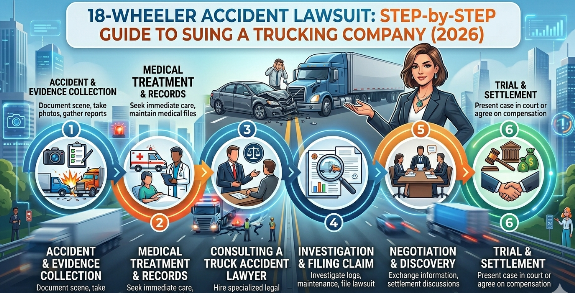
18-Wheeler Accident Lawsuit: Step-by-Step Guide to Suing a Trucking Company (2026)
⚠️ URGENT — Read This First: The trucking company's insurance team and rapid-response legal team are likely already at the crash scene. Every hour you wait, critical evidence disappears. Electronic logging device (ELD) data can be overwritten in as little as 14 days. This guide tells you exactly what to do, in what order, and why every step matters.
Table of Contents
- Why 18-Wheeler Lawsuits Are Completely Different From Car Accident Claims
- The Real Numbers: 18-Wheeler Accident Statistics in 2024–2026
- Who Can You Actually Sue? All Potentially Liable Parties
- The FMCSA Regulations That Can Win Your Case
- Step 1 — What to Do in the First 72 Hours After the Crash
- Step 2 — Preserve Evidence Before It Disappears
- Step 3 — Identify and Document Every Liable Party
- Step 4 — Calculate the True Value of Your Claim
- Step 5 — Hire the Right Truck Accident Attorney
- Step 6 — The Investigation Phase: What Your Attorney Will Do
- Step 7 — Filing the Lawsuit
- Step 8 — Discovery, Depositions, and Expert Witnesses
- Step 9 — Settlement Negotiations vs. Going to Trial
- Statute of Limitations by State: Every Deadline You Must Know
- Real 18-Wheeler Settlement Amounts: What Cases Actually Won
- The 7 Biggest Mistakes That Destroy Truck Accident Claims
- Frequently Asked Questions
1. Why 18-Wheeler Lawsuits Are Completely Different From Car Accident Claims {#section-1}
If you've been in a car accident before, everything you know about the claims process needs to be set aside. Suing a trucking company after an 18-wheeler crash is a fundamentally different legal exercise — more complex, higher-stakes, and governed by an entirely separate body of federal law.
Here is why:
The physics are catastrophically different. A fully loaded 18-wheeler can weigh up to 80,000 pounds. The average passenger car weighs approximately 4,000 pounds. That is a 20-to-1 weight disparity. When a vehicle carrying 40 tons of freight collides with your car at highway speed, the resulting injuries are not comparable to anything you experience in a typical two-car accident. Traumatic brain injuries, spinal cord damage, amputations, and fatalities are the norm, not the exception.
Federal law governs these cases, not just state law. Every interstate trucking company in the United States operates under the authority of the Federal Motor Carrier Safety Administration (FMCSA), a federal agency within the U.S. Department of Transportation. The FMCSA enforces the Federal Motor Carrier Safety Regulations (FMCSRs), a comprehensive body of rules covering driver hours, vehicle maintenance, drug testing, cargo loading, and carrier qualification. These regulations don't apply to ordinary car accidents — they are exclusive to commercial trucking, and when violated, they become powerful evidence of negligence that can dramatically change the outcome of your case.
Multiple defendants can be liable simultaneously. In a standard car accident, you typically sue one driver. In a truck accident case, you may have legal claims against the truck driver, the trucking company, the cargo loader, the truck manufacturer, the maintenance contractor, and the company that leased the truck — all in the same lawsuit. Each additional defendant means additional insurance policies and additional compensation available to you.
The insurance minimums are vastly higher. Under 49 CFR § 387.9, federal law requires interstate commercial trucking companies to carry a minimum of $750,000 in liability insurance for general freight, and up to $5,000,000 for hazardous materials. Compare that to the minimum auto insurance requirement in most states — often as low as $25,000 — and you begin to understand why truck accident settlements are measured in millions, not thousands.
Trucking companies send rapid-response teams to crash scenes. Large carriers maintain legal and insurance teams whose sole job is to reach serious accident scenes as quickly as possible to document the scene in a way that protects the company. These teams work to gather evidence, interview witnesses, and position the case before the victim even leaves the hospital. You need an attorney who understands this dynamic and responds accordingly.
2. The Real Numbers: 18-Wheeler Accident Statistics in 2024–2026 {#section-2}
Understanding the scale of this problem matters — both for context and because courts and juries respond to data that shows systemic industry failures.
According to the National Safety Council's analysis of NHTSA data:
- 5,340 people died in large truck crashes in 2024 — even after a 2.5% decrease from 2023, the 10-year trend is still up 30%
- 120,724 large trucks were involved in injury crashes in 2024, a 5.4% increase from 2023
- 70% of all fatalities in large-truck crashes are occupants of the other vehicle — not the truck
- Of those 5,340 deaths in 2024, the overwhelming majority were drivers and passengers in passenger cars, pedestrians, and cyclists
The FMCSA's own data reveals that the average cost of a commercial truck accident in which one person is injured is $148,279 — covering medical expenses, lost wages, and property damage. When a fatal trucking accident occurs, that figure explodes to an average of $7.2 million per accident.
Between 2016 and 2022, fatal crashes involving large trucks and buses increased by 26.4%, according to FMCSA data. Truck tractors — tractor-trailers and 18-wheelers specifically — accounted for 59% of all large truck involvement in fatal crashes, making them by far the most dangerous vehicle category on American roads by weight class.
More than half of all fatal large-truck crashes occur on rural roads. About a quarter happen on interstates. The peak month for fatal truck crashes is October. These are not random events — they are predictable consequences of a system in which drivers are pushed to meet delivery schedules, maintenance is deferred, and compliance shortcuts are taken.
What this means for your lawsuit: When your attorney presents these numbers to an insurer or a jury, the message is clear — trucking company negligence is not an isolated incident. It is a documented, industry-wide pattern. That framing is worth money.
3. Who Can You Actually Sue? All Potentially Liable Parties {#section-3}
One of the most important — and most misunderstood — aspects of 18-wheeler lawsuits is that the driver is rarely the only defendant, and often not even the most important one. Here is every party that may carry legal liability for your injuries.
The Truck Driver
The driver is the most obvious defendant. Liability attaches when the driver was:
- Driving while fatigued or in violation of hours-of-service (HOS) rules
- Under the influence of alcohol or controlled substances (CDL holders are subject to a 0.04% BAC limit — half the standard limit)
- Distracted by a phone, GPS, or other device
- Speeding or driving recklessly
- Operating without a valid Commercial Driver's License (CDL) or required endorsements
- Falsifying ELD or paper log entries
The Trucking Company (Motor Carrier)
The trucking company — also called the motor carrier — is almost always the primary target in serious cases because it carries the largest insurance policy and bears the deepest responsibility for the crash. Carrier liability arises from:
Vicarious liability / respondeat superior: If the driver was an employee acting within the scope of employment, the company is automatically liable for the driver's negligence. Courts broadly interpret "scope of employment" in trucking cases.
Negligent hiring: If the carrier hired a driver with a documented history of violations, failed drug tests, prior accidents, or a suspended CDL, and failed to check those records through the FMCSA Pre-employment Screening Program (PSP), the company faces independent liability for that hiring decision.
Negligent supervision: Carriers are required to monitor driver compliance with HOS rules, conduct random drug and alcohol testing, and enforce safety policies. Failure to do so creates direct liability.
Negligent entrustment: Giving a truck to a driver the company knew, or should have known, was unfit to drive creates an independent cause of action.
Maintenance failures: The FMCSA requires carriers to maintain systematic inspection, repair, and maintenance programs for all vehicles. Documented failure to perform required inspections or repair known defects is strong evidence of negligence.
The Cargo Loading Company
Improperly loaded, overloaded, or unsecured cargo is a frequent cause of truck accidents. When a load shifts unexpectedly or falls onto the roadway, the company responsible for loading and securing that cargo can be sued independently of the driver and carrier. This is especially common in flatbed, tanker, and oversized load accidents.
Under 49 CFR Part 393, federal law prescribes specific requirements for cargo securement. Violations of these standards create direct liability for whoever was responsible for loading the vehicle.
The Truck Manufacturer or Parts Manufacturer (Products Liability)
If a mechanical defect — brake failure, tire blowout, steering system failure, faulty ELD — contributed to the crash, the manufacturer of that component may be liable under products liability theory. These claims run parallel to negligence claims and can dramatically increase the total recovery available. Notable areas include:
- Brake system defects
- Tire defects (blowouts caused by manufacturing flaws)
- Electronic stability control failures
- Defective automatic emergency braking systems
The FMCSA and NHTSA issued a joint Notice of Proposed Rulemaking in 2025 addressing automatic emergency braking performance standards for heavy trucks — signaling that federal regulators themselves recognize the prevalence of AEB system failures in commercial vehicles.
The Truck Leasing Company
Many 18-wheelers are not owned by the carrier — they are leased from a third-party leasing company. Under the FMCSA's "lease and interchange" regulations (49 CFR Part 376), the authorized carrier assumes full responsibility for the leased vehicle. However, in some circumstances, the leasing company can also be joined as a defendant, particularly if the vehicle was not roadworthy at the time of the lease.
The Shipper
In some cases, the company that hired the trucking company to transport its goods — the shipper — can also be liable. This typically occurs when the shipper knew or should have known the carrier had a poor safety record and hired them anyway, or when the shipper pressured the carrier or driver to meet an unreasonable delivery schedule.
Key Takeaway: An experienced truck accident attorney will conduct a thorough investigation to identify every potentially liable party before filing suit. Each additional defendant means another insurance policy, another layer of potential recovery, and additional settlement leverage.
4. The FMCSA Regulations That Can Win Your Case {#section-4}
Federal trucking regulations are not just background noise in a truck accident lawsuit — they are the foundation of your case. When a carrier or driver violates an FMCSA rule, that violation often constitutes negligence per se: the violation itself establishes the breach of duty, without requiring you to prove the defendant acted unreasonably by some external standard. Here are the key regulations your attorney will investigate.
Hours of Service (HOS) Rules — 49 CFR Part 395
HOS rules are the FMCSA's effort to prevent fatigued driving, which the agency identifies as one of the leading causes of serious truck crashes. The current rules state:
- 11-hour driving limit: A driver may drive a maximum of 11 hours after 10 consecutive hours off duty
- 14-hour on-duty limit: A driver may not drive beyond the 14th consecutive hour after coming on duty
- 30-minute break requirement: After 8 hours of driving, a 30-minute off-duty break is required
- 60/70-hour weekly limit: Drivers are limited to 60 hours on duty in 7 consecutive days, or 70 hours in 8 consecutive days
- Sleeper berth provisions: Specific rules govern how drivers using sleeper berths can split their rest periods
When a driver exceeds these limits — and ELD data often proves they did — it establishes driver fatigue as a direct cause of the crash. Juries respond powerfully to evidence that a driver who fell asleep at the wheel had been awake for 20 consecutive hours in violation of federal rules the company was legally required to enforce.
2025–2026 Update: The FMCSA is actively piloting expanded HOS flexibility programs for certain carrier categories, while simultaneously tightening ELD enforcement. If your crash occurred in 2025 or 2026, your attorney needs to know whether the carrier was operating under a standard HOS regime or an authorized HOS exemption — the applicable rules differ.
Electronic Logging Device (ELD) Mandate — 49 CFR Part 395.8
Since 2019, virtually all commercial motor vehicles operating in interstate commerce are required to use FMCSA-certified ELDs that automatically record driving time. ELDs replaced paper logbooks that drivers routinely falsified. ELD data is among the most powerful evidence in truck accident cases because it is tamper-resistant, time-stamped, and directly documents hours-of-service compliance or violations.
Critical timing issue: Federal regulations only require carriers to retain ELD data for six months. If you do not take legal action to preserve this data before that window closes, it may be legally destroyed. Your attorney must send a formal evidence preservation demand — a spoliation letter — within days of the crash.
Driver Qualification Standards — 49 CFR Part 391
The FMCSA requires carriers to verify, before hiring any driver, that the driver:
- Holds a valid CDL with appropriate endorsements for the vehicle and cargo type
- Has passed a DOT physical examination by a certified medical examiner within the past 24 months
- Has a satisfactory driving record for the prior 3 years
- Has no disqualifying drug or alcohol violations
- Can safely operate the specific class of commercial vehicle
When a carrier hires a driver without completing these checks — or knowingly hires a driver with disqualifying history — every subsequent crash by that driver creates potential liability for negligent hiring.
Drug and Alcohol Testing — 49 CFR Part 382
CDL holders are subject to mandatory pre-employment, random, post-accident, reasonable suspicion, and return-to-duty drug and alcohol testing. The BAC limit for CDL drivers is 0.04% — half the standard legal limit for passenger vehicle drivers. After any accident involving a fatality or a driver citation, the carrier is required to conduct post-accident testing within specific time windows:
- Alcohol test: within 8 hours
- Drug test: within 32 hours
If the carrier fails to conduct required post-accident testing, that failure is itself evidence of negligence — and may indicate the carrier was trying to conceal drug or alcohol use.
Vehicle Inspection and Maintenance — 49 CFR Part 396
Carriers must maintain a systematic inspection, repair, and maintenance program for every vehicle in their fleet. Drivers are required to complete pre-trip and post-trip inspection reports (DVIRs), documenting any defects. Carriers must repair noted defects before the vehicle returns to service.
Federal rules require carriers to retain maintenance records for one year. Your attorney will subpoena these records during discovery to determine whether known mechanical defects — brake problems, tire wear, lighting failures — were left unaddressed before the crash.
Cargo Securement — 49 CFR Part 393
Improperly secured loads are a major cause of truck accidents. Federal rules specify working load limits, tie-down requirements, and securement methods for different cargo categories. When cargo shifts or falls and causes a crash, these regulations establish the standard of care for determining liability.
How to Look Up a Carrier's Compliance Record
The FMCSA's Safety Measurement System (SMS) is publicly accessible. Anyone can search a carrier's DOT number or company name and pull their inspection history, out-of-service orders, crash history, and violation patterns for the last 24 months. A carrier with a poor SMS score in categories like "Hours of Service" or "Unsafe Driving" is a carrier whose safety record will be front and center in your lawsuit.
5. Step 1 — What to Do in the First 72 Hours After the Crash {#section-5}
The first 72 hours after an 18-wheeler crash are the most critical period for your legal case. Evidence disappears, witnesses forget details, and the trucking company's defense team is already working. Here is exactly what to do:
At the Scene (If You Are Physically Able)
Call 911 immediately. A police report is mandatory — do not let the truck driver or anyone else persuade you to handle this privately. You need an official police report documenting the scene, the parties involved, and the officer's preliminary findings.
Photograph and video everything. Use your phone to document: the truck's license plate, DOT number (printed on the cab door), the company name on the trailer, the driver's CDL and physical appearance, road conditions, skid marks, debris, your injuries, and vehicle damage from every angle. Take more photos than you think you need.
Identify and record all witnesses. Get the full name, phone number, and address of every witness at the scene. Witness testimony frequently becomes decisive in cases where liability is disputed.
Do not give recorded statements to anyone. The trucking company's insurance adjuster may contact you within hours of the crash. You are not legally required to give them a recorded statement. Anything you say will be used to minimize your claim. Politely decline and refer them to your attorney.
Seek immediate medical attention. Go to the emergency room, even if you feel you are not seriously injured. Adrenaline masks pain. Many serious injuries — particularly traumatic brain injuries, internal bleeding, and spinal damage — do not present obvious symptoms immediately. If you delay medical treatment, the insurance company will argue your injuries were not caused by the crash.
Write down everything you remember. Within 24 hours, write a detailed account of the crash — the time, location, direction you were traveling, speed, road and weather conditions, what you saw before impact, what you felt during impact, and everything that happened afterward. Memory degrades quickly. A contemporaneous written account is valuable evidence.
Within 48–72 Hours
Hire a truck accident attorney. This is not the same as hiring a general personal injury lawyer. You need an attorney with specific experience litigating against commercial carriers. See Step 5 for what to look for.
File an insurance notification. Notify your own insurance company of the crash, but keep the conversation factual and brief. Do not speculate about fault. Do not give a recorded statement without your attorney present.
Report to FMCSA if appropriate. You can report unsafe trucking companies to the FMCSA Safety Violation Hotline at 1-888-368-7238 or online at nccdb.fmcsa.dot.gov. While this does not directly advance your lawsuit, it creates an official record of the incident.
6. Step 2 — Preserve Evidence Before It Disappears {#section-6}
Evidence in truck accident cases vanishes faster than in any other type of personal injury litigation. Understanding the timelines is critical.
The Evidence Preservation Timeline
| Evidence Type | Federal Retention Requirement | Practical Risk |
|---|---|---|
| ELD / Electronic Log Data | 6 months | Can be overwritten in 14 days |
| Driver Paper Logs | 6 months | May be "lost" if not demanded early |
| Black Box / ECM Data | 6 months | Some systems overwrite continuously |
| Post-Accident Drug/Alcohol Test | 1–5 years (by type) | Window for testing closes in 8–32 hours |
| Maintenance / DVIR Records | 1 year | May be destroyed at retention limit |
| Driver Qualification File | 3 years after employment | May be shredded after driver leaves |
| Dash Cam Footage (company) | No federal minimum | Often overwritten within 48–72 hours |
| Traffic Camera Footage | No federal minimum | Often overwritten within 30 days |
The Spoliation Letter
A spoliation letter is a formal legal demand sent to the trucking company and its insurer, requiring them to preserve all evidence related to the crash. Once a party receives a spoliation letter, they are legally obligated to halt their normal document destruction policies. Destroying evidence after receiving a spoliation letter constitutes "spoliation of evidence" — which courts can sanction through adverse inference instructions (telling the jury to assume the destroyed evidence was unfavorable to the trucking company).
Your attorney should send a spoliation letter within 24–48 hours of being retained. The letter should demand preservation of:
- All ELD data, driver logs, and trip records for the driver
- Black box / ECM data from the vehicle involved
- The truck itself (to prevent repairs or scrapping)
- Maintenance records, DVIRs, and inspection reports
- The driver's full qualification file
- Drug and alcohol test records for the driver
- All communications between the driver and dispatch on the day of the crash
- Dash cam footage from the truck cab
- The carrier's prior safety inspection history
- GPS tracking data for the truck's route
Securing Independent Evidence
Simultaneously, your attorney will work to secure evidence that is not in the trucking company's control:
- Traffic and surveillance camera footage from nearby businesses, toll booths, and government cameras — this footage is typically overwritten within 30 days
- Cell phone records from the driver, to establish distracted driving
- Weigh station records showing the truck's load weight
- Weather and road condition reports from NOAA or state DOT
- 911 call recordings from the crash
- Social media posts by the driver in the hours before the crash
7. Step 3 — Identify and Document Every Liable Party {#section-7}
Once evidence is preserved, your attorney will conduct a comprehensive investigation to identify everyone who bears legal responsibility for your injuries. This involves pulling the carrier's DOT safety record through the FMCSA SMS, reviewing the driver's PSP (Pre-employment Screening Program) report, obtaining the truck's inspection history through FMCSA's systems, and tracing the ownership structure of the vehicle and the carrier.
Many trucking companies use complex corporate structures — holding companies, subsidiaries, shell corporations — specifically designed to limit liability exposure. An experienced attorney knows how to pierce these structures and pursue every entity that had a role in putting that truck on the road.
The investigation will typically reveal the answer to several critical questions:
- Was the driver an employee or an "independent contractor"? (Courts and regulators increasingly look past contractor labels to find employer liability)
- Who owned the truck — the carrier, a leasing company, or an owner-operator?
- Who loaded and secured the cargo?
- Were there prior FMCSA violations or out-of-service orders against this carrier?
- Has the driver been in prior accidents or had prior violations?
- Was the truck recently inspected, and were there unresolved defect notices?
8. Step 4 — Calculate the True Value of Your Claim {#section-8}
One of the most consequential mistakes truck accident victims make is accepting an early settlement offer without understanding the full value of their claim. Insurance adjusters are trained to make early offers that feel significant but represent a fraction of what a properly litigated case would recover.
The full value of an 18-wheeler accident claim includes:
Economic Damages (Provable Financial Losses)
Past medical expenses: Every bill, every co-pay, every out-of-pocket cost from the date of the crash to the date of settlement or verdict.
Future medical expenses: For serious injuries, this is often the largest component of the claim. A life care planner — a medical professional who specializes in projecting long-term care costs — will calculate the cost of surgeries, physical therapy, medications, medical equipment, home modifications, and attendant care over the course of the victim's life expectancy.
Lost wages: Income lost from the date of the crash through recovery.
Lost earning capacity: If your injuries permanently limit your ability to work in the same field, at the same level, or at all, an economic expert will calculate the present value of that lifetime income loss.
Property damage: The fair market value of your vehicle and any personal property destroyed.
Out-of-pocket expenses: Transportation to medical appointments, home modifications, domestic services you can no longer perform.
Non-Economic Damages (Subjective Losses)
Pain and suffering: Compensation for the physical pain caused by the injuries, both past and ongoing. Calculated using the multiplier method (economic damages × 2 to 5, depending on severity) or the per diem method (daily rate × number of days of suffering).
Emotional distress and mental anguish: Post-traumatic stress disorder (PTSD), anxiety, depression, and other psychological consequences of the crash. Expert testimony from mental health professionals supports these claims.
Loss of enjoyment of life: Compensation for the activities, hobbies, and experiences the victim can no longer engage in because of their injuries.
Loss of consortium: Compensation to the victim's spouse for the loss of companionship, affection, and support.
Punitive Damages
In cases where the trucking company's conduct was particularly egregious — knowingly putting a fatigued or intoxicated driver on the road, covering up maintenance failures, falsifying safety records, or ignoring repeated FMCSA violations — punitive damages may be available. These are not designed to compensate the victim but to punish the defendant and deter similar conduct. In truck accident cases, punitive damages can dwarf compensatory damages, and their availability is a powerful settlement negotiating tool.
The Insurance Policy Stack
In 18-wheeler cases, you are not limited to a single insurance policy. A fully investigated truck accident claim may draw from:
- The truck driver's personal auto insurance (if applicable)
- The motor carrier's primary liability policy ($750K–$5M minimum under FMCSA rules)
- The motor carrier's umbrella or excess liability policy
- The cargo loader's general liability policy
- The truck manufacturer's products liability policy
- Your own underinsured/uninsured motorist (UIM) coverage
- Your own medical payments (MedPay) coverage
A thorough attorney will identify every applicable policy before negotiating.
9. Step 5 — Hire the Right Truck Accident Attorney {#section-9}
Not all personal injury attorneys are equipped to handle 18-wheeler cases. The complexity of federal trucking regulations, the technical nature of ELD and black box data, and the aggressive defense tactics employed by trucking company insurers require a specific kind of expertise. Here is what to look for.
What Qualifies an Attorney for Truck Cases
Demonstrated experience with FMCSA regulations. Ask the attorney directly: "Have you litigated cases involving FMCSA hours-of-service violations? Have you taken ELD data expert testimony?" If they struggle to answer or give vague responses, keep looking.
Access to qualified experts. Truck accident cases typically require testimony from accident reconstruction experts, ELD data analysts, FMCSA compliance experts, life care planners, and economic damages specialists. Attorneys without established relationships with these experts cannot compete against large carrier defense firms.
Resources to litigate. Major trucking companies are defended by well-funded, specialized defense firms. Successfully litigating against them requires the resources to conduct an aggressive investigation, depose multiple witnesses, hire multiple experts, and sustain a case that may take two or more years to resolve. Ask about the firm's financial resources and its willingness to take cases to trial.
Trial experience. The vast majority of truck accident cases settle — but the settlement value of your case is directly tied to how credibly your attorney can threaten trial. Insurance carriers and their attorneys know which plaintiff firms actually try cases and which ones fold at settlement pressure. Trial experience matters even in cases that never reach a courtroom.
Contingency fee arrangement. Reputable truck accident attorneys work on contingency — they receive a percentage of the recovery (typically 33–40%, depending on whether the case settles or goes to trial) and charge nothing unless they win. You should never pay upfront fees in a personal injury case.
Questions to Ask in Your Free Consultation
- How many 18-wheeler cases have you handled in the last three years, and what were the outcomes?
- Do you have access to FMCSA compliance experts and ELD data analysts?
- Will you personally handle my case, or will it be passed to a junior associate?
- What is your assessment of the strength of my case?
- What is your contingency fee structure, and what expenses will be deducted from my recovery?
- Have you ever taken a truck accident case to trial? What was the result?
💡 Find a verified truck accident attorney near you on LawAccidents.com →
All attorneys in our directory offer free consultations and work on contingency — you pay nothing unless they win.
10. Step 6 — The Investigation Phase: What Your Attorney Will Do {#section-10}
Once retained, your attorney begins a systematic investigation designed to build the strongest possible case for maximum recovery. Here is what that process looks like.
Formal Discovery Demands and Subpoenas
Your attorney will serve formal document requests on every defendant, demanding production of:
- The driver's full personnel file, including application, qualification records, training history, and disciplinary records
- All ELD data and trip records for the 7 days preceding the crash
- All maintenance records and DVIRs for the truck for the prior 12 months
- All drug and alcohol test results for the driver, including prior positive tests
- The carrier's safety management program and driver monitoring policies
- All communications between the driver and dispatch on the day of the crash
- The carrier's prior FMCSA inspection history and any out-of-service orders
- The carrier's accident history for the prior 36 months
- The trucking company's insurance policies
Accident Reconstruction
In serious cases, your attorney will retain an accident reconstruction expert — typically a licensed engineer with specialized training in commercial vehicle dynamics. Using physical evidence from the scene, ELD and black box data, vehicle damage patterns, and road geometry, the reconstruction expert will prepare an analysis and report establishing how the crash occurred and who was at fault. This expert will testify at trial if the case does not settle.
FMCSA Compliance Expert
A former FMCSA inspector or carrier safety officer will review all compliance records and identify every violation of federal regulations. This expert translates the dry language of federal regulations into plain English for the jury: "This driver had been awake for 21 hours. Federal law says he should have stopped 7 hours earlier. The company knew this and put him back on the road anyway."
Medical Expert Development
For serious injury cases, your attorney will coordinate with your treating physicians and, if necessary, independent medical experts to document the full nature and extent of your injuries, their causal relationship to the crash, and their long-term impact on your health and function.
Depositions
Depositions — sworn testimony taken outside court — are among the most powerful tools in a truck accident case. Your attorney will depose:
- The truck driver
- The carrier's safety director
- The carrier's dispatcher
- Any witnesses to the crash
- The driver's supervisor
- Maintenance personnel
- Any expert witnesses designated by the defense
Deposition testimony locks witnesses into their account, prevents them from changing their story at trial, and often uncovers admissions that prove invaluable in negotiations or at trial.
11. Step 7 — Filing the Lawsuit {#section-11}
If the carrier's insurance company does not make a fair settlement offer during the pre-litigation phase — which is common in serious cases — your attorney will file a lawsuit in the appropriate court. Here are the key decisions involved.
Where to File: Federal Court vs. State Court
Truck accident cases can be filed in either federal or state court, depending on the circumstances. Federal court is available when the parties are from different states and the amount in controversy exceeds $75,000 (diversity jurisdiction under 28 U.S.C. § 1332). Your attorney will evaluate which forum is more favorable for your specific case — jury composition, local court rules, and the speed of the litigation process all vary.
Naming All Defendants
The complaint will name every potentially liable party — the driver, the carrier, the cargo loader, the leasing company, and any other entities identified during the investigation. It is generally better to name more defendants initially and dismiss those who turn out not to be liable than to miss a defendant and be barred by the statute of limitations from adding them later.
The Complaint
The complaint sets out the factual allegations and legal claims. In a typical 18-wheeler case, the legal theories include:
- Negligence (driver)
- Vicarious liability / respondeat superior (carrier)
- Negligent hiring, retention, and supervision (carrier)
- Negligent entrustment (carrier)
- Negligence per se (for specific FMCSA violations)
- Products liability (manufacturer, if applicable)
- Negligent loading and cargo securement (cargo company, if applicable)
- Punitive damages (if conduct was sufficiently reckless)
Service of Process
After the complaint is filed, each defendant must be formally served with the lawsuit. Commercial carriers are typically served through their registered agents.
12. Step 8 — Discovery, Depositions, and Expert Witnesses {#section-12}
Formal discovery is the litigation phase in which both sides exchange evidence and information under court rules. For truck accident cases, this is where cases are won or lost.
In addition to the document discovery and depositions described in the investigation phase, formal discovery includes:
Interrogatories: Written questions that each party must answer under oath, covering everything from insurance coverage to prior accidents to the driver's employment history.
Requests for Admission: Formal requests that a party admit or deny specific factual statements. Strategic use of requests for admission can lock the defendant into admissions that simplify the case.
Expert witness disclosures: Both sides identify and disclose the expert witnesses they intend to call at trial, along with written reports summarizing each expert's opinions. Expert battles — particularly over accident reconstruction and damages quantification — are central to truck accident litigation.
Independent Medical Examinations (IME): The defense will likely request that you undergo an examination by a physician of their choosing. These examinations are designed to minimize the apparent severity of your injuries. Your attorney will prepare you for this examination and, if the IME report is unfavorable, rebut it with testimony from your treating physicians.
13. Step 9 — Settlement Negotiations vs. Going to Trial {#section-13}
The vast majority of 18-wheeler lawsuits — estimates suggest 95% or more — settle before reaching trial. But the settlement value of your case is directly tied to your attorney's demonstrated willingness and ability to go to trial. Here is how the negotiation process typically unfolds.
The Demand Letter
Before or after filing suit, your attorney will send a formal demand letter to the carrier's insurance company, setting out the facts of the case, the evidence of liability, the nature and extent of injuries, and a specific dollar demand for settlement. A well-crafted demand letter — backed by comprehensive medical records, expert reports, and documented FMCSA violations — signals to the insurer that your attorney has fully prepared the case and is ready to litigate.
Mediation
Many truck accident cases proceed to mediation — a confidential, non-binding process in which a neutral third-party mediator facilitates negotiation between the parties. Mediation is often required by courts before trial. If successful, mediation produces a binding settlement agreement.
Trial
If the case does not settle, it proceeds to trial — typically a jury trial in personal injury cases. The trial typically lasts one to two weeks for a serious truck accident case, involving opening statements, witness testimony, expert testimony, and closing arguments. The jury then deliberates and returns a verdict.
Even if a case goes to trial, settlement remains possible at any point, including during the trial itself. Some of the largest verdicts in trucking cases occur precisely because the carrier refused to make a reasonable settlement offer and the jury punished that decision.
14. Statute of Limitations by State: Every Deadline You Must Know {#section-14}
The statute of limitations is the absolute deadline for filing a lawsuit. Miss it, and your case is permanently barred — no matter how strong it is, no matter how severe your injuries, and no matter how clear the truck driver's fault. These deadlines are non-negotiable.
| State | Statute of Limitations | Notes |
|---|---|---|
| California | 2 years | CCP § 335.1; wrongful death also 2 years |
| Texas | 2 years | Tex. Civ. Prac. & Rem. Code § 16.003 |
| Florida | 2 years | HB 837, effective March 2023; was 4 years |
| New York | 3 years | CPLR § 214 |
| North Carolina | 3 years | NCGS § 1-52; SB 452 (2025) modified UIM rules |
| Georgia | 2 years | OCGA § 9-3-33 |
| Illinois | 2 years | 735 ILCS 5/13-202 |
| Pennsylvania | 2 years | 42 Pa.C.S. § 5524 |
| Ohio | 2 years | ORC § 2305.10 |
| Michigan | 3 years | MCL § 600.5805 (general PI); 1 year for PIP claims |
| New Jersey | 2 years | NJSA 2A:14-2 |
| Arizona | 2 years | ARS § 12-542 |
| Colorado | 3 years | CRS § 13-80-101; $1.5M damage cap raised 2025 |
| Washington | 3 years | RCW § 4.16.080 |
| Virginia | 2 years | Va. Code § 8.01-243 |
| Minnesota | 2 years | Minn. Stat. § 541.07 |
| Tennessee | 1 year | Tenn. Code § 28-3-104 (shortest in U.S.) |
| Louisiana | 1 year | La. Civ. Code Art. 3492 (prescriptive period) |
| Kentucky | 1 year | KRS § 413.140 |
| Massachusetts | 3 years | MGLA c. 260 § 2A |
Important caveats:
- Wrongful death claims may have different deadlines than personal injury claims in the same state — verify both
- Claims against government entities (federal, state, or municipal trucks) have separate, shorter notice requirements — often 90 to 180 days
- The discovery rule may extend the limitations period if injuries were not immediately apparent
- Minors typically have the limitations period tolled until they turn 18
- Always consult an attorney in your specific state — these deadlines change with legislation
⚠️ Florida specific note: Florida's HB 837 reduced the statute of limitations from 4 years to 2 years, effective March 2023. If you were injured in Florida in 2023 or later, your window is 2 years from the date of the crash.
15. Real 18-Wheeler Settlement Amounts: What Cases Actually Won {#section-15}
Understanding what similar cases have recovered helps calibrate your expectations and ensures you do not accept a lowball settlement. Here is what real truck accident cases have recovered.
Settlement Range by Injury Type
| Injury Category | Typical Settlement Range | Notes |
|---|---|---|
| Soft tissue (whiplash, sprains) | $50,000 – $150,000 | Lower end if no surgery required |
| Broken bones | $100,000 – $400,000 | Varies by bone, treatment, recovery |
| Herniated discs (surgery) | $150,000 – $500,000 | Cervical/lumbar surgery significantly increases value |
| Traumatic Brain Injury (mild) | $200,000 – $750,000 | Cognitive testing and neuropsychology key |
| Traumatic Brain Injury (severe) | $1,000,000 – $5,000,000+ | Life care plan essential |
| Spinal cord injury / paralysis | $2,000,000 – $10,000,000+ | Lifetime care costs are enormous |
| Amputation | $1,500,000 – $6,000,000+ | Prosthetics, rehab, lost earning capacity |
| Wrongful death | $1,000,000 – $17,000,000+ | Depends on decedent's age, income, dependents |
Notable Real Verdicts and Settlements (2023–2026)
These are publicly reported outcomes from actual truck accident cases:
- $17,000,000 — Wrongful death settlement involving multiple fatalities in an 18-wheeler crash (Trevino Injury Law, Texas, 2024–2025)
- $2,200,000 — Settlement for a tractor-trailer crash with serious injuries (Texas, 2024)
- $1,400,000 — Settlement for a victim struck by an 18-wheeler while stopped at a traffic light, suffering severe neck, back, and spinal injuries (Texas, 2024)
- $450,000,000 total recovered — Portfolio figure reported by Gerald L. Marcus law firm over 38 years of truck and personal injury cases (Los Angeles, 2026 report)
What Drives Settlement Value Up
- Documented FMCSA violations, particularly HOS violations
- Evidence of prior accidents or violations by the same driver or carrier
- Post-accident drug or alcohol test failure, or carrier's failure to conduct required testing
- ELD data preserved early showing clear hours-of-service violations
- Carrier's prior knowledge of the driver's fitness issues
- Catastrophic or permanent injuries with quantifiable lifetime care needs
- Punitive damages exposure (reckless conduct)
- Favorable jurisdiction with plaintiff-friendly jury pool
- Skilled attorney with trial experience and credible trial threat
What Drives Settlement Value Down
- Shared fault by the victim (under comparative negligence rules; contributory negligence in a small number of states including NC can bar recovery entirely)
- Failure to seek timely medical treatment
- Gaps in medical treatment
- Pre-existing injuries to the same body parts
- Social media posts inconsistent with claimed injuries
- Recorded statements given without an attorney present
16. The 7 Biggest Mistakes That Destroy Truck Accident Claims {#section-16}
Even the strongest truck accident case can be severely damaged — or completely destroyed — by mistakes made in the days and weeks after the crash. Here are the seven most costly errors, and how to avoid them.
Mistake 1: Giving a Recorded Statement to the Trucking Company's Insurer
This is the single most common and most damaging mistake. Insurance adjusters are skilled interviewers who will ask leading questions designed to get you to say things that minimize your injuries, admit comparative fault, or contradict later medical findings. You are not legally required to give this statement. Politely decline and provide your attorney's contact information.
Mistake 2: Accepting an Early Settlement Offer
Trucking company insurers routinely make quick settlement offers in the days after serious crashes. These offers are made precisely because the insurer knows the claim is worth far more. A $50,000 offer in the first week may be followed by a $2,000,000 jury verdict two years later. Never accept any settlement offer without first consulting an experienced truck accident attorney and understanding the full value of your claim — including future medical expenses you may not yet know about.
Mistake 3: Failing to Seek Immediate Medical Treatment
Two problems arise from delayed medical treatment: first, you may have injuries that worsen significantly if not treated; and second, the insurance company will use the gap in treatment as evidence that you were not seriously injured, or that your injuries were caused by something other than the crash. See a doctor the same day as the crash, and follow all treatment recommendations.
Mistake 4: Not Hiring an Attorney Before Evidence Disappears
The most valuable evidence in your case — ELD data, black box data, driver logs, dash cam footage — disappears within days or weeks. An attorney who is retained quickly can send a spoliation letter, hire an investigator to photograph and document the scene, and issue preservation demands before the carrier's normal document destruction policies kick in. Waiting weeks or months to hire an attorney may mean the best evidence in your case is already gone.
Mistake 5: Posting on Social Media
Trucking company defense attorneys routinely search social media accounts of claimants. A single photo of you at a family barbecue — even if you were in significant pain — can be used to argue you exaggerated your injuries. Lock down your social media accounts immediately after any serious accident and do not post anything related to your physical activities, the crash, or the case.
Mistake 6: Assuming the Truck Driver Is the Only Defendant
As detailed in Section 3, the driver is often the least financially significant defendant. Focusing only on the driver — and failing to investigate and name the carrier, cargo company, manufacturer, and other parties — can leave enormous sums of compensation on the table. A proper investigation identifies all liable parties before the statute of limitations runs.
Mistake 7: Settling Before Reaching Maximum Medical Improvement (MMI)
Maximum Medical Improvement is the point at which your treating physician determines that your condition has stabilized and further significant recovery is not expected. Settling before you reach MMI means you do not yet know the full extent of your injuries, your long-term care needs, or your permanent disability rating. Once you settle and sign a release, you cannot go back for more money even if your condition worsens. Never settle before MMI without a compelling reason — and only after a life care planner has projected your future medical costs.
17. Frequently Asked Questions {#section-17}
How long do I have to sue a trucking company after an 18-wheeler accident?
The deadline depends on your state's statute of limitations. Most states allow 2–3 years from the date of the crash. Tennessee and Louisiana have 1-year deadlines — the shortest in the country. Florida reduced its deadline to 2 years under HB 837, effective 2023. Missing the deadline permanently bars your claim. See the full state-by-state table in Section 14.
How much can I get from suing an 18-wheeler trucking company?
Settlements for serious injuries typically range from $100,000 to over $1,000,000. Catastrophic injury and wrongful death cases regularly reach $5–17 million. Federal law requires trucking companies to carry a minimum of $750,000 in liability insurance, with up to $5,000,000 for hazardous materials. The ultimate value of your case depends on injury severity, documented FMCSA violations, available insurance policies, and the quality of your legal representation.
Do I need to prove the truck driver was at fault?
Not necessarily — and certainly not exclusively. In cases involving FMCSA violations, the doctrine of negligence per se means the violation itself establishes the breach of duty. And even if the driver bears some fault, you may also have strong claims against the trucking company for negligent hiring, negligent supervision, and failure to maintain the vehicle. Multiple legal theories can support your case simultaneously.
Can I sue a trucking company if the truck driver was an independent contractor?
Very likely yes. Trucking companies routinely classify drivers as independent contractors to attempt to limit their liability exposure. Courts and regulators increasingly look past these labels. Under the FMCSA's "statutory employee" doctrine, carriers that exercise sufficient control over drivers — as most do — are treated as employers for liability purposes regardless of the contractor label. An experienced attorney will analyze the relationship and advise you on the strength of direct carrier liability claims.
What if I was partly at fault for the crash?
In most states, comparative negligence rules allow you to recover damages even if you were partially at fault, with your recovery reduced proportionally by your percentage of fault. If you were 20% at fault and suffered $1,000,000 in damages, you would recover $800,000. However, North Carolina and a handful of other states still apply contributory negligence, which bars any recovery if you were even 1% at fault. Know the rule in your state.
How long does an 18-wheeler lawsuit take?
Simple cases with clear liability and moderate injuries may settle within 6–12 months. More complex cases — catastrophic injuries, disputed liability, multiple defendants — typically take 18 months to 3 years. Cases that go to trial can take longer. Your attorney should give you a realistic timeline based on the specific facts of your case.
What if the trucking company files for bankruptcy?
This is a concern in cases involving smaller carriers. However, the FMCSA's financial responsibility rules require carriers to maintain minimum insurance coverage precisely to ensure victims can be compensated even if the carrier becomes insolvent. The MCS-90 endorsement required under 49 CFR § 387.15 requires the insurer to pay any final judgment for public liability, even if the underlying policy would otherwise have excluded the claim. Additionally, your claims against the driver, the cargo company, the manufacturer, and other parties survive the carrier's bankruptcy.
Is there a cap on how much I can recover?
Most states do not cap economic damages in truck accident cases. A smaller number of states cap non-economic damages (pain and suffering) in certain circumstances. Punitive damages may also be capped in some states. Colorado recently raised its personal injury damage cap to $1.5 million, effective 2025. Your attorney will advise you on any caps applicable in your state.
Conclusion: Your Next Move
An 18-wheeler accident is one of the most legally complex and financially significant situations you will ever face. The trucking company has experienced lawyers working for it before you leave the hospital. Evidence is disappearing while you read this. The statute of limitations clock is already running.
The decisions you make in the first 72 hours after a truck crash — whether to seek medical treatment, whether to give recorded statements, when to contact an attorney, whether to demand evidence preservation — will shape the entire trajectory of your case.
Here is what to do right now:
- Get medical treatment if you haven't already
- Do not give recorded statements to any insurance company
- Document everything — photos, witness names, the truck's DOT number and company name
- Contact a truck accident attorney immediately — the consultation is free and there are no fees unless you win
LawAccidents.com connects accident victims with verified, experienced truck accident attorneys across all 50 states. Every attorney in our network offers free case consultations and works on contingency.
👉 Find a Truck Accident Attorney Near You — Free Consultation →
👉 Use Our Car & Truck Accident Settlement Calculator →
👉 Read: 18-Wheeler Settlement Amounts 2026: How Much Can You Get? →
This article is for informational purposes only and does not constitute legal advice. Laws vary by state and individual circumstances. Always consult a licensed personal injury attorney in your state before making any legal decisions. LawAccidents.com is not a law firm and does not provide legal representation.
Sources: FMCSA Federal Motor Carrier Safety Regulations (49 CFR); National Safety Council Injury Facts 2024; NHTSA Fatality Analysis Reporting System (FARS); FMCSA Large Truck and Bus Crash Facts; FMCSA Safety Measurement System (SMS); state civil procedure statutes cited throughout.
Last updated: May 2026
Comments (0)