How to File a Car Accident Lawsuit: Step-by-Step Guide for 2026 (All 50 States)
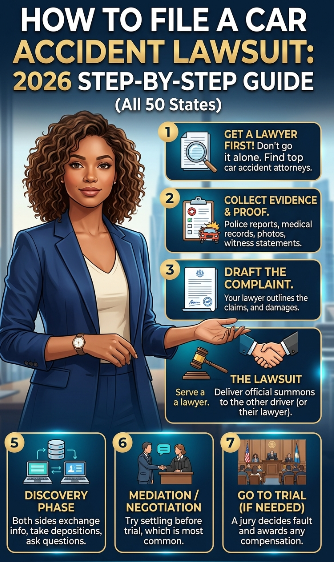
How to File a Car Accident Lawsuit: Step-by-Step Guide for 2026 (All 50 States)
By the LawAccidents.com Editorial Team | Updated May 2026 | Reviewed by a licensed personal injury attorney
If you've been seriously injured in a car accident and the insurance company is offering less than you deserve — or denying your claim entirely — filing a lawsuit may be your best path to real compensation. This guide walks you through every step of the process, from deciding whether to sue to what happens in the courtroom, updated with the latest 2026 state law changes.
Quick answer: Most car accident lawsuits never reach trial. Over 95% settle before a jury delivers a verdict. But filing a lawsuit — and showing you mean it — is often exactly what forces an insurer to offer a fair settlement.
Table of Contents
- Should You Sue or Settle?
- Who Can You Sue?
- How Long Do You Have to File? (Statute of Limitations by State — 2026)
- Step 1 — Seek Medical Treatment First
- Step 2 — Gather and Preserve Evidence
- Step 3 — Calculate Your Full Damages
- Step 4 — Hire a Car Accident Attorney
- Step 5 — File the Complaint
- Step 6 — The Discovery Phase
- Step 7 — Mediation and Pre-Trial Negotiations
- Step 8 — Trial
- How Long Does a Car Accident Lawsuit Take?
- How Much Does Filing a Lawsuit Cost?
- 2026 Law Changes That Affect Your Case
- Frequently Asked Questions
Should You Sue or Settle?
Before you file a lawsuit, you need to understand what you're choosing between.
Settling means you and the at-fault driver's insurance company agree on a dollar amount. You sign a release, you get a check, and the case is over. It's faster, cheaper, and guaranteed.
Suing means filing a formal civil complaint in court and going through the litigation process. It's slower and more expensive — but it often results in significantly higher compensation, especially for serious injuries.
When settlement makes sense:
- Your injuries are minor (soft tissue, short recovery)
- Liability is genuinely disputed
- You need money quickly
- The at-fault driver has minimal insurance and no significant assets
When filing a lawsuit makes sense:
- The insurance company is offering far below your actual damages
- You have significant medical bills, lost wages, or long-term disability
- Liability is clear (rear-end collision, red light violation, documented DUI)
- The insurer is acting in bad faith — delaying, denying without explanation, or misrepresenting your policy
Important: Filing a lawsuit doesn't mean you're headed to trial. In most cases, lawsuits are filed specifically to pressure the insurer into a fair settlement. Your attorney can file the complaint and continue negotiating at the same time.
Who Can You Sue?
In a car accident lawsuit, the defendants may include:
The at-fault driver — This is the most common defendant. If a driver ran a red light, was texting, or was drunk, they bear personal liability for your injuries.
The vehicle owner — If the at-fault driver was borrowing someone else's car, the owner may also be liable under a legal doctrine called negligent entrustment — especially if the owner knew the borrower was unlicensed or had a history of reckless driving.
An employer — If the at-fault driver was working at the time of the crash (making deliveries, driving a company vehicle, traveling between job sites), their employer can be held liable under the doctrine of respondeat superior. This is critically important because employers typically carry much larger insurance policies than individuals.
A government entity — If a dangerous road condition (missing guardrail, defective traffic signal, unrepaired pothole) contributed to the crash, you may have a claim against the city, county, or state transportation department. Note: claims against government entities have much shorter deadlines and special notice requirements — in some states, as short as 60 to 90 days after the accident. Contact an attorney immediately if government negligence is involved.
A vehicle or parts manufacturer — If a defective tire blowout, faulty brakes, or airbag malfunction caused or worsened the crash, a product liability claim against the manufacturer may be available in addition to — or instead of — a standard negligence claim.
A bar or alcohol retailer (Dram Shop laws) — In states with dram shop liability (including Texas, Illinois, Pennsylvania, and others), a bar or restaurant that overserved an obviously intoxicated driver can be held liable for accidents that driver causes.
How Long Do You Have to File? (Statute of Limitations — 2026)
This is the most important table in this article. Missing your deadline means losing your case permanently, regardless of how strong it is.
| State | Deadline | Notes |
|---|---|---|
| Alabama | 2 years | |
| Alaska | 2 years | |
| Arizona | 2 years | |
| Arkansas | 3 years | |
| California | 2 years | |
| Colorado | 3 years | Damage caps raised to $1.5M (2025) |
| Connecticut | 2 years | |
| Delaware | 2 years | |
| Florida | 2 years | HB 837 fully in effect — halved from 4 years |
| Georgia | 2 years | |
| Hawaii | 2 years | |
| Idaho | 2 years | |
| Illinois | 2 years | |
| Indiana | 2 years | |
| Iowa | 2 years | |
| Kansas | 2 years | |
| Kentucky | 2 years | |
| Louisiana | 1 year | Shortest deadline in the US |
| Maine | 6 years | |
| Maryland | 3 years | |
| Massachusetts | 3 years | |
| Michigan | 3 years | |
| Minnesota | 2 years | |
| Mississippi | 3 years | |
| Missouri | 5 years | |
| Montana | 3 years | |
| Nebraska | 4 years | |
| Nevada | 2 years | |
| New Hampshire | 3 years | |
| New Jersey | 2 years | Phase 2 minimums: $35K/$70K as of Jan 2026 |
| New Mexico | 3 years | |
| New York | 3 years | |
| North Carolina | 3 years | SB 452 eliminates UIM setoff — effective July 2025 |
| North Dakota | 6 years | |
| Ohio | 2 years | |
| Oklahoma | 2 years | |
| Oregon | 2 years | |
| Pennsylvania | 2 years | |
| Rhode Island | 3 years | |
| South Carolina | 3 years | |
| South Dakota | 3 years | |
| Tennessee | 1 year | |
| Texas | 2 years | |
| Utah | 4 years | |
| Vermont | 3 years | |
| Virginia | 2 years | |
| Washington | 3 years | |
| West Virginia | 2 years | |
| Wisconsin | 3 years | |
| Wyoming | 4 years |
Warning: These deadlines can be shorter if a government entity is involved, if the victim is a minor (the clock may not start until age 18), or if the at-fault driver was uninsured. Always confirm your exact deadline with an attorney in your state.
Step 1 — Seek Medical Treatment First
Before anything else — before you call a lawyer, before you file insurance claims — get medical attention.
This matters for two reasons that directly affect your lawsuit:
Your health comes first. Adrenaline masks pain. Whiplash, traumatic brain injuries, internal bleeding, and herniated discs often don't produce obvious symptoms in the first 24 to 48 hours. A doctor's evaluation creates a record of your injuries immediately after the accident.
The gap problem. Insurance defense attorneys will argue that any gap between the accident and your first medical visit means you weren't actually injured — or that something else caused your injuries. If you wait three weeks to see a doctor, you hand the defense a powerful argument.
What to do:
- Go to an emergency room or urgent care the same day if you have any pain, dizziness, headache, or stiffness
- Follow all treatment recommendations — missing appointments can be used against you
- Keep every bill, every prescription receipt, every physical therapy record
- Tell your doctor exactly how you feel — don't downplay symptoms
Step 2 — Gather and Preserve Evidence
Evidence collected in the first days after an accident is worth far more than evidence gathered weeks later. Here is what to preserve:
At the scene (if physically able):
- Photograph the vehicle positions, damage, skid marks, traffic signals, and weather conditions
- Get the other driver's full name, address, license number, insurance carrier, and policy number
- Get names and contact information of all witnesses
- Write down the badge number of responding officers and request a copy of the police report (usually available within 3–10 business days)
After the scene:
- Request surveillance footage from nearby businesses or traffic cameras as quickly as possible — most systems overwrite footage within 30 to 72 hours
- Download your own dashcam footage immediately and make backup copies
- Document your injuries with daily photos showing bruising, swelling, and healing progress
- Keep a pain journal — write down daily notes on your pain levels, activities you cannot perform, and how your injuries affect your life
Evidence your attorney will pursue:
- Cell phone records (to prove the other driver was texting)
- Employer records (to prove the driver was working at the time)
- Event Data Recorder (EDR / "black box") data from the vehicles
- Expert accident reconstruction reports
- Social media posts from the at-fault driver
Step 3 — Calculate Your Full Damages
One of the biggest mistakes accident victims make is settling before they understand the full value of their claim. Here is how damages are calculated:
Economic Damages (objective, documented losses)
Medical expenses:
- Emergency room, ambulance, and hospital bills
- Surgeon and specialist fees
- Physical therapy and rehabilitation
- Prescription medications
- Medical equipment (wheelchair, brace, crutches)
- Future medical costs (estimated by a medical expert for ongoing treatment)
Lost wages:
- Income lost while recovering (documented with pay stubs or tax returns)
- Lost earning capacity if your injuries prevent you from returning to your previous job or level of employment
Property damage:
- Vehicle repair or replacement value
- Personal property destroyed in the accident (phone, laptop, clothing)
- Rental car costs during repairs
Non-Economic Damages (subjective losses)
Pain and suffering: Compensation for physical pain, both past and ongoing. Calculated using either the multiplier method (total economic damages × 1.5 to 5, depending on severity) or the per diem method (a daily dollar amount for each day you suffer).
Emotional distress: Anxiety, depression, PTSD, sleep disorders, and psychological trauma that result from the accident.
Loss of enjoyment of life: If your injuries prevent you from enjoying activities you participated in before the crash — sports, hobbies, travel, family activities.
Loss of consortium: Compensation for your spouse's loss of companionship and support due to your injuries.
Punitive Damages
Available in a minority of cases where the at-fault driver's conduct was especially egregious — driving drunk, street racing, or deliberately using a vehicle as a weapon. Punitive damages are designed to punish the defendant and deter similar conduct. They can significantly increase the total award but are only available in specific circumstances.
Colorado note: As of 2025, Colorado raised its personal injury damage cap to $1.5 million — a significant increase that affects high-value claims in that state.
Step 4 — Hire a Car Accident Attorney
You have the legal right to represent yourself in a car accident lawsuit. You almost certainly should not.
Car accident litigation involves complex procedural rules, strict filing deadlines, rules of evidence, expert witnesses, and skilled insurance defense attorneys whose only job is to pay you as little as possible. Studies consistently show that represented plaintiffs recover significantly more — even after attorney fees — than unrepresented claimants.
How car accident attorneys are paid:
Personal injury attorneys work on contingency fee arrangements. This means:
- You pay nothing upfront
- The attorney takes a percentage of your recovery (typically 33% before trial, 40% if the case goes to trial)
- If you recover nothing, you owe nothing in attorney fees
- Case expenses (filing fees, expert witnesses, depositions) may be separate — confirm this upfront
What to look for in an attorney:
- Focuses primarily or exclusively on personal injury and car accident cases
- Licensed in the state where the accident occurred
- Willing to take your case to trial (many settlement mills will not — insurers know this and offer lower amounts)
- Clear communication about fees and case strategy
- Track record of verdicts and settlements in cases similar to yours
Questions to ask during a free consultation:
- Have you handled cases involving injuries like mine?
- What is your assessment of liability in my case?
- What is the realistic range of compensation?
- Will you personally handle my case or pass it to a junior associate?
- What percentage of your cases go to trial?
Free consultations: Most personal injury attorneys offer free initial consultations with no obligation. There is no reason not to consult with at least two or three attorneys before making a decision.
Step 5 — File the Complaint
If settlement negotiations with the insurer fail, your attorney will file a formal civil lawsuit. Here is what that process involves:
Drafting the complaint: Your attorney prepares a legal document called a complaint (or petition in some states) that identifies the parties, describes the facts of the accident, states the legal basis for liability, and specifies the damages being sought.
Filing in the correct court:
- Small claims court handles claims up to $5,000–$10,000 (varies by state) — no attorney required, informal process
- General civil court (Superior Court, District Court, Circuit Court — the name varies by state) handles larger claims
Serving the defendant: After filing, the defendant must be formally served with the complaint and a summons. This is a legally required step — service must be done in accordance with your state's civil procedure rules. Improper service can delay or derail your case.
The defendant's answer: The at-fault driver (and their insurer, who typically hires and pays for the defense attorney) has a set number of days (usually 20–30) to respond with a formal answer. The answer will typically deny most of your allegations.
Filing fees: Expect to pay $200–$500 in court filing fees depending on the state and court. Your attorney typically advances these costs and recovers them from the settlement or judgment.
Step 6 — The Discovery Phase
Discovery is the formal process by which both sides exchange evidence and information before trial. It is often the longest phase of litigation.
Written discovery:
- Interrogatories — Written questions that the other party must answer under oath
- Requests for production — Demands for documents, records, and other physical evidence
- Requests for admission — Requests that the other party admit or deny specific factual statements
Depositions:
A deposition is a formal, out-of-court interview conducted under oath, with a court reporter present. You will likely be deposed by the defense attorney. Your attorney will also depose the at-fault driver, eyewitnesses, and treating physicians.
Depositions are critical. Your testimony at deposition can be used against you at trial if you say something different. Your attorney will prepare you thoroughly before your deposition takes place.
Independent Medical Examination (IME):
The defense insurer has the right to have you examined by a physician of their choosing. These examinations are often adversarial — the insurer-hired doctor may minimize your injuries. Your attorney will advise you on how to handle this.
Expert witnesses:
Most car accident lawsuits involve expert witnesses, including:
- Accident reconstruction specialists (to prove how the crash happened)
- Medical experts (to explain your injuries and future treatment needs)
- Vocational rehabilitation experts (to quantify lost earning capacity)
- Economic experts (to calculate the present value of future losses)
Step 7 — Mediation and Pre-Trial Negotiations
Before trial, most courts require the parties to attempt mediation — a structured negotiation process with a neutral third-party mediator.
Mediation is:
- Confidential
- Non-binding (either party can walk away)
- Conducted by a professional mediator, often a retired judge or experienced attorney
- A genuine opportunity to resolve the case without trial
Most cases settle at or before mediation. The mediator helps both sides see the strengths and weaknesses in their positions and facilitates compromise. If your case is strong and your attorney is prepared, mediation can produce an excellent result.
If mediation fails, the case proceeds toward trial.
Step 8 — Trial
Fewer than 5% of car accident cases reach trial. If yours does, here is what to expect:
Jury selection (voir dire): Both sides question potential jurors and may exclude jurors who appear biased.
Opening statements: Each attorney summarizes what the evidence will show.
Plaintiff's case: Your attorney presents evidence, calls witnesses, and examines experts to prove liability and damages.
Defense case: The defense attorney presents their evidence, challenges your experts, and attempts to minimize damages or shift blame.
Closing arguments: Each attorney summarizes the evidence and argues for a favorable verdict.
Jury deliberation and verdict: The jury deliberates privately and delivers a verdict. In most states, personal injury verdicts require a majority (not unanimous) decision.
Post-trial motions and appeals: The losing party may file motions challenging the verdict or file an appeal. This can extend the timeline significantly.
How Long Does a Car Accident Lawsuit Take?
| Stage | Typical Timeline |
|---|---|
| Pre-suit negotiation | 1–6 months |
| Filing complaint to served answer | 2–6 weeks |
| Discovery phase | 6–18 months |
| Mediation | Scheduled 60–120 days before trial |
| Trial | 2–7 days of proceedings |
| Total (settlement before trial) | 12–24 months |
| Total (case goes to trial) | 2–4 years |
Factors that extend timelines: serious injuries requiring extended medical treatment, multiple defendants, government entities, appeals, crowded court dockets, and disputes over liability.
How Much Does Filing a Lawsuit Cost?
With a contingency fee attorney, your out-of-pocket cost to file is typically zero. The attorney advances all costs.
Common case expenses that are deducted from your settlement at the end:
| Expense | Typical Cost |
|---|---|
| Court filing fees | $200–$500 |
| Process server fees | $100–$300 |
| Medical records | $50–$300 |
| Deposition costs | $500–$2,000 per deposition |
| Expert witness fees | $2,000–$10,000+ per expert |
| Accident reconstruction | $3,000–$8,000 |
| Trial exhibits and graphics | $1,000–$5,000 |
In a typical settled case, total expenses run $3,000–$15,000. In a case that goes to trial with multiple experts, costs can exceed $50,000 — but a successful verdict typically far exceeds those costs.
Example: Your case settles for $300,000. Attorney fee at 33% = $99,000. Case expenses = $12,000. Your net recovery = $189,000. Without an attorney, the insurer might have offered $60,000–$80,000.
2026 Law Changes That Affect Your Case
Several states enacted significant changes to car accident law in 2025–2026. These directly affect your rights:
Florida — 2-year filing deadline now fully in effect HB 837, signed in 2023 and fully in effect as of 2025, cut Florida's personal injury statute of limitations from 4 years to 2 years. It also changed Florida's comparative fault rules from pure comparative to modified comparative — meaning if you are found more than 50% at fault, you recover nothing. Florida accident victims must act quickly. More: Florida Car Accident Law 2026 →
North Carolina — UIM setoff eliminated SB 452, effective July 2025, eliminates the practice of reducing uninsured/underinsured motorist (UIM) benefits by the amount of the at-fault driver's liability payment. This is a major win for North Carolina accident victims — it means you can recover your full UIM policy limits on top of the liability settlement.
New Jersey — Higher minimum insurance requirements Phase 2 of New Jersey's minimum liability insurance increase took effect January 2026, raising minimums to $35,000 per person / $70,000 per accident. This increases the baseline available to injured victims from minimum-coverage drivers.
Colorado — $1.5 million damage cap Colorado raised its personal injury damage cap to $1.5 million for claims arising after the effective date. This is significant for catastrophic injury cases.
California — Speed cameras in work zones California authorized automated speed cameras in highway work zones. Camera-generated speed records can now be used as evidence in accident cases involving speeding near construction sites.
Frequently Asked Questions
Can I file a lawsuit if the at-fault driver has no insurance?
Yes. You have two primary options: (1) file a claim under your own uninsured motorist (UM) coverage if you have it, or (2) sue the at-fault driver personally. If you win a judgment against an uninsured driver, collecting can be difficult unless they own property or have income that can be garnished. UM coverage is almost always the better and faster path. More: Uninsured Driver Accident Guide →
What if I was partially at fault for the accident?
It depends on your state's fault rules. Most states use comparative negligence, which reduces your recovery by your percentage of fault. For example, if you're 20% at fault for a $100,000 accident, you recover $80,000. Under modified comparative fault (used in most states), you recover nothing if you're more than 50% at fault. A small number of states still use contributory negligence, under which any fault on your part bars recovery entirely (Alabama, Maryland, North Carolina, Virginia, and Washington D.C.).
Do I have to go to court?
The vast majority of car accident cases — more than 95% — settle without a trial. Filing a lawsuit does not mean you will go to court. Your attorney can file and continue negotiating simultaneously.
What if the accident aggravated a pre-existing condition?
You are still entitled to compensation. Under the eggshell plaintiff doctrine, defendants take victims as they find them. If the accident worsened a pre-existing back injury, herniated disk, or degenerative condition, you can recover for the aggravation even if the underlying condition existed before the crash.
Can I sue even if I accepted a quick settlement from the insurance company?
Generally, no. When you sign an insurance settlement agreement, it almost always includes a release of all claims — a legal document permanently waiving your right to sue or seek additional compensation. This is why you should never sign any settlement agreement without first consulting an attorney, especially before you fully understand the extent of your injuries.
What is the average car accident lawsuit settlement in 2026?
Settlement amounts vary enormously based on injury severity, liability clarity, insurance limits, and jurisdiction. Minor injury cases typically settle for $15,000–$60,000. Moderate injury cases (broken bones, surgeries, 6–12 months recovery) often settle for $75,000–$300,000. Severe and catastrophic injury cases (TBI, spinal cord injuries, permanent disability) can settle or result in verdicts of $500,000 to several million dollars. More: Average Car Accident Settlements 2026 →
The Bottom Line
Filing a car accident lawsuit is a serious decision — but for victims with real injuries and a strong liability case, it is often the most powerful tool available to secure fair compensation. Insurance companies are not your ally. They employ teams of adjusters, attorneys, and investigators whose job is to pay you as little as possible.
The steps are straightforward: get medical treatment, preserve evidence, understand your damages, consult an attorney, and act before your state's deadline.
Act now — deadlines are absolute. If you were injured in a car accident, the clock is already running.
This article is for general informational purposes only and does not constitute legal advice. Laws vary by state and individual circumstances. Always consult a licensed personal injury attorney in your state before making legal decisions.
Sources: Florida HB 837 (2023, effective 2025); North Carolina SB 452 (2025); New Jersey Phase 2 insurance minimums (Jan 2026); Colorado HB 23-1187 (2023, updated cap 2025); California AB 645 speed camera authorization (2023, operational 2025–2026). State statutes of limitations sourced from individual state civil procedure codes, verified May 2026.
Comments (0)