How to Calculate Pain and Suffering After a Car Accident in California (2026 Complete Guide)
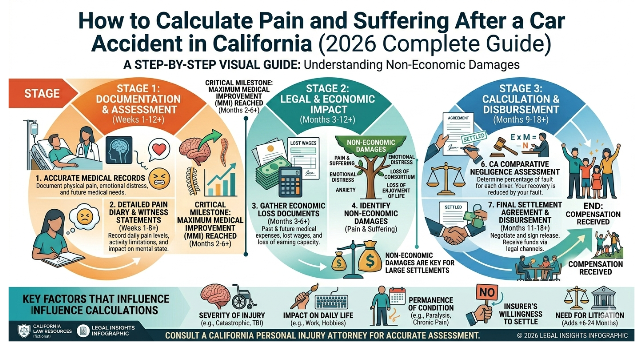
How to Calculate Pain and Suffering After a Car Accident in California (2026 Complete Guide)
URL: /article/pain-and-suffering-calculator-california-2026
Last Updated: May 2026 | By the LawAccidents.com Editorial Team | Reviewed for California Law Accuracy
You were hurt in a car accident that wasn't your fault. You have medical bills — those are easy to count. You have lost wages — you can calculate those too. But what about the pain you wake up with every morning? The anxiety that hits every time you get behind the wheel? The hobbies you can no longer enjoy? The nights you can't sleep because of the injury?
That is pain and suffering — and in California, it is often the largest single component of a car accident settlement. Yet most accident victims have no idea how it is calculated, how much they are entitled to, or what they can do to maximize it.
This guide answers every question you have about pain and suffering in California car accident cases — including the exact formulas used, the multiplier ranges for different injuries, the legal rules that affect your claim, and the specific steps you can take starting today to document and protect this critical part of your recovery.
Quick Answer: Pain and suffering in California car accidents is calculated using either the Multiplier Method (total economic damages × 1.5 to 5) or the Per Diem Method (daily rate × days of suffering). California has no cap on pain and suffering in car accident cases. For a $30,000 medical bill case with a multiplier of 3, pain and suffering alone could add $90,000 to your settlement — making it the most valuable part of many claims.
Table of Contents
- What Is Pain and Suffering Under California Law?
- California's No-Cap Rule: Why This Matters More Than You Think
- The Two Formulas: Multiplier Method vs. Per Diem Method
- Multiplier Ranges by Injury Type (2026 California Data)
- Real Calculation Examples: Step by Step
- What California Law Says About Pain and Suffering (Civil Code § 3333)
- Proposition 213: The Hidden Rule That Can Eliminate Your Pain and Suffering
- Physical Pain vs. Emotional Distress: What Is Covered?
- How Insurance Companies Attack Pain and Suffering Claims
- How to Document Pain and Suffering Effectively
- How Comparative Fault Reduces Your Pain and Suffering Award
- Pain and Suffering in Litigation vs. Settlement
- Frequently Asked Questions
1. What Is Pain and Suffering Under California Law? {#what-is}
Under California law, "pain and suffering" is a category of non-economic damages — compensation for harms that do not have a direct price tag attached to them. California Jury Instructions (CACI 3905A) define what falls within this category:
Physical pain and suffering includes:
- Physical pain experienced during and after the accident
- Discomfort from medical treatment, surgery, and rehabilitation
- Physical limitations on what you can do daily
- Chronic pain that persists after treatment
- Physical disfigurement and scarring
- Permanent disability or loss of physical function
Mental and emotional pain and suffering includes:
- Anxiety, fear, and worry caused by the accident and injuries
- Depression resulting from your physical limitations
- Post-Traumatic Stress Disorder (PTSD) — including fear of driving
- Grief and loss caused by permanent changes to your life
- Embarrassment or humiliation from visible injuries or scarring
- Sleep disturbances, nightmares, and intrusive thoughts
Loss of enjoyment of life includes:
- Inability to participate in sports, hobbies, or recreational activities you previously enjoyed
- Inability to spend quality time with family and children as before
- Loss of social activities and relationships
- Reduced capacity to experience pleasure
Loss of consortium includes:
- Impact on your relationship with your spouse or domestic partner
- Reduced ability to provide companionship, affection, or intimacy
All of these categories fall under the broad umbrella of "pain and suffering" in California personal injury law — and all are compensable in a car accident case.
2. California's No-Cap Rule: Why This Matters More Than You Think {#no-cap}
California is one of the most favorable states in the country for personal injury victims on this issue: California does not cap non-economic damages in car accident cases.
This is critically important. In many states, non-economic damages — including pain and suffering — are capped at a specific dollar amount regardless of how severe your injuries are. California law does not impose this restriction on car accident victims under California Civil Code § 3333.
What this means in practice: if your injuries are severe, permanent, or life-altering, a California jury can award whatever amount accurately reflects your actual suffering — whether that is $100,000 or $10,000,000. There is no ceiling.
Important Exception: Medical Malpractice
The only area where California does cap non-economic damages is medical malpractice under the Medical Injury Compensation Reform Act (MICRA). As of 2026, the cap for non-fatal medical malpractice cases is $470,000, rising gradually to $750,000 over the next several years. For wrongful death medical malpractice cases, the cap is $650,000, rising to $1,000,000.
This cap does not apply to car accident cases, truck accident cases, slip and fall cases, or any other personal injury case outside of medical malpractice.
Important Exception: Proposition 213
California Proposition 213 eliminates the right to recover non-economic damages (including pain and suffering) for certain uninsured drivers. This critical rule is covered in detail in Section 7 below.
3. The Two Formulas: Multiplier Method vs. Per Diem Method {#formulas}
There is no single formula dictated by California law for calculating pain and suffering. Instead, two widely used methods serve as starting points for negotiations between attorneys and insurance companies — and for jury deliberations when cases go to trial.
Method 1: The Multiplier Method
This is the most commonly used calculation method in California car accident cases.
Formula:
Total Economic Damages × Multiplier = Pain and Suffering Damages
Total Economic Damages = all your quantifiable financial losses:
- Past medical bills
- Future medical expenses
- Past lost wages
- Future lost earning capacity
- Other out-of-pocket accident-related expenses
The Multiplier is a number between 1.5 and 5 (and occasionally higher in catastrophic cases) that reflects the severity, duration, and permanence of your injuries. Higher multipliers apply to more severe, permanent, or life-altering injuries.
Example:
- Medical bills: $25,000
- Lost wages: $10,000
- Total economic damages: $35,000
- Multiplier: 3 (moderate-serious injury)
- Pain and suffering damages: $35,000 × 3 = $105,000
- Total settlement value: $140,000
This example illustrates why pain and suffering is so important: it more than doubled the total value of the claim compared to economic damages alone.
Method 2: The Per Diem Method
This method assigns a daily dollar value to your pain and suffering and multiplies it by the number of days you suffered.
Formula:
Daily Rate × Number of Days Suffering = Pain and Suffering Damages
How the daily rate is set: The most defensible daily rate is often based on your actual daily earnings (your daily wage), on the theory that you would not accept one day of this level of pain and suffering for one day's pay. However, the daily rate is ultimately a negotiating position — and it can be set higher for more severe injuries.
Example:
- Daily rate: $250 (based on approximately $90,000 annual salary)
- Recovery period: 365 days (one year of significant symptoms)
- Pain and suffering: $250 × 365 = $91,250
When is the Per Diem Method better? The per diem method tends to work well when:
- Your economic damages are relatively low but your suffering period was long
- You have strong documentation of daily symptoms throughout recovery
- Your recovery period is clearly defined (beginning and end)
When is the Multiplier Method better? The multiplier method tends to work better when:
- You have significant medical bills that justify a high total economic damages base
- Your injury is severe and warrants a high multiplier
- Your recovery period is ongoing or indefinite
Experienced California personal injury attorneys choose the method — or combination of methods — that produces the highest defensible result for their client's specific facts.
What Insurers Actually Use: The Colossus Problem
It is important to understand that major insurance companies do not manually apply these formulas. They use automated valuation software — most commonly a program called Colossus — that assigns points to injuries, treatments, and documented limitations, then generates a settlement range.
Colossus systematically undervalues pain and suffering because:
- It relies heavily on diagnosis codes and treatment records, not narrative descriptions of suffering
- It does not capture the full human impact of chronic pain, PTSD, or loss of enjoyment
- It is calibrated to minimize payouts, not to fairly compensate victims
This is why the initial insurance settlement offer is almost always too low when it comes to pain and suffering. Your attorney knows how to build documentation that forces the adjuster to override the software and manually justify a higher number.
4. Multiplier Ranges by Injury Type (2026 California Data) {#multiplier-ranges}
The multiplier is not arbitrary — it tracks the objective characteristics of your injury. Here is the realistic range for each injury category based on 2025–2026 California settlements and verdicts:
| Injury Type | Typical Multiplier | Rationale |
|---|---|---|
| Minor whiplash (full recovery < 8 weeks) | 1.5 – 2.0 | Short duration, full recovery, limited documentation |
| Moderate soft tissue (3–6 months treatment) | 2.0 – 3.0 | Extended treatment, documented symptoms |
| Herniated disc (no surgery) | 2.5 – 3.5 | Significant pain, long treatment, potential permanency |
| Broken bones (full recovery) | 2.0 – 3.0 | Documented pain, limited if full recovery |
| Broken bones (complications or surgery) | 3.0 – 4.5 | Significant impact, extended recovery |
| Herniated disc (surgery required) | 3.5 – 5.0 | Surgical trauma, long recovery, possible permanency |
| Knee or shoulder surgery | 3.0 – 4.5 | Surgical impact, lengthy rehabilitation |
| Traumatic Brain Injury (mild) | 2.5 – 3.5 | Cognitive impact, uncertainty of recovery |
| Traumatic Brain Injury (moderate–severe) | 4.0 – 7.0+ | Life-altering, permanent cognitive changes |
| Spinal cord injury (incomplete) | 5.0 – 8.0+ | Permanent disability, extraordinary life impact |
| Spinal cord injury (complete/paralysis) | 7.0 – 10.0+ | Catastrophic, permanent, total life transformation |
| Permanent disfigurement / scarring | 3.0 – 6.0 | Visible daily reminder, psychological impact |
| PTSD / severe emotional distress | 3.0 – 5.0 | Documented, treated psychological trauma |
Important caveat: These multipliers apply to the negotiated settlement range. Jury verdicts — especially in Los Angeles, San Francisco, and other plaintiff-friendly California counties — can push well beyond these ranges when a case goes to trial with compelling evidence and effective advocacy.
5. Real Calculation Examples: Step by Step {#examples}
Example 1: Minor Whiplash — Quick Recovery
Facts: Rear-end collision. Whiplash and neck strain. 8 weeks of physical therapy. Full recovery. Clear liability.
Economic Damages:
- Emergency room visit: $2,800
- Physical therapy (8 weeks): $4,200
- Lost wages (1 week): $1,500
- Total: $8,500
Pain and Suffering (Multiplier Method):
- Multiplier: 2.0 (minor injury, full recovery, short duration)
- Pain and suffering: $8,500 × 2.0 = $17,000
Total Case Value: $25,500
Example 2: Herniated Disc, No Surgery
Facts: T-bone intersection accident. C5-C6 herniated disc. 9 months of physical therapy and epidural injections. Residual symptoms at MMI. Moderate permanency finding.
Economic Damages:
- Emergency room: $4,500
- MRI scans (×2): $3,800
- Physical therapy (9 months): $12,600
- Epidural injections (×3): $7,200
- Lost wages (3 weeks): $4,800
- Future treatment estimate: $8,000
- Total: $40,900
Pain and Suffering (Multiplier Method):
- Multiplier: 3.5 (significant injury, long treatment, documented permanency)
- Pain and suffering: $40,900 × 3.5 = $143,150
Total Case Value: $184,050
Example 3: Surgical Knee Injury (ACL Reconstruction)
Facts: Rear-end collision at highway speed. ACL tear requiring surgery. 14 months of treatment including surgery, hospital stay, and rehabilitation. Permanent mild instability noted at MMI.
Economic Damages:
- Emergency room: $6,200
- MRI / imaging: $2,400
- ACL surgery: $42,000
- Hospital stay (2 nights): $18,000
- Physical therapy (12 months): $16,800
- Lost wages (6 weeks): $9,600
- Future physical therapy: $6,000
- Total: $101,000
Pain and Suffering (Multiplier Method):
- Multiplier: 4.0 (surgery, long recovery, permanent limitation)
- Pain and suffering: $101,000 × 4.0 = $404,000
Total Case Value: $505,000
Example 4: Traumatic Brain Injury (Moderate)
Facts: High-speed freeway collision. Moderate TBI. Cognitive deficits documented by neuropsychological testing. Unable to return to prior executive-level work. Permanent impairment rating.
Economic Damages:
- Emergency room and hospitalization: $68,000
- Neurological and specialist care: $24,000
- Neuropsychological testing: $8,500
- Cognitive rehabilitation therapy (18 months): $38,000
- Lost wages (2 years): $220,000
- Future reduced earning capacity (lifetime): $850,000
- Future care needs: $180,000
- Total: $1,388,500
Pain and Suffering (Multiplier Method):
- Multiplier: 5.0 (severe, permanent, life-altering)
- Pain and suffering: $1,388,500 × 5.0 = $6,942,500
Total Case Value: $8,331,000+
(Note: This case likely involves significant insurance coverage — commercial defendant, umbrella policies — that makes recovery at this level achievable.)
Example 5: Per Diem Method for a Moderate Injury
Facts: Side-impact collision. Fractured ribs (3), soft tissue back injury. 6 months of treatment. Full recovery at MMI. Economic damages: $22,000. Victim earns $75,000/year ($205/day).
Per Diem Calculation:
- Daily rate: $250 (slightly above actual daily wage to reflect severity of rib fractures)
- Days of significant suffering: 180 days (6 months)
- Pain and suffering: $250 × 180 = $45,000
Multiplier Comparison:
- Economic damages: $22,000
- Multiplier: 2.5
- Pain and suffering: $22,000 × 2.5 = $55,000
Attorney's choice: The multiplier method produces a higher number ($55,000 vs. $45,000) and would be the preferred approach in this case.
6. What California Law Says About Pain and Suffering {#california-law}
Several specific California statutes and legal doctrines govern pain and suffering in car accident cases:
California Civil Code § 3333
This is the foundational statute authorizing non-economic damages in tort cases. It states that an accident victim is entitled to compensation for "the detriment proximately caused" by the defendant's negligence — which California courts have consistently interpreted to include pain, suffering, emotional distress, and loss of enjoyment of life.
California Civil Jury Instructions (CACI) 3905A
This is the jury instruction California judges read to juries in personal injury cases. It is the definitive statement of what California law considers compensable pain and suffering. The instruction tells juries to award "reasonable compensation for any pain, discomfort, fears, anxiety, and other mental and emotional distress" suffered by the plaintiff.
Significantly, CACI 3905A also states: "No fixed standard exists for deciding the amount of these damages. You must use your judgment to decide a reasonable amount based on the evidence and your common sense." This means pain and suffering awards are inherently fact-specific and subjective — which is both the challenge and the opportunity in building your case.
The Eggshell Plaintiff Doctrine
California follows the "eggshell plaintiff" rule: a defendant must take their victim as they find them. If you had a pre-existing spinal condition that was aggravated or accelerated by the accident, you are still entitled to full compensation for the worsening — even though the injury might have been minor for a healthier person.
Insurance companies aggressively challenge pain and suffering claims based on pre-existing conditions. The eggshell plaintiff doctrine is your legal defense against this tactic.
California Civil Code § 3294 — Punitive Damages
In cases involving malice, oppression, or fraud — including drunk driving cases and cases of extreme recklessness — California allows additional punitive damages on top of compensatory pain and suffering. Punitive damages are not capped in non-medical-malpractice personal injury cases and can multiply the total award substantially.
7. Proposition 213: The Hidden Rule That Can Eliminate Your Pain and Suffering {#prop-213}
This is one of the most important and least-known rules in California car accident law — and it can completely eliminate your pain and suffering claim if it applies to you.
California Proposition 213 (codified at California Civil Code § 3333.4) prohibits the recovery of non-economic damages — including all pain and suffering — from at-fault drivers in certain situations:
Who Proposition 213 Affects:
1. Uninsured vehicle owners If you owned the vehicle involved in the accident and did not have California's required minimum auto insurance at the time of the crash, you cannot recover pain and suffering damages from the at-fault driver — even if the accident was 100% their fault.
2. Drivers convicted of DUI related to the accident If you were driving under the influence of alcohol or drugs and were convicted of a DUI related to the accident, you cannot recover non-economic damages.
3. Drivers committing felonies If you were committing a felony at the time of the accident that contributed to the crash, you are barred from recovering non-economic damages.
What Proposition 213 Does NOT Affect:
- You can still recover economic damages (medical bills, lost wages, property damage) even if Proposition 213 applies
- Proposition 213 does not apply if you were a passenger (not the driver/owner) of the uninsured vehicle
- Proposition 213 does not apply to claims against your own insurance company (UM/UIM claims)
- Proposition 213 does not apply if the at-fault driver was drunk and you were sober — even if you were uninsured
Real-world impact: If you were driving an uninsured vehicle and suffered $50,000 in pain and suffering from a crash that was entirely the other driver's fault, Proposition 213 means you receive $0 for pain and suffering — regardless of how severe your injuries are.
This is why carrying California's required minimum auto insurance is not just a legal obligation — it is financial self-protection. Check your coverage today if you're not certain what you carry.
8. Physical Pain vs. Emotional Distress: What Is Covered? {#what-is-covered}
Many accident victims underestimate the value of their emotional distress claims. California law treats emotional distress as fully compensable — and in serious cases, it can represent a substantial portion of total damages.
Physical Pain — Most Common, Easiest to Document
Physical pain is the most straightforward component of pain and suffering. It encompasses:
- The immediate pain of the accident itself
- Pain from medical procedures, surgeries, and injections
- Post-surgical pain during recovery
- Chronic or permanent pain that persists at MMI
- Headaches, migraines, and neurological pain
- Muscle pain, spasms, and limited range of motion
How to document physical pain: Consistent medical records from treating physicians are the gold standard. Your doctor's notes should reflect your reported pain levels at every appointment. A daily pain journal that tracks your symptoms, activities, and limitations adds powerful supporting evidence.
Post-Traumatic Stress Disorder (PTSD)
PTSD is increasingly recognized in California car accident cases and can add substantial value to a claim. Documented PTSD symptoms include:
- Flashbacks to the accident
- Nightmares and sleep disturbances
- Hypervigilance and anxiety while driving or riding in vehicles
- Avoidance of roads, vehicles, or situations that trigger memories of the accident
- Panic attacks
- Emotional numbness or detachment
How to document PTSD: Diagnosis and treatment by a licensed mental health professional — psychiatrist, psychologist, or licensed therapist — creates the documentation needed to support a PTSD damages claim. Without professional treatment records, PTSD claims are significantly harder to prove.
Loss of Enjoyment of Life
This category covers the reduction in your quality of life caused by your injuries. Courts and juries consider:
- Sports and athletic activities you can no longer participate in
- Hobbies you have had to abandon or significantly modify
- Social activities and relationships that have been affected
- Travel and family activities you can no longer enjoy
- The difference between who you were before the accident and who you are now
How to document loss of enjoyment: Photographs and social media evidence of your pre-accident activities, testimony from family and friends who observed the change, and your own narrative account of what the injury has taken from you.
Anxiety and Fear of Driving
Developing anxiety or fear related to driving is extremely common after serious car accidents — and it is compensable. If you experience anxiety when driving, when riding as a passenger, or when approaching the location of the accident, document it with your treating physician or a mental health professional.
Emotional Impact on Relationships — Loss of Consortium
If your injuries have affected your relationship with your spouse or domestic partner — in terms of companionship, affection, support, or intimacy — your spouse may have an independent claim for loss of consortium. This claim belongs to the spouse, not the injured victim, and is filed separately or as part of the same case.
9. How Insurance Companies Attack Pain and Suffering Claims {#insurance-attacks}
Understanding how insurance companies challenge pain and suffering claims gives you the knowledge to protect them. Here are the most common attack strategies and exactly how to defend against each one:
Attack 1: "Your injuries are subjective — we only pay for what we can document."
Pain is inherently subjective. Insurance adjusters exploit this by claiming they cannot value what they cannot see on a medical bill.
Defense: Consistent medical records in which your treating physician documents your reported pain levels, functional limitations, and the impact on your daily life. A daily pain journal. Photographs of activities you can no longer perform. Testimony from family members who have observed your suffering.
Attack 2: "You have a pre-existing condition."
The insurer argues that your pain is the result of a pre-existing degenerative condition, not the accident.
Defense: The eggshell plaintiff doctrine. Your treating physician should document the difference between your baseline condition pre-accident and your condition post-accident. If you have prior medical records showing your pre-accident condition was manageable and the accident significantly worsened it, that aggravation is fully compensable.
Attack 3: "Your treatment was excessive or unnecessary."
The adjuster argues that some or all of your treatment was beyond what the injury required, and therefore the economic damages base for the multiplier calculation should be reduced.
Defense: Medical necessity letters from your treating physicians. Expert testimony from an independent medical expert if necessary. Documentation that each treatment was recommended by a licensed medical professional.
Attack 4: "You posted on social media and looked fine."
A single photograph or social media post that appears inconsistent with your claimed injuries will be used to argue you are exaggerating your suffering.
Defense: Do not post on social media from the date of the accident until your case is fully resolved. Set all accounts to private. Inform family members not to tag you in photos or posts. Even a photo taken during a brief good moment can be used out of context to undermine months of documented suffering.
Attack 5: "Your gaps in treatment show you recovered faster than claimed."
If you missed medical appointments or had periods without treatment, the insurer argues this proves your injuries were not serious.
Defense: Consistent, uninterrupted medical treatment from the date of the accident through MMI. If you had to miss appointments due to financial hardship or insurance issues, document the reason in your medical records. Never voluntarily stop treatment before your doctor recommends it.
Attack 6: "The Colossus number is our final offer."
The adjuster presents a number generated by their automated valuation software and implies it is objective and non-negotiable.
Defense: Colossus is explicitly designed to minimize payouts. Your attorney builds documentation that forces a manual override — detailed physician narratives, functional assessments, psychological evaluations, and evidence of the full scope of your non-economic damages. An insurer that refuses to move from a Colossus number in a legitimate case faces bad faith exposure.
Related: Your Insurance Company Is Not Your Friend After a Car Accident
10. How to Document Pain and Suffering Effectively {#documentation}
The difference between a $30,000 pain and suffering award and a $150,000 pain and suffering award is often the quality of documentation. Here is exactly what to do from the day of your accident:
Start a Pain Journal Immediately
A daily pain journal is one of the most powerful tools for documenting pain and suffering. Start it the day of the accident and maintain it every single day through your recovery.
What to record each day:
- Your pain level on a scale of 1–10, for each area of your body
- What activities you attempted and could not complete
- How the injury affected your sleep the prior night
- Any emotional symptoms: anxiety, depression, fear, nightmares
- Activities you skipped or modified because of your injuries
- How the injury affected your interactions with family members
- Any medications you took for pain
- How you felt driving or riding in a vehicle
A journal entry that reads "3/15/26 — Pain in neck 7/10 on waking. Could not pick up my daughter this morning. Did not sleep through the night for the third week in a row. Anxious when driving to doctor appointment" is far more persuasive than a bare medical record.
Communicate Every Symptom to Your Doctor
Every pain, limitation, and emotional symptom you experience should be communicated to your treating physician at every appointment — and it should appear in the medical record. If you have a headache, mention it. If you cannot lift your arm above shoulder height, mention it. If you are having nightmares about the accident, mention it.
Medical records drive the pain and suffering calculation. A symptom that is not in the medical record may as well not exist from the insurance company's perspective.
Seek Mental Health Treatment If You Are Struggling
If you are experiencing anxiety, depression, PTSD, or other psychological symptoms, seek professional treatment from a licensed therapist, psychologist, or psychiatrist. These treatment records create the documented foundation for an emotional distress claim.
Many accident victims resist seeking mental health treatment because of stigma or cost. From a legal standpoint, untreated emotional symptoms are worth far less in a settlement than documented, treated psychological injuries.
Gather Before-and-After Evidence
Evidence of who you were before the accident and how dramatically your life changed is compelling to juries and useful in negotiations:
- Photographs and videos of you participating in sports, hobbies, or family activities pre-accident
- Social media posts pre-accident showing your activity level
- Testimony from coworkers, coaches, teammates, or friends about your pre-accident capabilities
- Employment records documenting your performance and attendance before versus after the accident
Get Your Family Members on Record
People who live with you and observe your suffering every day are powerful witnesses. Your spouse, partner, parent, or children can describe:
- How your sleep has changed
- What activities you can no longer do with them
- Changes in your personality, mood, or energy level
- Assistance they now provide for tasks you used to handle independently
These observations can be captured in witness statements prepared by your attorney or as deposition testimony in litigation.
11. How Comparative Fault Reduces Your Pain and Suffering Award {#comparative-fault}
California's pure comparative negligence rule under California Civil Code § 1714 applies to pain and suffering damages just as it does to economic damages. If you are found partially at fault for the accident, your pain and suffering award is reduced by your percentage of fault.
Example:
- Your total damages: $200,000 (including $120,000 in pain and suffering)
- You are found 25% at fault
- Your recovery: $200,000 × 75% = $150,000
- Your pain and suffering reduced from $120,000 to $90,000
How insurance companies use comparative fault to reduce pain and suffering specifically:
Because pain and suffering is subjective and the largest component of many claims, it is the primary target when insurers try to assign you partial fault. Common arguments:
- You were speeding slightly before the impact
- You did not brake in time
- You were not wearing your seatbelt (California Vehicle Code § 27315 — failure to wear a seatbelt can reduce damages)
- You had a reaction time affected by fatigue or distraction
Important: Your attorney should aggressively contest any comparative fault assignment. A 10% reduction in fault on a $300,000 claim is $30,000. Over the range of a serious injury case, the difference between 0% fault and 25% fault can be hundreds of thousands of dollars in pain and suffering alone.
12. Pain and Suffering in Litigation vs. Settlement {#litigation-vs-settlement}
Pain and suffering is valued differently depending on whether your case settles or goes to trial:
In Settlement Negotiations
Settlements are negotiated between your attorney and the insurance adjuster. The multiplier or per diem calculation serves as a reference point, but the actual settlement depends on:
- The strength of your documentation
- The insurance company's risk assessment of what a jury might award
- The policy limits available
- The skill of your attorney's negotiation
In settlements, pain and suffering amounts tend to be more conservative — partly because of the inherent uncertainty of how a jury would react, and partly because insurance companies systematically discount non-economic damages in their internal calculations.
At Trial
California juries in plaintiff-friendly venues — particularly Los Angeles, San Francisco, Alameda, and Santa Clara counties — are known for substantial pain and suffering awards that significantly exceed pre-trial settlement offers. A jury that is emotionally connected to a plaintiff's story can award pain and suffering amounts that dwarf what any insurance company was willing to discuss in negotiations.
This is why the decision of whether to file a lawsuit and take a case to trial is so significant. The risk — trial is expensive and time-consuming — is weighed against the potential upside of a jury verdict that fully values the human cost of your injuries.
When Filing a Lawsuit Increases Your Pain and Suffering Settlement
Even without going to trial, filing a lawsuit dramatically increases your settlement leverage on pain and suffering. Here is why:
Once a lawsuit is filed, the insurance company must engage defense counsel, conduct depositions, and face the real possibility of a jury verdict. In deposition, you will testify about your pain in detail — and your attorney will use that testimony to build the documentary foundation for a much higher pain and suffering claim than what was presented in the demand letter.
Most cases that are filed settle significantly higher than the pre-litigation demand, often specifically because the litigation process forces the insurance company to confront the full human reality of your suffering.
Related: How Long Does a Car Accident Settlement Take in California?
13. Frequently Asked Questions {#faq}
Q: Is there a cap on pain and suffering in California car accident cases? A: No. California does not cap non-economic damages (including pain and suffering) in car accident, truck accident, motorcycle accident, or other personal injury cases. The only cap applies to medical malpractice cases, where non-economic damages are currently capped at $470,000 for non-fatal cases (rising gradually over the next decade). In car accident cases, there is no ceiling on what a jury can award.
Q: How do I calculate my pain and suffering damages? A: The two primary methods are: (1) Multiplier Method — multiply your total economic damages by a factor of 1.5 to 5 depending on injury severity; (2) Per Diem Method — assign a daily dollar value (often based on your daily earnings) and multiply by the number of days you suffered. Your attorney will use whichever method produces the higher, more defensible result for your specific injuries.
Q: What multiplier should I use for my case? A: Multipliers range from 1.5 (minor injury, full recovery) to 5.0 or higher (catastrophic, permanent injury). For a herniated disc without surgery: 2.5–3.5. For surgery required: 3.5–5.0. For TBI or spinal cord injury: 4.0–10.0+. The exact multiplier depends on severity, permanency, and the impact on your daily life.
Q: Can I claim pain and suffering if I was uninsured? A: Not for non-economic damages against the at-fault driver. California Proposition 213 bars uninsured vehicle owners from recovering pain and suffering from at-fault drivers. You can still recover economic damages (medical bills, lost wages, property damage). This does not apply if you were a passenger, or if the at-fault driver was drunk.
Q: Does pain and suffering include mental health issues like anxiety and PTSD? A: Yes. California law explicitly recognizes emotional distress — including anxiety, depression, PTSD, and fear of driving — as compensable non-economic damages. The key is documentation: treatment records from a licensed mental health professional are essential to proving emotional distress claims.
Q: How do I prove pain and suffering to the insurance company? A: The most effective documentation includes: consistent medical records with your doctor noting your reported symptoms at every visit, a daily pain journal, before-and-after photographs, testimony from family members, mental health treatment records, and your own detailed narrative. The more thoroughly documented, the more difficult it is for the insurer to minimize.
Q: What if I had a pre-existing condition before the accident? A: You are still entitled to compensation for the aggravation or worsening of a pre-existing condition caused by the accident. California's eggshell plaintiff doctrine requires the at-fault driver to take you as they find you. Your attorney will document the difference between your pre-accident baseline and your post-accident condition.
Q: How much is pain and suffering worth in a minor car accident? A: For truly minor injuries (soft tissue with full recovery in 6–8 weeks), pain and suffering typically adds $5,000–$20,000 to a California car accident settlement. For moderate injuries (disc herniation, broken bones, 3–9 months treatment), pain and suffering typically adds $50,000–$150,000.
Q: Will I get more for pain and suffering if I go to trial? A: Generally yes — California juries, especially in Los Angeles, San Francisco, and other plaintiff-friendly counties, award higher pain and suffering damages than pre-trial settlements. However, trial involves cost, time, and risk. Your attorney should evaluate whether the potential increase justifies going to trial versus accepting a strong settlement offer.
Q: Do I need an attorney to claim pain and suffering? A: Technically no, but in practice, unrepresented claimants recover dramatically less for pain and suffering than represented ones. Insurance companies know that most unrepresented victims don't know what their pain and suffering is worth and don't have the documentation or negotiating leverage to fight for it. The Insurance Research Council documents that represented California claimants recover approximately 3.5 times more overall than unrepresented claimants — and pain and suffering is where much of that difference lives.
The Bottom Line
Pain and suffering is not a bonus or a secondary consideration in a California car accident case. For most seriously injured victims, it is the largest single component of their total compensation — and in catastrophic injury cases, it can represent millions of dollars.
The difference between a victim who receives fair compensation for their pain and suffering and one who gets a fraction of what they deserve almost always comes down to two things: documentation and legal representation.
Start your pain journal today. See every medical appointment. Tell your doctor every symptom. And before you speak with any insurance company, consult with a California personal injury attorney who can tell you what your pain and suffering is actually worth.
Get a Free Case Evaluation — Find Out What Your Pain and Suffering Claim Is Worth →
Find a Top-Rated California Car Accident Attorney Near You →
This article is for informational purposes only and does not constitute legal advice. Pain and suffering damages depend on the specific facts of your case, applicable California law, and the available insurance coverage. Consult a licensed California personal injury attorney for advice specific to your situation.
LawAccidents.com connects accident victims with experienced personal injury attorneys. Find a lawyer near you →
Related Articles on LawAccidents.com:
- Average Car Accident Settlement in California 2026
- How Long Does a Car Accident Settlement Take in California?
- What Happens If the Other Driver Has No Insurance in California?
- Who's At Fault in a Car Accident? California Fault Laws Explained
- Your Insurance Company Is Not Your Friend After a Car Accident
- 18-Wheeler Accident Settlement Amounts 2026
"For a complete guide on how pain and suffering is calculated in California, see our dedicated guide: How to Calculate Pain and Suffering — California 2026"
Comments (0)