What Is a Personal Injury Claim? Complete Guide for 2026
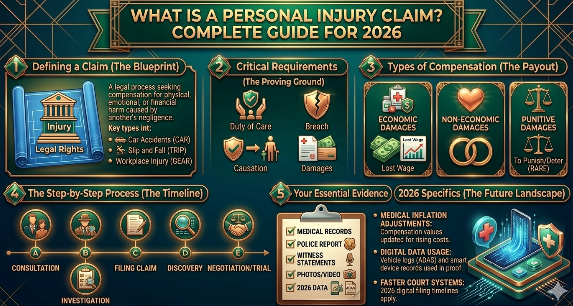
What Is a Personal Injury Claim? Complete Guide for 2026
Category: Personal Injury Claims Last Updated: May 9, 2026 Read Time: 14 min Attorney-Reviewed: ✓ Yes
Injured because of someone else's negligence? You may have a personal injury claim — and the right to significant financial compensation. This guide explains exactly what a personal injury claim is, whether you have one, and how the entire process works from start to finish.
Table of Contents
- What Is a Personal Injury Claim?
- What Types of Accidents Qualify?
- The 4 Elements You Must Prove
- What Compensation Can You Recover?
- How Much Is a Personal Injury Claim Worth in 2026?
- The Personal Injury Claim Process — Step by Step
- How Long Do You Have to File?
- Personal Injury Claim vs. Lawsuit — What's the Difference?
- Do You Need a Personal Injury Attorney?
- Frequently Asked Questions
What Is a Personal Injury Claim? {#step1}
A personal injury claim is a legal demand for financial compensation made by someone who was injured due to another person's or entity's negligence, recklessness, or intentional misconduct.
In simple terms: if someone else's actions — or failure to act — caused your injury, you have the legal right to demand they pay for it.
Personal injury law covers an enormous range of situations — from car accidents and slip-and-fall injuries to medical malpractice and defective products. What they all have in common is this: an innocent person was harmed, and someone else is legally responsible.
There are two ways to pursue a personal injury claim:
Insurance claim: Most personal injury cases begin as a claim filed with the at-fault party's insurance company. This is faster and does not require going to court.
Personal injury lawsuit: If the insurance company denies the claim, disputes liability, or offers an unreasonably low settlement, your attorney files a lawsuit in civil court to recover full compensation.
The vast majority of personal injury cases — more than 95% — are resolved through settlement before ever reaching trial.
Important: A personal injury claim is a civil matter, completely separate from any criminal charges. Even if the at-fault party is never criminally charged, you can still pursue a civil personal injury claim against them.
What Types of Accidents Qualify? {#step2}
Personal injury law covers a wide range of accidents and incidents. The most common include:
Vehicle Accidents
- Car accidents
- Truck and 18-wheeler accidents
- Motorcycle accidents
- Uber, Lyft, and rideshare accidents
- Pedestrian accidents
- Bicycle accidents
- Bus accidents
Premises Liability
- Slip and fall accidents
- Trip and fall on unsafe property
- Swimming pool accidents
- Dog bites and animal attacks
- Negligent security leading to assault
Medical Negligence
- Surgical errors
- Misdiagnosis or delayed diagnosis
- Medication errors
- Birth injuries
- Hospital negligence
Product Liability
- Defective vehicles or auto parts
- Dangerous medications
- Defective medical devices
- Unsafe consumer products
Workplace Accidents
- Construction site injuries
- Industrial accidents
- Exposure to toxic substances
- Falls from height
Other Common Claims
- Wrongful death caused by negligence
- Nursing home abuse and neglect
- Assault and battery (civil claim)
- Traumatic brain injuries
💡 Key Point: The type of accident matters less than whether someone else's negligence caused it. If the answer is yes, you likely have a personal injury claim.
The 4 Elements You Must Prove {#step3}
To win a personal injury claim, your attorney must establish four legal elements. All four must be present — missing even one can defeat your case.
Element 1: Duty of Care
The at-fault party must have owed you a legal duty to act with reasonable care. This is almost always easy to establish:
- Drivers owe a duty of care to other road users
- Property owners owe a duty to keep their premises reasonably safe
- Doctors owe a duty to provide competent medical care
- Manufacturers owe a duty to produce safe products
Element 2: Breach of Duty
The at-fault party violated their duty of care through negligent, reckless, or intentional conduct. Examples:
- A driver running a red light
- A store owner failing to clean up a spill
- A doctor missing an obvious diagnosis
- A manufacturer knowingly selling a defective product
Element 3: Causation
The breach of duty directly caused your injury. This is sometimes the most contested element — the defense will often argue your injury had a different cause or existed before the accident.
Your attorney uses medical records, expert testimony, and accident reconstruction to establish a direct causal link between the negligent act and your specific injuries.
Element 4: Damages
You suffered actual, measurable harm as a result. This includes physical injuries, financial losses, emotional suffering, and other impacts on your life.
⚠️ Warning: Insurance companies focus their defense on breaking one of these four elements — most commonly causation ("your injury isn't from our client's actions") or damages ("you weren't really that hurt"). An experienced attorney anticipates and counters these arguments.
What Compensation Can You Recover? {#step4}
Personal injury compensation falls into three categories:
Economic Damages — Your Financial Losses
Medical expenses All past and future medical costs directly related to your injury:
- Emergency room treatment
- Surgery and hospitalization
- Prescription medications
- Physical therapy and rehabilitation
- Future medical care and ongoing treatment
- Medical equipment and home modifications
Lost wages Income you lost while recovering from your injuries — including salary, hourly wages, tips, commissions, and self-employment income.
Loss of future earning capacity If your injuries permanently affect your ability to work — whether by limiting the type of work you can do or reducing your hours — you can recover for the income you will lose over the remainder of your working life.
Property damage Repair or replacement costs for any property damaged in the incident, including your vehicle.
Out-of-pocket expenses Transportation to medical appointments, home care assistance, childcare costs incurred due to your injury, and other direct expenses.
Non-Economic Damages — Your Human Losses
Pain and suffering Compensation for the physical pain you experienced and continue to experience as a result of your injuries. This is typically the largest component of a personal injury settlement.
Emotional distress Anxiety, depression, PTSD, fear, and psychological trauma caused by the accident and your injuries.
Loss of enjoyment of life If your injuries prevent you from participating in activities you previously enjoyed — sports, hobbies, travel, social activities — you can recover for this diminishment of quality of life.
Loss of consortium A spouse can recover for the loss of companionship, intimacy, and partnership resulting from their partner's serious injuries.
Punitive Damages — Punishment for Extreme Misconduct
In cases involving gross negligence, recklessness, or intentional harm — such as drunk driving, assault, or knowingly selling a dangerous product — courts may award punitive damages on top of compensatory damages.
Punitive damages are designed to punish the defendant and deter similar conduct. They can multiply the total award significantly in egregious cases.
📌 Related: How to Calculate Pain and Suffering After a Car Accident in California (2026)
How Much Is a Personal Injury Claim Worth in 2026? {#step5}
Personal injury settlement values vary enormously based on the severity of injuries, liability clarity, and individual circumstances. Here are realistic ranges based on current data:
| Injury Type | Typical Settlement Range |
|---|---|
| Minor soft tissue (whiplash, sprains) | $10,000 – $35,000 |
| Moderate injuries (fractures, disc injuries) | $50,000 – $150,000 |
| Serious injuries (surgery required) | $100,000 – $500,000 |
| Severe injuries (spinal, TBI, permanent disability) | $500,000 – $3 million+ |
| Catastrophic injuries (paralysis, amputation) | $1 million – $10 million+ |
| Wrongful death | $500,000 – $15 million+ |
Key Factors That Increase Your Settlement
- Clear, undisputed liability
- Serious, well-documented injuries
- High medical bills and ongoing treatment needs
- Significant lost income
- Young victim with long working life ahead
- Strong witness testimony and evidence
- Experienced personal injury attorney
Key Factors That Reduce Your Settlement
- Shared fault — your own negligence contributed
- Delayed medical treatment
- Gaps in medical care
- Pre-existing conditions in the same area of injury
- Limited insurance coverage of the at-fault party
- Weak documentation
💡 Reality Check: Insurance companies start with lowball offers. The first offer you receive is almost never close to what your case is actually worth. Always have an attorney evaluate any offer before signing anything.
📌 Related: Average Car Accident Settlement in California 2026: Real Numbers by Injury Type
The Personal Injury Claim Process — Step by Step {#step6}
Understanding the process removes the uncertainty and helps you make better decisions at every stage.
Step 1: Seek Medical Treatment Immediately
Your health comes first — and your medical records are the foundation of your entire claim. See a doctor within 24–72 hours of any accident, even if you feel relatively fine. Delayed treatment gives insurance companies grounds to dispute your injuries.
Step 2: Document Everything
Photograph the scene, your injuries, and any property damage. Collect witness information. Keep every medical bill, receipt, and piece of correspondence. Start a daily pain journal documenting your symptoms and how your injuries affect your daily life.
Step 3: Consult a Personal Injury Attorney
Most personal injury attorneys offer free consultations and work on contingency — you pay nothing unless they win. An attorney evaluates your case, identifies all liable parties, and advises you on the realistic value of your claim before you make any decisions.
Step 4: Investigation and Evidence Gathering
Your attorney investigates the incident thoroughly — obtaining accident reports, security footage, phone records, expert opinions, and any other evidence needed to establish liability and document your damages.
Step 5: Medical Treatment and Recovery
Continue all prescribed medical treatment. Your attorney will typically advise waiting until you reach Maximum Medical Improvement (MMI) — the point where your condition has stabilized — before demanding settlement. This ensures all your damages are known and documented.
Step 6: Demand Letter
Your attorney sends a formal demand letter to the at-fault party's insurance company detailing the facts of the case, the evidence of liability, your injuries and treatment, and the compensation demanded.
Step 7: Negotiation
The insurance company responds — typically with a counteroffer below your demand. Your attorney negotiates, presenting evidence and legal arguments to increase the offer. Most cases settle at this stage.
Step 8: Settlement or Lawsuit
If a fair settlement is reached, you sign a release and receive payment — typically within 2–6 weeks of signing. If the insurance company refuses a fair offer, your attorney files a lawsuit and the litigation process begins.
Step 9: Litigation (If Necessary)
Discovery, depositions, expert witness preparation, and pre-trial motions. The vast majority of cases settle during this phase before going to trial.
Step 10: Trial (Rare)
Less than 5% of personal injury cases go to trial. If yours does, your attorney presents your case to a judge or jury who determines liability and damages.
How Long Do You Have to File? {#step7}
Every state has a statute of limitations — a hard deadline by which you must file a lawsuit. Miss it and you permanently lose your right to compensation.
| State | Deadline | Notes |
|---|---|---|
| California | 2 years | From date of injury |
| Texas | 2 years | From date of injury |
| Florida | 2 years | Reduced from 4 years — HB 837 in effect |
| New York | 3 years | From date of injury |
| Illinois | 2 years | From date of injury |
| Pennsylvania | 2 years | From date of injury |
| Georgia | 2 years | From date of injury |
| Colorado | 3 years | Damage caps raised to $1.5M in 2026 |
| New Jersey | 2 years | Phase 2 minimums $35K/$70K as of Jan 2026 |
| Michigan | 3 years | From date of injury |
⚠️ Critical Exceptions:
- Government entities: Claims against city, county, or state governments may require a formal notice of claim within 60–180 days — far shorter than the general statute of limitations.
- Minors: In many states, the clock doesn't start running until the injured minor turns 18.
- Discovery rule: In some cases — particularly medical malpractice — the clock starts when you discovered (or reasonably should have discovered) the injury, not when it occurred.
Do not wait. Evidence disappears, witnesses' memories fade, and insurance companies begin building their defense immediately. The sooner you act, the stronger your case.
Personal Injury Claim vs. Lawsuit — What's the Difference? {#step8}
Many people use these terms interchangeably, but they are different things:
| Insurance Claim | Personal Injury Lawsuit | |
|---|---|---|
| Where it happens | Outside of court | Civil court |
| Who you deal with | Insurance adjuster | Judge, jury, opposing counsel |
| Timeline | 3–12 months typically | 1–3+ years |
| Cost | Lower legal fees | Higher but contingency-based |
| Control | More flexible | Formal legal process |
| Outcome | Negotiated settlement | Verdict or settlement |
The typical path:
Most personal injury cases begin as insurance claims. If the insurance company offers fair compensation, the case settles without a lawsuit ever being filed. A lawsuit becomes necessary when:
- The insurance company denies the claim entirely
- The settlement offer is unreasonably low
- Liability is seriously disputed
- The statute of limitations is approaching
Filing a lawsuit does not mean going to trial. The majority of lawsuits settle before trial — often shortly after filing, when the insurance company realizes the plaintiff is serious.
Do You Need a Personal Injury Attorney? {#step9}
For minor incidents with no injuries and minimal property damage, handling the claim yourself may be reasonable. For everything else — the answer is almost always yes.
What an attorney does that you cannot do alone:
Accurately values your claim Most injury victims significantly undervalue their own cases — especially future medical costs, lost earning capacity, and pain and suffering. Attorneys know what similar cases have settled for and fight for full value.
Handles all insurance communication Everything you say to an insurance adjuster can be used against you. Your attorney manages all communication, protecting you from tactics designed to minimize your payout.
Investigates thoroughly Attorneys have resources — accident reconstruction experts, medical experts, investigators — that individual claimants don't have access to.
Negotiates effectively Insurance companies take attorney-represented claimants far more seriously. Studies consistently show that represented claimants recover 3 to 3.5 times more on average than unrepresented claimants — even after attorney fees.
Files before the deadline Missing the statute of limitations is permanent and irreversible. An attorney tracks all deadlines and ensures your rights are protected.
The cost: nothing upfront
Personal injury attorneys work on contingency — meaning their fee is a percentage of your recovery, typically 33%. If they don't win, you pay nothing. There is no financial risk in consulting an attorney.
📌 Related: Find a Personal Injury Attorney Near You — Free Consultation
Frequently Asked Questions {#faq}
How do I know if I have a personal injury claim? If you were injured due to someone else's negligence and suffered measurable harm — medical bills, lost wages, pain and suffering — you likely have a claim. The best way to know for certain is a free consultation with a personal injury attorney.
What if I was partly at fault for my own injury? In most states following comparative negligence rules, you can still recover compensation even if you were partially at fault. Your recovery is simply reduced by your percentage of fault. For example, if you were 20% at fault and your damages total $100,000, you recover $80,000.
How long does a personal injury claim take? Minor claims with clear liability typically settle in 3–6 months. Complex claims involving serious injuries or disputed liability can take 1–3 years. Cases that go to trial may take longer.
Do I have to go to court? Most likely no. Over 95% of personal injury cases settle out of court through negotiation with the insurance company. Your attorney handles everything — you rarely need to appear in court unless your case goes to trial.
What if the at-fault party has no insurance? Your own uninsured motorist coverage may apply for vehicle accidents. In other cases, you may be able to sue the at-fault party personally and pursue their assets. An attorney can identify all available sources of recovery.
Can I still file if I signed something at the scene? It depends on what you signed. A standard accident report or medical release is different from a liability waiver or settlement release. If you signed anything from an insurance company, contact an attorney immediately.
What is the difference between personal injury and workers' compensation? Workers' compensation covers workplace injuries through a separate administrative system — you generally cannot sue your employer directly. However, if a third party (not your employer) caused your workplace injury, you may have both a workers' comp claim and a personal injury lawsuit.
How much does a personal injury attorney cost? Nothing upfront. Personal injury attorneys work on contingency — typically 33% of the settlement. If they don't recover compensation for you, you owe nothing.
The Bottom Line
A personal injury claim is your legal right when someone else's negligence causes you harm. The process exists to make you whole — to restore, as much as money can, what was taken from you by someone else's careless or reckless actions.
The most important steps you can take right now:
- See a doctor if you haven't already — your medical records are your foundation
- Document everything — photos, records, receipts, a daily journal
- Do not give recorded statements to any insurance company without legal advice
- Consult an attorney — it costs nothing and protects everything
This article is attorney-reviewed and updated regularly to reflect current state laws. It is intended for general informational purposes and does not constitute legal advice. Laws vary by state. Consult a licensed attorney in your jurisdiction for advice specific to your situation.
Last Updated: May 9, 2026 | Reviewed by: LawAccidents.com Legal Team
→ Find a Personal Injury Attorney Near You — Free Consultation → Browse All Personal Injury Guides → Average Car Accident Settlement in California 2026
Comments (0)