Wrongful Death Car Accident Lawsuit: What Families Need to Know (2026)
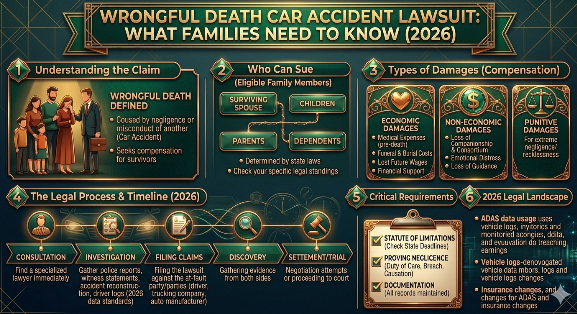
Wrongful Death Car Accident Lawsuit: What Families Need to Know (2026)
Category: Wrongful Death Last Updated: May 9, 2026 Read Time: 15 min Attorney-Reviewed: ✓ Yes
Losing a family member in a car accident is devastating. On top of the grief, families face mounting medical bills, funeral costs, lost income, and a legal system they've never had to navigate before. This guide explains your rights, your options, and exactly what to expect — in plain language.
Table of Contents
- What Is a Wrongful Death Car Accident Lawsuit?
- Who Can File a Wrongful Death Lawsuit?
- What Damages Can You Recover?
- How Much Are Wrongful Death Settlements Worth in 2026?
- How Do You Prove Wrongful Death?
- Wrongful Death vs. Criminal Charges — What's the Difference?
- State-by-State Filing Deadlines
- How Long Does a Wrongful Death Case Take?
- How to Choose the Right Attorney
- Frequently Asked Questions
What Is a Wrongful Death Car Accident Lawsuit? {#step1}
A wrongful death lawsuit is a civil legal claim filed by the surviving family members of someone who was killed due to another person's negligence, recklessness, or intentional misconduct.
In the context of car accidents, wrongful death claims arise when:
- A drunk or impaired driver causes a fatal crash
- A distracted driver (texting, phone use) kills another person
- A speeding or reckless driver causes a fatal collision
- A commercial truck driver or trucking company causes a fatal accident
- A defective vehicle or faulty part contributed to the death
- A government agency failed to maintain safe road conditions
The goal of a wrongful death lawsuit is not to punish the at-fault party — criminal courts handle punishment. The goal is financial compensation for the family members whose lives have been permanently damaged by the loss.
Important: A wrongful death lawsuit is completely separate from any criminal charges. The at-fault driver can be sued in civil court even if they are never criminally charged — or even if they are acquitted in criminal court.
Who Can File a Wrongful Death Lawsuit? {#step2}
This varies by state, but in most states the following family members have the legal right to file:
Tier 1 — Almost Always Eligible:
- Surviving spouse or domestic partner
- Biological or adopted children of the deceased
- Parents of an unmarried deceased child
Tier 2 — Eligible in Many States:
- Siblings
- Grandparents
- Financial dependents who relied on the deceased for support
Who Actually Files the Lawsuit:
In most states, the lawsuit is filed by the personal representative or executor of the deceased's estate — typically the spouse or an adult child. The compensation is then distributed to eligible family members according to state law.
⚠️ Important: If multiple family members want to file, they generally must be consolidated into a single lawsuit. You cannot have multiple separate wrongful death lawsuits from different family members for the same death.
Special Situations:
Unmarried partners: Depending on the state, a long-term partner who was not legally married may or may not have standing to file. California and New York are more permissive; other states are stricter.
Estranged family members: Legal separation or estrangement does not automatically disqualify a spouse from filing. However, it may affect the damages awarded.
Minor children: If the deceased's children are minors, a court-appointed guardian typically manages the claim on their behalf.
What Damages Can You Recover? {#step3}
Wrongful death damages fall into two broad categories: economic and non-economic.
Economic Damages (Calculable Financial Losses)
Medical expenses prior to death If the victim survived for any period after the accident before dying, all medical bills from that period are recoverable — emergency care, surgery, ICU, life support.
Funeral and burial expenses The full cost of funeral services, burial or cremation, and related expenses. In 2026, average funeral costs in the U.S. range from $8,000 to $15,000.
Lost income and future earnings This is typically the largest economic component. It accounts for:
- All income the deceased would have earned from the time of death through their expected working life
- Benefits, bonuses, and retirement contributions
- Value of household services (cooking, childcare, maintenance)
A 40-year-old earning $75,000 per year with 25 remaining working years represents approximately $1.875 million in lost future earnings — before accounting for raises, inflation, or benefits.
Loss of inheritance In some states, families can recover for the inheritance they would have received had the deceased lived a normal lifespan.
Non-Economic Damages (Human Losses)
Loss of companionship and consortium The emotional and relational loss suffered by a spouse — the loss of intimacy, partnership, emotional support, and shared life.
Loss of parental guidance Minor children can recover for the loss of a parent's guidance, nurturing, education, and presence throughout their upbringing.
Pain and suffering of the deceased If the victim was conscious and suffered before death, the estate can claim compensation for that pre-death pain and suffering.
Grief and emotional distress of survivors Many states allow surviving family members to recover for their own emotional suffering, depression, and psychological trauma.
Punitive Damages
In cases involving extreme recklessness — drunk driving, street racing, intentional conduct — courts may award punitive damages on top of compensatory damages. These are designed to punish the defendant and deter similar behavior.
Punitive damages in wrongful death car accident cases have reached $5 million to $50 million in high-profile cases involving repeat DUI offenders or egregious commercial trucking negligence.
How Much Are Wrongful Death Settlements Worth in 2026? {#step4}
Wrongful death settlements vary enormously based on the victim's age, income, family situation, and the circumstances of the crash. Here are realistic ranges based on current data:
| Situation | Typical Settlement Range |
|---|---|
| Retired adult, minimal dependents | $250,000 – $750,000 |
| Working adult, no children | $500,000 – $1.5 million |
| Working parent with young children | $1 million – $4 million |
| High-income earner (doctor, executive) | $2 million – $8 million+ |
| Young adult (20s–30s), full career ahead | $1.5 million – $5 million |
| Drunk driving fatality (punitive damages) | $2 million – $15 million+ |
| Commercial truck fatality | $1 million – $10 million+ |
What drives these numbers up:
- Young victim with long earning potential
- Multiple dependent children
- High pre-death income
- Clear, undisputed liability
- Drunk driving or extreme recklessness (opens punitive damages)
- Commercial vehicle involved (trucking company has deep pockets)
- Strong evidence and expert witnesses
What drives numbers down:
- Victim was elderly or had limited remaining work life
- Victim had pre-existing serious health conditions
- Shared fault by the victim
- Minimal financial dependents
- Insurance policy limits of the at-fault driver
💡 Important Note on Policy Limits: Many individual drivers carry only $25,000–$100,000 in liability coverage. If the at-fault driver's policy limit is $50,000, that may be the maximum you can recover from their insurer — regardless of what the case is actually worth. An attorney can help identify other sources of recovery, including umbrella policies, employer coverage, or the at-fault driver's personal assets.
How Do You Prove Wrongful Death? {#step5}
To win a wrongful death lawsuit, your attorney must establish four legal elements:
1. Duty of Care The at-fault party owed a legal duty to the deceased. Every driver on the road owes a duty of care to other drivers, passengers, pedestrians, and cyclists. This element is almost always easy to establish in car accident cases.
2. Breach of Duty The at-fault party violated that duty through negligence, recklessness, or intentional misconduct. Examples include:
- Running a red light
- Driving under the influence
- Excessive speeding
- Distracted driving
- Unsecured cargo falling from a truck
3. Causation The breach of duty directly caused the accident and the victim's death. This must be proven with evidence — not just assumed.
4. Damages The death caused measurable harm to the surviving family members — financial loss, emotional loss, or both.
Key Evidence in Wrongful Death Cases:
- Police accident report
- Toxicology report (if DUI suspected)
- Traffic camera and dashcam footage
- Cell phone records (if distracted driving suspected)
- Eyewitness testimony
- Accident reconstruction expert analysis
- Medical records and death certificate
- Employment records and tax returns (to establish lost income)
- Expert economist testimony (to calculate future earnings)
- Trucking company logs and black box data (in truck accident cases)
📌 Related: 18-Wheeler Accident Lawsuit: Step-by-Step Guide to Suing a Trucking Company (2026)
Wrongful Death vs. Criminal Charges — What's the Difference? {#step6}
This is one of the most common questions families ask. Here is a clear breakdown:
| Criminal Case | Wrongful Death Civil Case | |
|---|---|---|
| Who files it | The government (prosecutor) | The family (through an attorney) |
| Goal | Punishment — prison, fines | Compensation for the family |
| Standard of proof | Beyond a reasonable doubt | Preponderance of evidence (51%+) |
| Outcome | Conviction or acquittal | Financial settlement or judgment |
| Your role | Witness only | Plaintiff — you control the case |
| Timeframe | Often years | Typically 1–3 years |
The critical point: You can file a wrongful death lawsuit regardless of what happens in criminal court.
The O.J. Simpson case is the most famous example — acquitted in criminal court, found liable in civil court. The same principle applies here. Even if the at-fault driver is never charged, pleads guilty to a lesser offense, or is acquitted, your family's civil case proceeds independently.
In fact, a criminal conviction for the at-fault driver strengthens your civil case significantly — it can be used as evidence of negligence.
State-by-State Filing Deadlines (Statute of Limitations) {#step7}
Missing the deadline means losing your right to sue — permanently. Here are the deadlines for the most populous states:
| State | Deadline | Notes |
|---|---|---|
| California | 2 years | From date of death |
| Texas | 2 years | From date of death |
| Florida | 2 years | Changed from 4 years — HB 837 fully in effect |
| New York | 2 years | From date of death |
| Illinois | 2 years | From date of death |
| Pennsylvania | 2 years | From date of death |
| Georgia | 2 years | From date of death |
| Ohio | 2 years | From date of death |
| North Carolina | 2 years | From date of death |
| Colorado | 2 years | From date of death |
| Michigan | 3 years | From date of death |
| Maine | 2 years | From date of death |
⚠️ Critical Exceptions:
- If a government vehicle was involved (city bus, police car, municipal truck), you may have as little as 60–180 days to file a formal notice of claim. Miss this window and your case is gone.
- If the victim lingered in the hospital before dying, the clock may start from the date of death, not the date of the accident — but this varies by state.
- For minor children who lost a parent, some states toll (pause) the statute of limitations until the child turns 18.
Do not wait. Evidence disappears. Witnesses move. Insurance companies begin building their defense immediately. The sooner your attorney starts investigating, the stronger your case.
How Long Does a Wrongful Death Case Take? {#step8}
There is no universal answer, but here are realistic timelines:
Settlement without litigation: 6–18 months If liability is clear and the insurance company negotiates in good faith, many wrongful death cases settle within 6 to 18 months without ever filing a lawsuit.
Settlement after filing a lawsuit: 1–3 years Filing a lawsuit does not mean going to trial — the vast majority of cases settle after a lawsuit is filed but before trial. This process takes 1 to 3 years due to discovery, depositions, and negotiation.
Trial: 2–5 years Cases that actually go to trial are rare — less than 5% of personal injury cases. But if the defendant disputes liability strongly or offers an unreasonably low settlement, trial may be necessary. These cases can take 3 to 5 years from accident to verdict.
Factors that speed up resolution:
- Clear, undisputed liability (dashcam footage, DUI conviction)
- Cooperative insurance company
- Complete medical and financial documentation
Factors that slow it down:
- Disputed fault
- Multiple defendants (trucking company + driver + manufacturer)
- Complex damages calculations requiring expert witnesses
- High-value cases where defendants fight harder
How to Choose the Right Wrongful Death Attorney {#step9}
Not all personal injury attorneys are equipped to handle wrongful death cases. These cases are more complex, more emotionally demanding, and require a higher level of resources and expertise.
What to look for:
Wrongful death experience specifically Ask how many wrongful death cases the attorney has handled and what results they achieved. General car accident experience is valuable but not sufficient.
Trial experience Insurance companies know which attorneys will actually go to trial and which ones will fold. An attorney with genuine trial experience commands higher settlements.
Resources to invest in your case Wrongful death cases require accident reconstruction experts, economists, medical experts, and investigators. Smaller firms may not have the resources to retain these experts. Ask directly: "Do you have the resources to take this case to trial if necessary?"
Contingency fee — no upfront cost Wrongful death attorneys work on contingency, meaning you pay nothing unless they win. Standard contingency fees range from 33% to 40% of the recovery. Ensure the fee agreement is clear before signing.
Compassionate communication This is not just a legal matter — it is the most painful experience of your family's life. Your attorney should be accessible, communicative, and genuinely invested in your family's outcome.
Questions to ask in your free consultation:
- How many wrongful death cases have you handled?
- What were the outcomes?
- Who specifically will be working on my case?
- Do you have experience with [drunk driving / truck accidents / specific circumstances]?
- What do you think my case is worth?
- What is your fee structure, including litigation costs?
📌 Related: Find a Car Accident Attorney Near You — Free Consultation
Frequently Asked Questions {#faq}
Can I sue if the at-fault driver died in the same accident? Yes. You file the lawsuit against the at-fault driver's estate. Their liability insurance still covers the claim up to policy limits. If the estate has additional assets and your damages exceed the policy, you may be able to pursue those as well.
What if my loved one was partly at fault? In most states following comparative negligence rules, you can still recover — your award is simply reduced by the deceased's percentage of fault. For example, if your loved one was found 20% at fault and total damages are $1 million, you recover $800,000. Only a few states still follow the old contributory negligence rule that bars recovery if the victim had any fault at all.
Can I file a wrongful death claim if there was also a criminal case? Yes — and the criminal conviction strengthens your civil case. They proceed independently and simultaneously. You do not have to wait for criminal proceedings to conclude before filing your civil lawsuit.
What if the at-fault driver had minimal insurance? Your attorney will investigate all potential sources of recovery: the at-fault driver's personal assets, umbrella insurance policies, employer coverage if they were working at the time, vehicle manufacturer if a defect contributed, road authority if poor road conditions were a factor, and your own underinsured motorist coverage.
How are wrongful death proceeds distributed among family members? Distribution depends on state law and the terms of any settlement agreement. Generally, a probate court approves the distribution. Spouses and minor children typically receive priority. An attorney guides this process.
Is wrongful death compensation taxable? Generally, no. Compensatory damages in wrongful death settlements — including lost wages, medical bills, and pain and suffering — are typically not subject to federal income tax under IRS rules. Punitive damages, however, may be taxable. Consult a tax professional for your specific situation.
What is the difference between a wrongful death claim and a survival action? A wrongful death claim compensates the surviving family for their losses. A survival action compensates for what the deceased themselves suffered — pain, suffering, and lost earnings between the accident and death. Many states allow both to be filed simultaneously. Your attorney will pursue both if applicable.
The Bottom Line
No lawsuit brings back a loved one. But a wrongful death claim can:
- Hold the responsible party accountable
- Provide financial security for your family
- Cover medical bills, funeral costs, and lost income
- Ensure your children have the financial support they would have had
- Send a message that reckless driving has real consequences
If you lost a family member in a car accident caused by someone else's negligence, you have legal rights — and a limited window of time to act.
The consultation is free. You pay nothing unless your attorney wins.
This article is attorney-reviewed and updated regularly to reflect current state laws. It is intended for general informational purposes and does not constitute legal advice. Laws vary by state. Consult a licensed attorney in your jurisdiction for advice specific to your situation.
Last Updated: May 9, 2026 | Reviewed by: LawAccidents.com Legal Team
→ Find a Wrongful Death Attorney Near You — Free Consultation → Browse All Wrongful Death Guides → 18-Wheeler Accident Lawsuit Guide 2026
Comments (0)