What Is Medical Malpractice? How to Know If You Have a Case (2026)
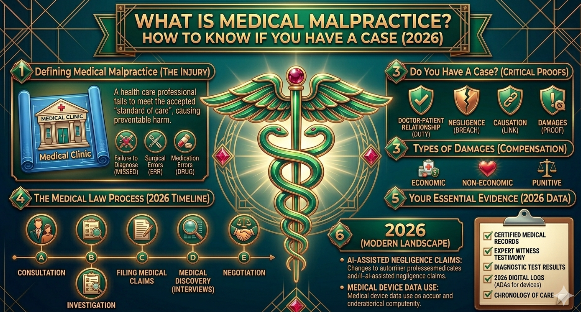
What Is Medical Malpractice? How to Know If You Have a Case (2026)
Category: Medical Malpractice Last Updated: May 9, 2026 Read Time: 28 min Attorney-Reviewed: ✓ Yes
You trusted a doctor, hospital, or medical professional with your health — and something went wrong. Now you're left with worsened injuries, new complications, mounting bills, and unanswered questions. This guide tells you exactly what medical malpractice is, whether what happened to you legally qualifies, and what you can do about it.
Table of Contents
- What Is Medical Malpractice?
- Medical Malpractice vs. Bad Outcome — A Critical Distinction
- The Most Common Types of Medical Malpractice
- The 4 Legal Elements You Must Prove
- The Standard of Care — The Heart of Every Case
- What Compensation Can You Recover?
- How Much Are Medical Malpractice Settlements Worth in 2026?
- The Medical Malpractice Claim Process — Step by Step
- The Role of Expert Witnesses
- State Damage Caps — How They Affect Your Case
- State-by-State Filing Deadlines
- How to Choose the Right Medical Malpractice Attorney
- Frequently Asked Questions
What Is Medical Malpractice? {#step1}
Medical malpractice occurs when a healthcare provider — a doctor, surgeon, nurse, hospital, or other medical professional — fails to provide the standard of care that a reasonably competent provider would have delivered under similar circumstances, and that failure directly causes injury, worsening of condition, or death.
In legal terms, medical malpractice is a form of professional negligence. It is not simply a bad result or an unexpected complication. Medicine involves inherent risk, and not every poor outcome is the result of negligence. Medical malpractice exists specifically at the intersection of two things: a deviation from accepted medical standards AND harm caused by that deviation.
Every year in the United States, medical errors affect millions of patients. Studies published in leading medical journals have estimated that medical errors are among the leading causes of death in the United States, with figures ranging from 250,000 to over 400,000 deaths annually attributed to preventable medical mistakes. Beyond fatalities, hundreds of thousands more patients suffer serious non-fatal injuries due to medical negligence each year.
Despite how common medical errors are, medical malpractice cases are among the most legally complex and challenging to pursue. They require specialized attorneys, expensive expert witnesses, and a thorough understanding of both medicine and law. This guide gives you the foundation to understand your rights and make informed decisions.
Who Can Be Held Liable for Medical Malpractice?
Medical malpractice is not limited to doctors. Any licensed healthcare provider whose negligence causes patient harm can be held liable:
- Physicians — general practitioners, specialists, surgeons
- Surgeons — general surgery, orthopedic, cardiac, neurosurgery
- Anesthesiologists — errors during anesthesia administration are among the most serious
- Nurses and nurse practitioners — medication errors, failure to monitor, failure to escalate
- Pharmacists — dispensing wrong medication or wrong dosage
- Dentists and oral surgeons
- Radiologists — misreading scans, missing tumors or fractures
- Pathologists — incorrect tissue analysis, wrong cancer diagnosis
- Mental health professionals — in certain circumstances
- Hospitals and healthcare systems — for systemic failures, inadequate staffing, negligent hiring
- Urgent care and emergency room facilities
- Nursing homes and long-term care facilities
Important: Hospitals can be held liable not only for their own institutional negligence but also for the negligence of employees acting within the scope of their employment. Even independent contractor physicians may create hospital liability under certain circumstances.
Medical Malpractice vs. Bad Outcome — A Critical Distinction {#step2}
This is the question at the heart of every medical malpractice case — and it is one that trips up many patients who believe they have been wronged.
Not every bad medical outcome is malpractice.
Medicine is an imperfect science practiced on complex, individual human beings. Complications occur in even the most skilled hands. Patients die despite flawless care. Treatments fail for reasons no one could have predicted. These outcomes, however tragic, do not constitute medical malpractice.
Medical malpractice requires proof of a specific failure: the healthcare provider did not meet the standard of care — meaning they did something a reasonably competent provider would not have done, or they failed to do something a reasonably competent provider would have done — and that specific failure caused your harm.
Examples That Illustrate the Distinction
Scenario A — Not Malpractice: A patient undergoes a complex cardiac bypass surgery. The surgeon performs the procedure correctly according to all accepted standards. The patient develops a post-operative infection — a known risk of all surgeries — despite proper wound care. The patient recovers but faces additional treatment. This is a known complication, not malpractice.
Scenario B — Malpractice: The same surgery is performed. The surgical team leaves a sponge inside the patient's chest cavity. The patient develops a severe infection requiring emergency reoperation. This is a clear departure from the standard of care — a "never event" that should never occur with proper surgical protocol.
Scenario C — Not Malpractice: A patient presents with vague abdominal pain. The doctor orders appropriate tests based on the symptoms presented, which return normal results. Three weeks later the patient is diagnosed with a rare cancer that was not detectable at the earlier visit. This is a tragic outcome but not necessarily malpractice if the doctor's workup was appropriate for the symptoms.
Scenario D — Malpractice: A patient presents with classic symptoms of appendicitis — fever, nausea, pain localized to the lower right abdomen. The doctor dismisses the patient without ordering appropriate tests. The patient's appendix ruptures 12 hours later causing life-threatening sepsis. This is a failure to meet the standard of care for the presenting symptoms.
The line between bad outcome and malpractice is not always obvious. That is exactly why medical malpractice cases require expert medical testimony — to educate the court on what the standard of care required and how the provider deviated from it.
💡 Tip: If you suspect medical malpractice, do not try to self-diagnose your legal situation. Contact a medical malpractice attorney for a free evaluation. They have medical consultants who review cases at no cost to you and can tell you quickly whether your situation meets the legal threshold.
The Most Common Types of Medical Malpractice {#step3}
Medical malpractice takes many forms. Understanding the most common types helps you recognize whether your experience may qualify.
1. Misdiagnosis and Delayed Diagnosis
Misdiagnosis is the single most common form of medical malpractice, accounting for approximately 33% of all medical malpractice claims according to research published in BMJ Quality & Safety.
Misdiagnosis occurs when a doctor incorrectly identifies your condition as something other than what it actually is. Delayed diagnosis occurs when the correct diagnosis is eventually reached, but negligent delay in reaching it allowed your condition to worsen.
Common misdiagnosis cases involve:
- Cancer — missed tumors on imaging, dismissed symptoms, delayed biopsy orders
- Heart attack — particularly in women, whose symptoms often present atypically
- Stroke — missed or delayed diagnosis leading to preventable permanent disability
- Pulmonary embolism — frequently dismissed as anxiety or musculoskeletal pain
- Appendicitis — delayed diagnosis leading to rupture and sepsis
- Meningitis — dismissed as flu or headache, leading to brain damage or death
- Ectopic pregnancy — misdiagnosed as miscarriage or gastrointestinal issue
The legal question is not simply whether the diagnosis was wrong, but whether a reasonably competent physician, given the same symptoms and information, would have arrived at the correct diagnosis. If the answer is yes and your condition worsened as a result, you may have a medical malpractice claim.
2. Surgical Errors
Surgery is inherently risky, but certain errors in the operating room represent clear departures from acceptable standards:
Wrong-site surgery: Operating on the wrong body part — the wrong knee, the wrong side of the brain, the wrong organ. These are considered "never events" — errors so egregious they should never occur with proper surgical protocols.
Wrong-patient surgery: Performing a procedure on the wrong patient entirely due to identification failures.
Retained surgical objects: Leaving surgical instruments, sponges, clamps, or other objects inside the patient's body after surgery. This is one of the most common surgical never-events and causes serious infection, pain, and additional surgery.
Unnecessary surgery: Recommending and performing surgery that was not medically indicated — exposing the patient to surgical risks without medical justification.
Anesthesia errors: Administering too much or too little anesthesia, failing to monitor the patient properly during anesthesia, or failing to account for drug interactions. Anesthesia errors can cause permanent brain damage, paralysis, or death.
Nerve damage: While some nerve damage is an accepted risk of surgery near major nerves, damage caused by improper technique may constitute malpractice.
Post-operative negligence: Failures in post-operative monitoring, failure to recognize and treat complications, premature discharge.
3. Medication Errors
Medication errors are among the most common and preventable forms of medical negligence, affecting millions of patients annually.
Types of medication errors include:
- Wrong medication: Prescribing or dispensing a drug not indicated for the patient's condition
- Wrong dosage: Prescribing too high or too low a dose, particularly dangerous with anticoagulants, chemotherapy agents, and cardiac medications
- Dangerous drug interactions: Failing to review the patient's existing medications before prescribing a new drug that interacts dangerously
- Failure to account for allergies: Prescribing or administering a medication the patient is known to be allergic to
- Wrong route of administration: Intravenous versus oral medications given incorrectly
- Pharmacy dispensing errors: Pharmacist filling a prescription with the wrong drug or wrong strength
Medication errors can occur at any point in the chain — the prescribing physician, the hospital nursing staff, or the pharmacist. In serious cases, multiple parties may share liability.
4. Birth Injuries
Birth injury malpractice cases are among the most emotionally devastating — and among the most valuable — in all of medical law. When negligence during pregnancy, labor, or delivery injures a mother or child, the consequences can last a lifetime.
Cerebral palsy caused by oxygen deprivation during delivery is one of the most common birth injury malpractice claims. When a fetal heart monitor shows signs of distress and the medical team fails to perform an emergency C-section in time, the resulting brain damage may constitute malpractice.
Common birth injury malpractice scenarios include:
- Failure to perform a timely C-section when fetal distress is present
- Improper use of forceps or vacuum extraction causing skull fractures, nerve damage, or brain injury
- Failure to diagnose and treat umbilical cord complications
- Failure to identify and treat maternal infections (Group B Strep, chorioamnionitis)
- Erb's palsy and brachial plexus injuries caused by improper delivery technique
- Failure to monitor fetal heart rate and respond appropriately
- Delayed treatment of maternal hemorrhage
- Medication errors during labor and delivery
Birth injury cases are particularly complex because they often involve lifetime damages — a child with cerebral palsy may require round-the-clock care, specialized equipment, and multiple surgeries over a 70-year lifespan. Settlements and verdicts in birth injury cases regularly reach into the millions of dollars.
5. Failure to Treat
A doctor can commit malpractice not only by doing something wrong but by failing to do something right.
Failure to treat cases arise when a healthcare provider:
- Correctly diagnoses a condition but fails to prescribe appropriate treatment
- Discharges a patient prematurely before they are medically stable
- Fails to order necessary tests despite clear clinical indications
- Fails to refer a patient to a specialist when the case exceeds their competence
- Ignores abnormal test results and fails to follow up
- Fails to provide adequate post-operative care and monitoring
Failure to treat cases frequently overlap with misdiagnosis — a doctor who misidentifies a heart attack as acid reflux and sends the patient home has both misdiagnosed and failed to treat.
6. Hospital-Acquired Infections (HAIs)
Hospitals are required to follow strict infection control protocols. When those protocols are not followed and a patient develops a serious infection — MRSA, C. difficile, surgical site infections, catheter-associated urinary tract infections — the hospital may be liable.
HAIs affect approximately 1 in 31 hospital patients on any given day according to the CDC, and many are preventable with proper hygiene and protocol adherence. When a hospital's failure to follow established infection control procedures causes a patient to develop a serious or life-threatening infection, a medical malpractice claim may exist.
7. Emergency Room Errors
Emergency rooms are high-pressure environments where mistakes can happen — but "high pressure" is not a defense to negligence. Common ER malpractice scenarios include:
- Failure to triage appropriately, leading to dangerous delays in treatment
- Misdiagnosis of stroke, heart attack, or pulmonary embolism
- Premature discharge of unstable patients
- Failure to order appropriate imaging or diagnostic tests
- Medication errors in an urgent setting
- Failure to communicate critical test results
8. Anesthesia Malpractice
Anesthesia errors deserve special mention because they are frequently catastrophic. An anesthesiologist's job is to keep the patient unconscious, pain-free, and physiologically stable throughout a surgical procedure. Errors in this high-stakes specialty can cause:
- Anesthesia awareness — the patient regains consciousness during surgery and experiences pain but cannot communicate
- Brain damage from oxygen deprivation
- Cardiac arrest
- Paralysis
- Death
Common anesthesia errors include failure to review the patient's medical history and medication list, improper dosing, failure to monitor vital signs, delayed recognition of complications, and improper intubation.
9. Radiology and Pathology Errors
Radiologists read X-rays, CT scans, MRIs, and other imaging. Pathologists analyze tissue samples and biopsies. Errors in either specialty can delay life-saving diagnosis by weeks, months, or years.
A missed tumor on a CT scan. A benign pathology report on tissue that was actually cancerous. An overlooked fracture on an X-ray. These errors set patients on the wrong treatment path — or no treatment path at all — while their condition progresses.
The 4 Legal Elements You Must Prove {#step4}
Medical malpractice cases are built on four essential legal elements. All four must be established for a successful claim.
Element 1: A Doctor-Patient Relationship Existed
You must show that a formal professional relationship existed between you and the healthcare provider — that they agreed to diagnose or treat you. This is almost always straightforward: if you were seen as a patient, the relationship existed.
Edge cases arise when a doctor provides informal advice — at a social gathering, for example — without formally examining the patient. In those situations, a formal doctor-patient relationship may not exist.
Element 2: The Provider Was Negligent
This is the core of every medical malpractice case. You must prove that the healthcare provider deviated from the accepted standard of care — that they acted in a way that a reasonably competent provider in the same specialty, with the same training, would not have acted under similar circumstances.
"Reasonably competent" is key. The law does not demand perfection. It demands the level of skill and care that a competent professional in that field would exercise. The standard is measured not against the best doctor in the world, but against a reasonable, competent practitioner.
This element is almost always established through expert medical testimony — typically a physician in the same specialty who reviews the case and offers a professional opinion that the defendant's conduct fell below the standard of care.
Element 3: The Negligence Caused Your Injury
Causation is frequently the most contested element in medical malpractice cases. You must prove not only that the provider was negligent, but that their specific negligence directly caused your specific harm.
This is more complex than it sounds. Many medical malpractice plaintiffs were already ill or injured before the negligence occurred. The defense will argue that the patient's poor outcome was caused by their underlying condition, not by the alleged negligence.
Your attorney must establish, typically through expert medical testimony, that the negligence was the proximate cause of your harm — that but for the provider's deviation from the standard of care, you would not have suffered the injury you did.
Element 4: You Suffered Damages
You must have suffered actual, measurable harm as a result of the negligence. This includes physical injury, emotional harm, additional medical costs, lost income, and other documented losses.
Without documented damages, even clear negligence may not support a viable malpractice claim. This is a practical consideration — medical malpractice cases are extraordinarily expensive to pursue, requiring tens of thousands of dollars in expert fees and litigation costs. The potential damages must justify that investment.
⚠️ Important: The high cost of pursuing medical malpractice cases means that even valid cases with clear negligence may not be economically viable if damages are minimal. An experienced malpractice attorney will evaluate not just whether negligence occurred, but whether the damages justify the investment required to pursue the case.
The Standard of Care — The Heart of Every Case {#step5}
No concept is more central to medical malpractice law than the standard of care — and no concept is more frequently misunderstood by patients.
The standard of care is defined as the level of care, skill, and treatment that, in light of all relevant surrounding circumstances, is recognized as acceptable and appropriate by reasonably prudent similar healthcare professionals.
Several important points about the standard of care:
It is specialty-specific. A general practitioner is held to the standard of a reasonably competent general practitioner — not to the standard of a specialist. However, if a general practitioner undertakes a procedure outside their competence without referring to a specialist, the failure to refer may itself be a deviation.
It is not perfection. The law does not require doctors to be perfect. It requires them to meet the standard a competent practitioner would meet. A doctor can make the best possible decision given the available information and still have a patient experience a bad outcome — that is not malpractice.
It evolves with medicine. What constituted acceptable care in 2010 may be below the standard in 2026 as medical knowledge and technology advance. Standards are evaluated based on what was accepted practice at the time of the alleged malpractice.
It may vary by location. Historically, the standard of care was local — a rural general practitioner was held to the standards of rural general practice. Modern courts increasingly apply a national standard, particularly for specialists, but some jurisdictions retain elements of the locality rule.
It is established through experts. No judge or jury has the medical training to determine whether a surgeon's technique was appropriate or whether a dosing decision was within acceptable parameters. Expert witnesses — physicians in the relevant specialty — are required to educate the court on what the standard required and how the defendant deviated from it.
What Compensation Can You Recover? {#step6}
Medical malpractice compensation covers the full scope of harm caused by the negligence — past, present, and future.
Economic Damages
Additional medical expenses All medical costs caused by the malpractice — corrective surgeries, additional hospitalizations, specialist treatment, rehabilitation, long-term care, home nursing, medical equipment, and medications. In serious cases, future medical expenses are calculated by economists and life care planners who project costs over the patient's expected lifespan.
Lost income Wages, salary, bonuses, and other income lost during recovery. For permanent injuries, future earning capacity losses are calculated based on the patient's age, education, career trajectory, and the impact of their injuries on their ability to work.
Home care and assistance If your injuries require in-home nursing care, assistance with daily activities, or home modifications, these costs are recoverable — including future costs over your lifetime.
Life care plan costs In catastrophic injury cases, a life care planner — a specialized medical expert — creates a comprehensive projection of all future care needs and associated costs over the patient's lifetime. This document becomes a cornerstone of damages in high-value cases.
Non-Economic Damages
Pain and suffering Physical pain experienced as a result of the malpractice — both past pain already endured and future pain expected to continue. This is often the largest component of a malpractice award.
Emotional distress and mental anguish The psychological impact of the malpractice — anxiety, depression, PTSD, fear of medical treatment, and the psychological burden of living with a worsened condition.
Loss of enjoyment of life If the malpractice has permanently diminished your quality of life — preventing activities you loved, limiting your independence, or altering the fundamental nature of your daily existence — you can recover for this loss.
Disfigurement Scarring, deformity, or other permanent physical changes caused by the malpractice.
Loss of consortium A spouse can recover for the loss of companionship, intimacy, and partnership resulting from their partner's malpractice-caused injuries.
Punitive Damages
In cases involving gross negligence — reckless indifference to patient safety, fraudulent concealment of errors, or intentional misconduct — punitive damages may be available. These are designed to punish the defendant and deter similar conduct.
Punitive damages in medical malpractice cases are relatively rare but can be substantial when the conduct is particularly egregious — such as operating while impaired, falsifying medical records, or performing unnecessary procedures for financial gain.
⚠️ Note on Damage Caps: Many states have enacted statutory caps that limit non-economic damages in medical malpractice cases. These caps can significantly affect the total value of your recovery. See the section on damage caps below for details.
How Much Are Medical Malpractice Settlements Worth in 2026? {#step7}
Medical malpractice cases represent some of the highest-value personal injury claims in the legal system. Here are realistic ranges based on current settlement data:
| Case Type | Typical Settlement Range |
|---|---|
| Misdiagnosis — minor injury | $100,000 – $500,000 |
| Misdiagnosis — cancer (delayed treatment) | $500,000 – $2 million+ |
| Surgical error — moderate injury | $150,000 – $600,000 |
| Surgical error — serious/permanent injury | $500,000 – $3 million+ |
| Retained surgical object | $200,000 – $1 million+ |
| Medication error — moderate injury | $100,000 – $500,000 |
| Medication error — death or severe injury | $500,000 – $3 million+ |
| Anesthesia error — brain damage/death | $1 million – $10 million+ |
| Birth injury — cerebral palsy | $1 million – $10 million+ |
| Birth injury — moderate injury | $250,000 – $2 million |
| Emergency room error — death | $500,000 – $5 million+ |
| Wrongful death — medical malpractice | $500,000 – $8 million+ |
What Drives These Numbers
Age of the victim: A 30-year-old with catastrophic injuries has 50+ years of future care costs and lost earning capacity ahead of them. The same injury in a 75-year-old patient may yield significantly lower damages.
Severity and permanence: Temporary injuries — even serious ones — are worth less than permanent disabilities that affect the patient for the rest of their life.
Clarity of negligence: Cases where the deviation from the standard of care is undeniable — a sponge left in a patient, wrong-site surgery — tend to settle for more because the defendant has little credible defense.
Jurisdiction: State damage caps, local jury composition, and the reputation of local courts all affect settlement values. Malpractice cases in New York and California generally yield higher values than cases in states with strict damage caps.
Quality of expert witnesses: The strength, credibility, and communication ability of your medical experts directly affects case value.
Defendant resources: A major hospital system or a physician with umbrella coverage through a hospital has deeper pockets than a solo practitioner with a small malpractice policy.
💡 Important: Medical malpractice verdicts make headlines — $50 million birth injury verdicts, $20 million surgical error judgments. Settlements are typically lower than verdicts, and verdict amounts are often reduced post-trial or on appeal. An experienced attorney will give you a realistic assessment of what your specific case is worth.
The Medical Malpractice Claim Process — Step by Step {#step8}
Medical malpractice cases follow a distinctive process that differs from other personal injury claims in important ways.
Step 1: Recognize the Warning Signs
The process begins with you. Warning signs that medical malpractice may have occurred include:
- Your condition worsened unexpectedly after treatment
- You were told the wrong thing was treated (wrong site, wrong patient)
- You developed a serious complication that was not disclosed as a risk
- A second opinion contradicts your original diagnosis or treatment
- You discovered a foreign object was left inside your body
- A cancer or serious disease was missed for months or years
- You experienced complications from a medication interaction your doctor should have anticipated
- A healthcare provider expressed surprise at your outcome or seemed evasive afterward
Step 2: Obtain and Preserve All Medical Records
Request complete copies of your medical records immediately — every visit note, lab result, imaging report, surgical record, nursing note, and discharge summary related to your care. Under federal law (HIPAA), you have the right to your medical records.
Do this as soon as possible. Medical records can be lost, altered, or destroyed. Having your own complete copy protects you.
Your attorney will also independently subpoena records from all relevant providers.
Step 3: Consult a Medical Malpractice Attorney
Medical malpractice is a specialized field. Not every personal injury attorney handles malpractice cases — they require medical knowledge, access to expert witnesses, and resources to fund expensive litigation. Seek an attorney who specifically handles medical malpractice.
Most medical malpractice attorneys offer free consultations. They will review your case preliminarily to determine whether it warrants further investigation.
Step 4: Medical Expert Review
Before any lawsuit is filed, your attorney will have your case reviewed by one or more qualified medical experts — typically physicians in the same specialty as the defendant. The expert reviews your medical records, identifies the deviation from the standard of care, and determines whether that deviation caused your harm.
This review is not optional — it is legally required in many states before a malpractice lawsuit can be filed. Even in states where it is not legally required, no competent attorney files a malpractice case without it.
If the expert finds that malpractice occurred, they provide a preliminary opinion that supports proceeding with the case. If the expert finds no deviation, the attorney will advise you honestly that the case does not have merit.
Step 5: Certificate of Merit / Expert Affidavit
More than 30 states require that a malpractice plaintiff file a certificate of merit or expert affidavit along with or shortly after the complaint — a sworn statement from a qualified medical expert that the case has merit. This requirement exists to deter frivolous malpractice claims.
Your attorney handles this requirement. Failure to comply can result in dismissal of your case.
Step 6: Filing the Lawsuit
Your attorney files a formal complaint in the appropriate court, naming the defendant(s) and describing the negligent acts and resulting damages. The defendants are served and have a period (typically 30–90 days) to respond.
Step 7: Discovery
Both sides exchange information, documents, and expert opinions through the discovery process:
- Document discovery: Medical records, hospital policies, training records, billing records
- Interrogatories: Written questions each party must answer under oath
- Depositions: Oral testimony under oath from all parties, witnesses, and experts — taken before trial with a court reporter present
- Expert disclosures: Both sides identify their expert witnesses and exchange expert reports
Discovery in medical malpractice cases is extensive and can take 12–18 months in complex cases.
Step 8: Mediation
Before trial, most courts require or strongly encourage the parties to attempt mediation — a structured negotiation facilitated by a neutral mediator. A significant percentage of malpractice cases settle at mediation.
Step 9: Trial
If mediation fails, the case proceeds to trial. A medical malpractice trial typically lasts 1–3 weeks. Each side presents opening statements, calls fact witnesses and expert witnesses, introduces evidence, and makes closing arguments. The jury then deliberates and returns a verdict.
Medical malpractice trials are complex. They require clear, compelling presentation of technical medical information to jurors who have no medical training. The quality of your attorney's trial skills and the credibility of your experts are paramount.
Step 10: Post-Trial
If you receive a favorable verdict, the defendant may appeal. Appeals can take 1–3 additional years. Many large verdicts are ultimately settled for less than the jury award during the appeal process.
If you lose at trial, your attorney may advise appeal if there were significant legal errors during the proceedings.
The Role of Expert Witnesses {#step9}
In no other area of personal injury law do expert witnesses play a more central role than in medical malpractice. Understanding this is essential to understanding why these cases are expensive and complex.
Why Experts Are Required
Judges and juries are not doctors. They cannot evaluate from their own knowledge whether a surgeon's technique was appropriate, whether a dosing decision was within normal parameters, or whether a radiologist should have caught a tumor on a scan. Expert witnesses bridge the gap between complex medical knowledge and legal fact-finding.
The Plaintiff's Experts
In a medical malpractice case, the plaintiff typically needs:
Standard of care expert: A physician in the same specialty as the defendant who testifies that the defendant's conduct fell below acceptable standards. This expert must be credible, well-qualified, and able to explain complex medicine in terms a jury can understand.
Causation expert: Often the same as the standard of care expert, this physician establishes that the deviation from the standard of care caused the plaintiff's specific injuries.
Damages experts: Depending on the case, these may include:
- A life care planner who projects future medical and care needs
- An economist who calculates the present value of future losses
- A vocational expert who evaluates the impact on earning capacity
- A treating physician who describes the nature and permanence of the injuries
The Defense Experts
The defendant's insurance company and attorneys will retain their own experts — typically well-compensated physicians who regularly testify for the defense — to challenge the plaintiff's experts on standard of care, causation, and damages.
The battle of experts is central to every malpractice trial. Jurors must evaluate competing expert opinions from credentialed physicians on both sides and decide which they find more convincing.
The Cost of Experts
Expert witnesses in medical malpractice cases charge substantial fees — often $500 to $1,500 per hour for review, deposition, and trial testimony. A complex malpractice case may require $50,000 to $150,000 in expert fees alone.
This is one reason why medical malpractice attorneys only accept cases where the potential damages justify the investment. It is also why contingency fee representation is so important — the attorney fronts these costs and recovers them from the settlement.
State Damage Caps — How They Affect Your Case {#step10}
One of the most significant — and controversial — aspects of medical malpractice law is the existence of statutory damage caps in many states.
Damage caps limit the amount of non-economic damages (pain and suffering, emotional distress, loss of enjoyment of life) that a plaintiff can recover in a medical malpractice case, regardless of what a jury awards.
States With Damage Caps (Key Examples)
| State | Cap Amount | Notes |
|---|---|---|
| California | $350,000 | MICRA — raised from $250,000 in 2022; adjusts for inflation annually |
| Texas | $250,000 | Against individual physicians; $500,000 total including hospitals |
| Florida | Removed | Florida Supreme Court struck down caps in 2017 |
| Colorado | $300,000 | Non-economic; total cap $1.5M raised in 2026 |
| Missouri | $400,000 | Non-catastrophic; $700,000 for catastrophic injuries |
| Indiana | $1.8 million | Total damages cap including economic |
| Virginia | $2.5 million | Increases annually; applies to total damages |
| Maryland | $890,000 | Adjusts annually for inflation |
| Michigan | $474,200 | Non-economic; adjusts annually |
| Ohio | $250,000 | Or 3× economic damages up to $350,000 |
States Without Damage Caps
New York, Pennsylvania, Illinois, Georgia, and several other states do not cap non-economic damages in medical malpractice cases — meaning juries in these states can award the full amount they believe a plaintiff deserves for pain and suffering.
How Caps Affect Your Case
In a capped state, a jury might award $2 million in non-economic damages — but the judge will reduce it to the statutory cap. This directly reduces the total settlement value of cases in those states.
Caps disproportionately affect the most severely injured patients — those with catastrophic, permanent injuries who would otherwise receive the largest pain and suffering awards. A paralyzed patient who a jury believes deserves $5 million in non-economic damages may see that award capped at $250,000 in Texas.
Caps also affect the economics of pursuing malpractice cases. When potential recovery is capped, cases that would otherwise be viable — where negligence is clear but the cap limits recovery — may not be economically feasible to pursue even with contingency representation.
State-by-State Filing Deadlines {#step11}
Medical malpractice statutes of limitations are among the most complex in all of personal injury law. They vary by state, they often have special rules for discovery and fraudulent concealment, and they frequently differ for cases involving minors.
Missing the deadline means permanently losing your right to sue — no exceptions.
| State | General Deadline | Discovery Rule | Notes |
|---|---|---|---|
| California | 3 years from injury OR 1 year from discovery | Yes | Whichever comes first |
| Texas | 2 years | Limited | From date of negligence or reasonable discovery |
| Florida | 2 years | Yes | From discovery; 4-year outer limit |
| New York | 2.5 years | Limited | From act of malpractice |
| Illinois | 2 years | Yes | 4-year outer limit |
| Pennsylvania | 2 years | Yes | From discovery |
| Georgia | 2 years | Yes | 5-year outer limit |
| Ohio | 1 year | Yes | From discovery; 4-year outer limit |
| Michigan | 2 years | Yes | 6-year outer limit |
| North Carolina | 3 years | Yes | 4-year outer limit |
| Washington | 3 years | Yes | From discovery |
| Colorado | 2 years | Yes | 3-year outer limit |
| New Jersey | 2 years | Yes | From discovery |
| Virginia | 2 years | Limited | From date of act |
The Discovery Rule
Many states apply the discovery rule to medical malpractice — the statute of limitations does not begin running until the patient discovered, or reasonably should have discovered, that they were harmed by negligence.
This rule exists because patients often do not immediately know that their adverse outcome was caused by negligence. A missed cancer diagnosis, for example, may not be discovered until another physician reviews the original images years later.
Fraudulent Concealment
If a healthcare provider actively concealed the malpractice — falsifying records, lying to the patient, hiding the error — most states toll (pause) the statute of limitations until the concealment is discovered.
Minors
In most states, the statute of limitations for minors is either tolled entirely until the minor reaches age 18, or a separate, extended deadline applies. Birth injury cases may have particularly long statutes of limitations because the injury may not be fully apparent for years.
⚠️ Critical Warning: Do not try to calculate your deadline yourself. Medical malpractice statutes of limitations are complex and state-specific. Contact an attorney immediately. Even if you think your deadline has passed, an attorney may identify tolling provisions that extend your time to file.
How to Choose the Right Medical Malpractice Attorney {#step12}
Medical malpractice is one of the most specialized areas of personal injury law. Choosing the right attorney is one of the most important decisions you will make.
Why Specialization Matters
Not every personal injury attorney handles medical malpractice. These cases require:
- Deep knowledge of medical standards and terminology
- Established relationships with credible expert witnesses
- Resources to fund expensive litigation — often $50,000–$200,000 in case costs
- Experience taking complex cases to trial
- Understanding of state-specific procedural requirements (certificates of merit, expert affidavits)
An attorney who primarily handles car accident cases and occasionally takes a malpractice case is not the same as an attorney who focuses primarily on medical malpractice.
What to Look For
Proven medical malpractice track record Ask specifically about medical malpractice cases — how many they have handled, what results they achieved, and whether those cases went to trial or settled.
Trial experience Insurance companies know which attorneys will actually go to trial. An attorney with a genuine trial record commands higher settlements because the threat of trial is credible.
Medical knowledge and expert network A good malpractice attorney can speak intelligently about medicine — they have developed working knowledge of the relevant standards through handling many similar cases. They should also have an established network of credible expert witnesses.
Resources Medical malpractice cases require substantial upfront investment. Ask directly whether the firm has the resources to fund your case through trial if necessary.
Contingency fee with clear terms Standard contingency fees range from 33% to 40%, with litigation costs either deducted from the recovery or billed separately. Make sure the fee agreement is clear and in writing before signing.
Communication and accessibility Medical malpractice cases take years. You need an attorney who communicates regularly, returns calls, and keeps you informed. Ask who will be your primary point of contact throughout the case.
Questions to Ask at Your Free Consultation
- How many medical malpractice cases have you handled in the last three years?
- Have you handled cases involving [my specific type of malpractice]?
- What results have you achieved in similar cases?
- Who will be handling my case day-to-day?
- Do you have the resources to take my case to trial if necessary?
- How do you evaluate whether a case has merit?
- What is your honest assessment of my case?
- What is your fee structure, including how litigation costs are handled?
Red Flags to Avoid
- Attorneys who guarantee outcomes — no ethical attorney promises a specific result
- Attorneys who immediately quote you a settlement value without reviewing your records
- Attorneys who pressure you to sign immediately
- General practice attorneys with no specific malpractice experience
- Attorneys who cannot name any medical malpractice cases they have tried
📌 Related: Find a Personal Injury Attorney Near You — Free Consultation
Frequently Asked Questions {#faq}
How do I know if I have a medical malpractice case? The clearest indicator is getting a second medical opinion that contradicts your original treatment — or discovering that your condition was misdiagnosed, improperly treated, or worsened by a procedure. However, the only reliable way to know whether you have a viable legal case is to consult a medical malpractice attorney who will have your records reviewed by a medical expert. This review is free.
How long does a medical malpractice case take? Medical malpractice cases are among the most time-consuming in personal injury law. Cases that settle without litigation may resolve in 12–18 months. Cases that proceed through discovery and mediation typically take 2–4 years. Cases that go to trial can take 4–6 years or more from the date of malpractice to final resolution.
Can I sue a hospital as well as the doctor? Yes, in many cases. Hospitals can be directly liable for their own institutional negligence — inadequate staffing, failure to maintain equipment, negligent hiring and credentialing. They can also be vicariously liable for the negligence of employees acting within the scope of their employment. Whether a physician is an employee or independent contractor affects the hospital's liability, and this analysis varies by state and circumstance.
What if the doctor who harmed me has since retired or died? You can still pursue a claim against the physician's estate or, more practically, against their medical malpractice insurance policy — which typically remains in effect for acts committed during the coverage period even after the physician retires, surrenders their license, or dies.
What if I signed a consent form before the procedure? Informed consent forms acknowledge that you were informed of and accept the known risks of a procedure. They do not release healthcare providers from liability for negligence. A surgeon can still be liable for malpractice even if you signed a consent form listing complications as known risks — if the complication resulted not from inherent surgical risk but from a deviation from the standard of care.
What if the doctor admitted the mistake? A physician's acknowledgment that something went wrong is significant but does not automatically establish legal malpractice. Many doctors apologize out of compassion or communicate about complications without admitting legal liability. What matters legally is whether the outcome resulted from a deviation from the standard of care. That said, admissions can be valuable evidence and should be documented immediately — write down exactly what was said, by whom, and when.
Can I sue for emotional distress if I wasn't physically injured? In most states, medical malpractice requires a physical injury. Pure emotional distress claims without accompanying physical harm are generally not actionable. However, if physical harm is present, emotional distress damages are recoverable as part of the overall case.
What if multiple doctors were negligent? You can name multiple defendants in a single lawsuit. In many malpractice cases — particularly hospital cases — multiple providers share responsibility. Joint and several liability rules (which vary by state) affect how damages are apportioned among defendants.
Is there a minimum amount my damages must reach to pursue a case? There is no legal minimum, but there is a practical one. Medical malpractice cases cost $50,000–$200,000 to litigate. Attorneys working on contingency will only accept cases where the potential recovery justifies the investment. As a general rule, attorneys typically require that damages be at least $100,000–$250,000 to make a malpractice case economically viable. Cases with lower damages, even when negligence is clear, may not be pursued.
What do I do with my medical records? Request complete copies of all records from all providers involved in the care at issue. Keep them organized and do not alter them in any way. Provide originals or certified copies to your attorney — never provide your only copies. Store digital backups securely.
The Bottom Line
Medical malpractice is not a complaint about a doctor who gave you bad news or a treatment that didn't work. It is a serious legal claim — one that requires proving a specific deviation from accepted medical standards that directly caused you measurable harm.
If you believe you or a loved one was harmed by medical negligence:
- Get your medical records immediately — while they are complete and unaltered
- See another doctor — document the extent of your harm and get a second opinion on your treatment
- Write down everything — what happened, what was said, by whom, and when
- Do not sign anything from any healthcare provider or insurance company
- Contact a medical malpractice attorney immediately — the statute of limitations is running from the moment the malpractice occurred
The consultation is free. The attorney fronts all costs. You pay nothing unless they win.
What was taken from you — your health, your time, your quality of life, your future — deserves to be fought for.
This article is attorney-reviewed and updated regularly to reflect current state laws. It is intended for general informational purposes and does not constitute legal advice. Laws vary by state. Consult a licensed attorney in your jurisdiction for advice specific to your situation.
Last Updated: May 9, 2026 | Reviewed by: LawAccidents.com Legal Team
→ Find a Medical Malpractice Attorney Near You — Free Consultation → Browse All Medical Malpractice Guides → What Is a Personal Injury Claim? Complete Guide 2026 → Wrongful Death Car Accident Lawsuit: What Families Need to Know
Comments (0)