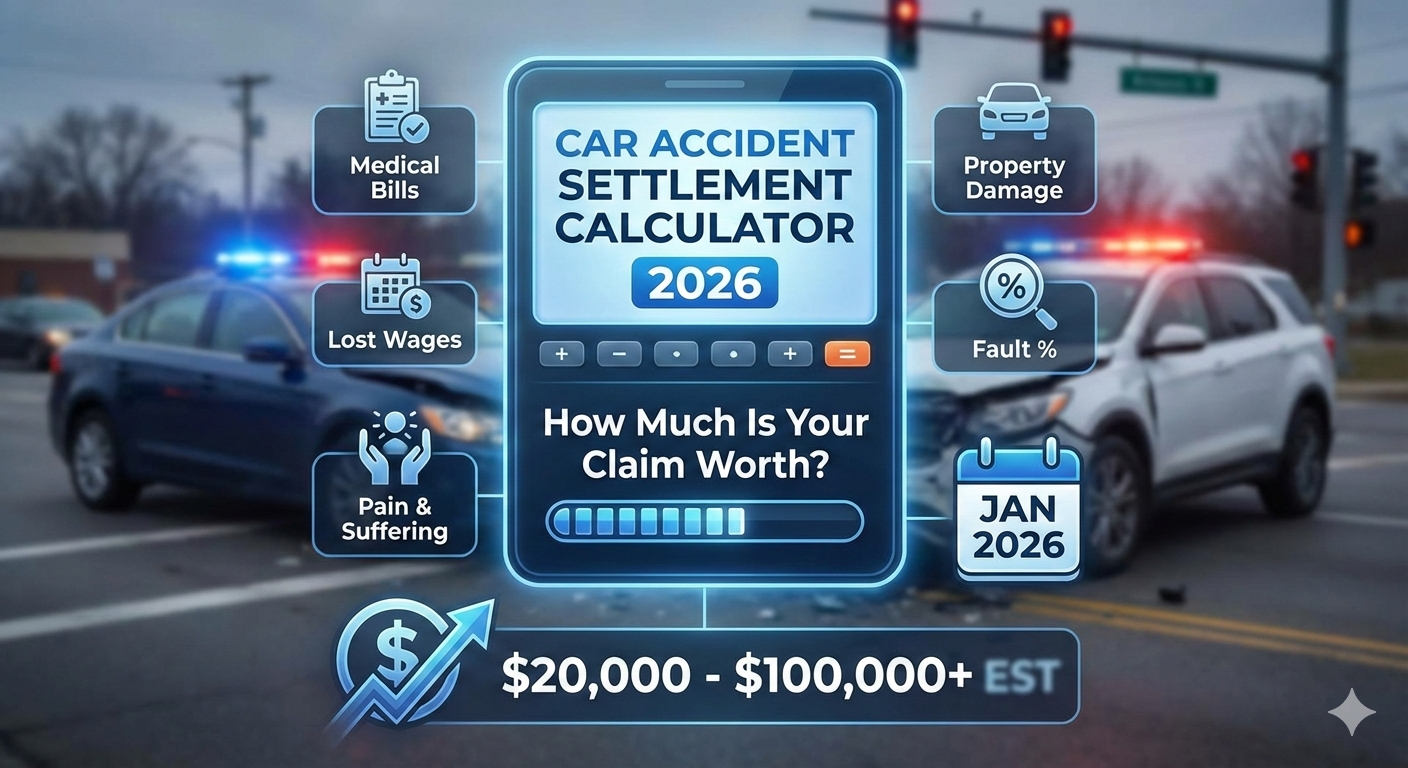
# Car Accident Settlement Calculator 2026: How Much Is Your Claim Actually Worth?
**Last Updated: January 18, 2026**
If you've been injured in a car accident, your first question is probably: "How much compensation can I expect?" Understanding your car accident settlement value is crucial before negotiating with insurance companies. The average car accident injury settlement in the United States is $30,416, but your case could be worth significantly more or less depending on multiple factors.
In this comprehensive guide, we'll break down everything you need to know about car accident settlements in 2026, including real settlement amounts, calculation methods, and proven strategies to maximize your compensation.
## Understanding Car Accident Settlement Amounts in 2026
Car accident settlements vary dramatically based on injury severity, medical expenses, lost wages, and fault determination. For non-injury car accidents, settlements typically range from $500 to $25,000, while injury cases can reach hundreds of thousands or even millions of dollars.
### Average Settlement Ranges by Injury Type
Recent data from January 2026 reveals the following settlement ranges for common car accident injuries:
**Minor Injuries (Soft Tissue Damage, Whiplash)**
The average settlement for soft tissue injuries in car accidents is $17,500, with typical ranges between $2,500 and $50,000. These injuries include:
- Whiplash and neck strain
- Muscle sprains and strains
- Minor back injuries
- Bruising and contusions
Settlements in this category typically cover emergency room visits, physical therapy, chiropractic care, and a few weeks of lost wages. The key to maximizing these settlements is thorough documentation of all medical treatments and their impact on your daily life.
**Moderate Injuries (Broken Bones, Lacerations)**
For minor injuries like sprains, whiplash, or minor soft tissue damage, settlements might range from $5,000 to $25,000. More serious moderate injuries including:
- Fractured or broken bones
- Severe lacerations requiring stitches
- Herniated or bulging discs
- Concussions
These cases often settle between $25,000 and $75,000, depending on whether surgery is required and the length of recovery time. Cases involving surgical intervention typically command higher settlements because they demonstrate the severity and permanence of injuries.
**Severe and Catastrophic Injuries**
Settlement values may reach hundreds of thousands or millions of dollars, depending on future medical needs, life expectancy, and available insurance coverage. These life-altering injuries include:
- Traumatic brain injuries (TBI)
- Spinal cord injuries and paralysis
- Loss of limbs (amputation)
- Severe burn injuries
- Multiple fractures requiring extensive surgery
- Permanent disability or disfigurement
High-value settlements in this category account for lifetime medical care, home modifications, lost earning capacity, and the profound impact on quality of life.
## Key Factors That Determine Your Car Accident Settlement Value
### 1. Medical Expenses: Past, Present, and Future
Your medical bills form the foundation of your settlement calculation. Insurance companies scrutinize every medical expense, which is why documentation is critical.
**Current Medical Costs Include:**
- Emergency room treatment
- Ambulance transportation
- Hospital stays and surgery
- Doctor visits and specialists
- Physical therapy and rehabilitation
- Prescription medications
- Medical equipment (wheelchairs, braces, crutches)
- Diagnostic tests (X-rays, MRIs, CT scans)
**Future Medical Expenses:**
For serious injuries, your settlement must account for ongoing medical needs. This requires expert medical testimony to establish:
- Expected duration of treatment
- Probability of additional surgeries
- Long-term rehabilitation requirements
- Home healthcare needs
- Medical equipment and assistive devices
- Medication costs over your lifetime
### 2. Lost Wages and Diminished Earning Capacity
Beyond medical expenses, car accidents often result in significant financial losses from missed work.
**Immediate Lost Income:**
- Days missed during initial recovery
- Time off for medical appointments
- Reduced hours during rehabilitation
**Long-Term Earning Impact:**
For permanent injuries, settlements must compensate for:
- Inability to return to previous occupation
- Need to accept lower-paying work
- Lost promotion opportunities
- Reduced retirement contributions
- Loss of employment benefits
Economic experts often provide testimony to calculate lifetime earning losses, especially in cases involving young victims or high-income professionals.
### 3. Pain and Suffering Compensation
Non-economic damages compensate for the intangible losses that don't have a specific dollar amount attached.
**Physical Pain and Suffering:**
- Severity and duration of pain
- Chronic pain conditions
- Physical limitations and disability
- Loss of enjoyment of life activities
- Scarring and disfigurement
**Emotional and Psychological Impact:**
- Anxiety and depression
- Post-traumatic stress disorder (PTSD)
- Sleep disturbances
- Fear of driving or being in vehicles
- Strain on personal relationships
Settlement amounts combine economic losses (medical bills, lost wages, property damage) and non-economic damages (pain, suffering, emotional distress).
### 4. Liability and Fault Determination
Who caused the accident dramatically impacts settlement value. In Colorado, your percentage of fault impacts your settlement under the state's modified comparative negligence law. Many states follow similar rules.
**Comparative Negligence Systems:**
- **Pure Comparative Negligence:** Your settlement is reduced by your percentage of fault, even if you're 99% responsible
- **Modified Comparative Negligence:** You can only recover if you're less than 50% or 51% at fault (varies by state)
- **Contributory Negligence:** If you're even 1% at fault, you may be barred from recovery (only in a few states)
**Strong Liability Evidence Includes:**
- Police accident reports
- Eyewitness statements
- Traffic camera footage
- Dash cam recordings
- Cell phone records (proving distracted driving)
- Toxicology reports (DUI cases)
- Vehicle damage analysis
- Accident reconstruction expert testimony
### 5. Insurance Policy Limits
Even with severe injuries, your settlement is often capped by available insurance coverage. The only potential limiting factor is the amount of insurance coverage available to pay for these claims.
**Typical Coverage Limits:**
- Minimum state requirements (often $25,000/$50,000)
- Standard policies ($100,000/$300,000)
- High-limit policies ($250,000/$500,000 or more)
- Commercial truck insurance ($1 million+)
When insurance is insufficient, additional compensation sources may include:
- Your own underinsured motorist (UIM) coverage
- At-fault driver's personal assets
- Multiple liable parties
- Business insurance (for company vehicles)
### 6. Quality of Legal Representation
People who hire a lawyer recover settlements that are, on average, 3.5 times higher than those who go through the process alone. Experienced car accident attorneys provide:
**Negotiation Expertise:**
Insurance adjusters are trained to minimize payouts. Skilled attorneys counter lowball offers by presenting compelling evidence of your losses and leveraging their knowledge of fair settlement values.
**Case Investigation:**
Top attorneys conduct thorough investigations including:
- Hiring accident reconstruction experts
- Securing expert medical testimony
- Obtaining all available video evidence
- Interviewing witnesses
- Analyzing police reports for errors
**Trial Preparation:**
When insurance companies refuse fair settlements, having an attorney ready to take your case to trial creates powerful negotiating leverage.
## How Insurance Companies Calculate Settlement Offers
Understanding the insurance company's perspective helps you negotiate effectively. Many people believe that insurers use some type of standard equation or algorithm to value a car accident claim, but modern approaches are more nuanced.
### The Claims Adjuster's Evaluation Process
**Step 1: Special Damages Calculation**
Adjusters begin by totaling your economic losses:
- All medical expenses
- Lost wage documentation
- Property damage
- Out-of-pocket expenses
**Step 2: General Damages Assessment**
For pain and suffering, adjusters consider:
- Injury severity and permanence
- Treatment duration and intensity
- Impact on daily activities
- Age and occupation of the victim
- Prior medical conditions
**Step 3: Liability Analysis**
The adjuster evaluates:
- Police reports and citations issued
- Witness statements
- Physical evidence
- State traffic laws
- Your comparative fault, if any
**Step 4: Policy Limit Review**
Even with strong evidence, initial offers rarely approach policy limits. Insurers hope to settle for a fraction of available coverage.
### Why Initial Offers Are Always Low
Insurance companies typically begin with lowball offers designed to minimize payouts. Common tactics include:
**Minimizing Injury Severity:**
Adjusters may claim your injuries are:
- Pre-existing conditions
- Not related to the accident
- Exaggerated or fabricated
- Less serious than your doctors state
**Disputing Medical Necessity:**
Insurance companies often challenge:
- Whether certain treatments were necessary
- The frequency of therapy sessions
- The need for specific diagnostic tests
- Future medical care projections
**Attacking Liability:**
Even when their insured is clearly at fault, adjusters may:
- Claim you contributed to the accident
- Argue you could have avoided the collision
- Dispute the extent of property damage
- Question witness credibility
## Step-by-Step: Calculating Your Car Accident Settlement Value
### Method 1: Medical Expenses Multiplier
This traditional approach multiplies your total medical expenses by a factor based on injury severity:
**Minor injuries:** Medical expenses × 1.5 to 3
**Moderate injuries:** Medical expenses × 3 to 5
**Severe injuries:** Medical expenses × 5 to 10+
**Example Calculation:**
- Total medical bills: $45,000
- Injury severity: Moderate (herniated disc requiring surgery)
- Multiplier: 4
- Pain and suffering: $45,000 × 4 = $180,000
- Lost wages: $12,000
- **Total settlement value: $237,000**
**Important:** This method provides only a rough estimate. Modern insurance companies use more sophisticated analysis.
### Method 2: Per Diem Approach
This method assigns a daily dollar amount to your pain and suffering, then multiplies by the number of days you experienced pain.
**Calculation:**
- Daily rate (often your daily earnings): $250
- Days in pain: 180 days
- Pain and suffering: $250 × 180 = $45,000
- Add medical expenses: $30,000
- Add lost wages: $8,000
- **Total settlement value: $83,000**
### Method 3: Computer Software Analysis
Major insurance companies now use proprietary software like Colossus that evaluates thousands of data points including:
- Injury codes from medical records
- Treatment duration and frequency
- Diagnostic findings
- Medication prescribed
- Previous similar claims in your area
- Your age, occupation, and activities
- Gaps in medical treatment
This technology-driven approach means thorough, consistent medical documentation is more critical than ever.
## Real Car Accident Settlement Examples from 2026
### Case Study 1: Rear-End Collision with Whiplash
**Accident Details:**
- 35-year-old teacher rear-ended at red light
- Other driver admitted fault
- Whiplash and soft tissue neck injury
**Medical Treatment:**
- Emergency room visit: $2,800
- Chiropractic care (12 weeks): $4,200
- Physical therapy (8 weeks): $3,600
- Total medical: $10,600
**Lost Income:**
- 2 weeks missed work: $2,400
**Settlement Outcome:**
- Initial offer: $8,500
- Attorney demanded: $35,000
- Final settlement: $28,500
- Settlement breakdown: Medical ($10,600) + Lost wages ($2,400) + Pain/suffering ($15,500)
### Case Study 2: Intersection T-Bone Collision
**Accident Details:**
- 52-year-old construction worker
- Other driver ran red light
- Fractured ribs, broken arm, concussion
**Medical Treatment:**
- Ambulance and ER: $8,500
- Hospital stay (3 days): $22,000
- Orthopedic surgery: $35,000
- Physical therapy: $6,500
- Follow-up care: $4,000
- Total medical: $76,000
**Lost Income:**
- 4 months missed work: $24,000
- Reduced capacity upon return: $8,000
- Total lost wages: $32,000
**Settlement Outcome:**
- Initial offer: $95,000
- Attorney demanded: $285,000
- Final settlement: $215,000
- Settlement included future medical needs and permanent physical limitations
### Case Study 3: Head-On Collision with Catastrophic Injuries
**Accident Details:**
- 28-year-old graphic designer
- Drunk driver crossed center line
- Traumatic brain injury, facial fractures, PTSD
**Medical Treatment:**
- Life flight and trauma surgery: $85,000
- ICU stay (10 days): $120,000
- Reconstructive facial surgery: $55,000
- Rehabilitation (6 months): $90,000
- Ongoing therapy and treatment: $45,000
- Total current medical: $395,000
- Projected lifetime medical: $1.2 million
**Lost Income:**
- Cannot return to previous work
- Lost earning capacity (age 28-65): $1.8 million
**Settlement Outcome:**
- Policy limits: $250,000
- Underinsured motorist claim: $500,000
- Drunk driver's assets: $180,000
- Final total recovery: $930,000
- Case also pursued punitive damages
## Timeline: How Long Does It Take to Settle a Car Accident Claim?
Car accident claims typically resolve within 3-6 months of filing, though the timeline varies significantly based on case complexity.
### Factors Affecting Settlement Timeline
**Quick Settlements (1-3 Months):**
- Clear liability (rear-end collision)
- Minor injuries with complete recovery
- Minimal property damage
- Cooperative insurance company
- No disputed issues
**Average Timeline (3-6 Months):**
- Moderate injuries requiring surgery
- Some liability disputes
- Multiple medical providers
- Need for expert opinions
- Standard negotiation back-and-forth
**Extended Timeline (6-24+ Months):**
- Catastrophic or permanent injuries
- Disputed fault/comparative negligence
- Multiple liable parties
- Insurance company bad faith
- Insufficient insurance coverage
- Case goes to litigation
**Important:** Never settle until reaching "maximum medical improvement" (MMI) - the point where your condition has stabilized and doctors can accurately predict future medical needs.
## Common Mistakes That Reduce Your Settlement Value
### 1. Accepting the First Offer
Insurance adjusters are quick to make settlement offers that promise a speedy resolution, but these initial offers typically represent 20-40% of your claim's true value.
**Why It Happens:**
- Financial pressure from medical bills
- Fear the offer will be withdrawn
- Lack of understanding of claim value
- Insurance adjuster pressure tactics
**The Solution:**
Consult with an experienced car accident attorney before accepting any settlement offer. Most offer free consultations to review offers.
### 2. Giving Recorded Statements Too Early
Insurance adjusters often request recorded statements within hours or days of your accident, before you know the extent of your injuries.
**The Risks:**
- Statements used to minimize injury severity
- Inadvertent admissions of partial fault
- Inconsistencies used against you later
- Locked into early assessments before full diagnosis
**Better Approach:**
Provide only basic information initially. Consult an attorney before giving detailed recorded statements.
### 3. Gaps in Medical Treatment
Delays or gaps in treatment signal to insurance companies that your injuries aren't serious.
**Problematic Gaps:**
- Waiting days/weeks to see a doctor after the accident
- Missing scheduled appointments
- Not following prescribed treatment
- Stopping therapy prematurely
**How to Avoid:**
- Seek immediate medical attention
- Follow all doctor recommendations
- Keep all scheduled appointments
- Document reasons for any missed appointments (work conflicts, transportation issues)
### 4. Posting on Social Media
Insurance companies routinely monitor claimants' social media accounts looking for evidence to dispute injury claims.
**Dangerous Posts:**
- Photos of physical activities
- Check-ins at gyms, sporting events
- Comments about feeling fine
- Vacation photos
- Any activity contradicting claimed limitations
**Best Practice:**
Avoid all social media posting about your accident, injuries, activities, or emotional state until your case is resolved.
### 5. Not Documenting Everything
Insufficient documentation dramatically reduces settlement value.
**Essential Documentation:**
- All medical records and bills
- Prescription receipts
- Photos of injuries (immediately and throughout healing)
- Accident scene photos
- Property damage documentation
- Lost wage verification from employer
- Journal of pain levels and daily limitations
- Impact on family and relationships
### 6. Settling Before Understanding Full Injury Impact
Some injuries don't manifest immediately or worsen over time.
**Delayed Injuries:**
- Whiplash symptoms may appear days later
- Traumatic brain injuries can have delayed onset
- Psychological trauma (PTSD, anxiety) develops gradually
- Chronic pain conditions emerge months later
**The Problem:**
Once you sign a settlement release, you cannot reopen your claim if injuries worsen or new problems develop.
**The Solution:**
Wait until your treating physicians confirm you've reached maximum medical improvement (MMI) before settling.
## Maximizing Your Car Accident Settlement: Proven Strategies
### 1. Hire an Experienced Car Accident Attorney
A single lead (CPL) can cost $300-$1,000, with client acquisition (CPA) often running into thousands ($2,500-$3,000). Insurance companies know this and factor it into their settlement offers.
**What Attorneys Provide:**
- Accurate claim valuation
- Professional evidence gathering
- Expert witness coordination
- Aggressive negotiation
- Trial readiness if needed
- Protection from insurance tactics
**Contingency Fee Structure:**
Most car accident attorneys work on contingency (typically 33-40%), meaning:
- No upfront costs
- No fees unless you win
- Attorney motivated to maximize settlement
- You keep 60-67% of recovery
**When to Hire an Attorney:**
- Injuries requiring hospitalization or surgery
- Permanent disability or scarring
- Disputed liability
- Multiple parties involved
- Commercial vehicles (trucks, buses)
- Insufficient insurance coverage
- Insurance company denies claim or offers inadequate settlement
### 2. Build a Comprehensive Medical Record
Strong medical documentation is your most powerful evidence.
**Key Elements:**
- Immediate post-accident medical evaluation
- Consistent treatment with specialists
- Following all prescribed treatment plans
- Diagnostic imaging (X-rays, MRIs, CT scans)
- Written doctor opinions on:
- Causation (injury caused by accident)
- Prognosis and expected recovery
- Permanent limitations or disability
- Future medical needs
### 3. Gather Strong Accident Evidence
The clearer the other driver's fault, the stronger your negotiating position.
**Critical Evidence:**
- Police report
- Accident scene photos from multiple angles
- Vehicle damage photos
- Skid marks, debris field
- Traffic signal timing/camera footage
- Dashcam or surveillance video
- Witness contact information and statements
- Weather and road conditions
### 4. Calculate the True Cost of Your Claim
Many victims underestimate their losses.
**Don't Forget:**
- Future medical expenses
- Long-term care needs
- Home modifications (wheelchair ramps, bathroom adaptations)
- Vehicle modifications
- Reduced life expectancy impacts
- Loss of consortium (spouse's claim)
- Impact on career advancement
- Education and retraining costs
- Pain and suffering for extended recovery
### 5. Demonstrate the Impact on Your Life
Insurance companies respond to compelling human stories backed by evidence.
**Effective Documentation:**
- Daily pain journal
- Photos throughout recovery process
- Testimony from family and friends
- Employer statements about performance changes
- Activities you can no longer enjoy
- Impact on hobbies, sports, social life
- Psychological treatment records
### 6. Be Patient and Don't Rush
Simple cases with minor injuries: 3–6 months. Moderate cases: 6–12 months. Complex or severe cases: 1–3+ years.
**Why Patience Pays:**
- Gives time to fully understand injury extent
- Allows for complete medical treatment
- Reveals any complications or delayed symptoms
- Strengthens your negotiating position
- Prevents leaving money on the table
## When to Take Your Case to Court
If you and the other party cannot reach an agreement, the case will go to trial and be heard by a judge and/or jury.
### Signs You Should Litigate
**Strong Litigation Indicators:**
- Insurance company refuses reasonable settlement
- Severe permanent injuries warrant higher compensation
- Clear evidence of egregious negligence
- Punitive damages available (drunk driving, intentional misconduct)
- Settlement offer doesn't cover medical expenses
- Bad faith insurance practices
### Litigation Pros and Cons
**Advantages:**
- Potential for significantly higher award
- Jury sympathy for injured victims
- Discovery process forces evidence disclosure
- Punitive damages possibility
- Sets precedent for similar cases
**Disadvantages:**
- Longer timeline (1-3+ years)
- No guaranteed outcome
- Trial stress and uncertainty
- Public court proceedings
- Appeal possibilities
- Higher attorney fees if you lose
**The Statistics:**
Approximately 95% of personal injury cases settle before trial. Insurance companies often increase settlement offers significantly as trial dates approach.
## Special Situations That Affect Settlement Value
### Uninsured/Underinsured Motorist Claims
When the at-fault driver has insufficient or no insurance:
**Your Options:**
1. **Uninsured Motorist (UM) Coverage:** When at-fault driver has no insurance
2. **Underinsured Motorist (UIM) Coverage:** When at-fault driver's limits are insufficient
3. **Personal Assets:** Sue the at-fault driver personally (often ineffective)
4. **Multiple Liable Parties:** Identify other responsible parties
**Important:** Review your own auto policy to understand UM/UIM coverage limits.
### Commercial Vehicle Accidents
Accidents with commercial trucks, buses, or delivery vehicles typically involve:
**Higher Settlement Potential:**
- Commercial policies often have $1 million+ limits
- Federal regulations create additional liability grounds
- Multiple liable parties (driver, trucking company, cargo owner, maintenance company)
- Stricter safety standards
- Electronic logging device (ELD) data
- Corporate assets available
**Unique Considerations:**
- Federal Motor Carrier Safety Regulations apply
- Company safety records discoverable
- Driver qualification and training issues
- Hours of service violations
- Maintenance records
### Hit-and-Run Accidents
When the at-fault driver flees:
**Compensation Sources:**
- Your uninsured motorist coverage
- Crime victim compensation programs
- Law enforcement may locate driver later
- Witnesses or camera footage identifying vehicle
**Critical Steps:**
- Report immediately to police
- Gather witness information
- Search for security camera footage
- Document everything thoroughly
### Drunk Driving Accidents
Impaired driver cases often allow:
**Enhanced Damages:**
- Punitive damages in addition to compensatory damages
- Higher settlement values due to gross negligence
- Criminal restitution orders
- Dram shop liability (alcohol vendor)
- Social host liability
**Evidence to Gather:**
- Police reports with BAC results
- Toxicology reports
- Criminal case records
- Witness statements about impairment
- Bar or restaurant receipts
## State-Specific Settlement Considerations
Settlement values and processes vary significantly by state.
### No-Fault Insurance States
States requiring personal injury protection (PIP) coverage:
- Florida, Hawaii, Kansas, Kentucky, Massachusetts, Michigan, Minnesota, New Jersey, New York, North Dakota, Pennsylvania, Utah
**How It Works:**
- Your own insurance pays medical bills regardless of fault
- Limits ability to sue for pain and suffering
- Typically requires "serious injury threshold" to sue
### Tort States
Most states allow you to pursue claims against at-fault drivers:
**Pure Comparative Negligence (13 states):**
You can recover even if 99% at fault, reduced by your percentage
**Modified Comparative Negligence (33 states):**
You can recover only if less than 50% or 51% at fault (varies by state)
**Contributory Negligence (4 states + DC):**
If you're even 1% at fault, you may be barred from recovery
### Statute of Limitations by State
Typical deadlines to file lawsuits:
- 1 year: Kentucky, Louisiana, Tennessee
- 2 years: Most states (majority)
- 3 years: Some states
- 4+ years: Rare
**Critical:** Missing the deadline means losing all rights to compensation, regardless of injury severity.
## FAQ: Car Accident Settlements
**Q: How long do I have to settle my car accident claim?**
You can settle anytime before the statute of limitations expires (typically 2-4 years), but should wait until reaching maximum medical improvement.
**Q: Can I negotiate the settlement amount myself?**
Yes, but studies show people who hire lawyers recover 3.5 times more than those who negotiate alone.
**Q: What if my medical bills exceed the settlement?**
Your attorney can often negotiate medical bill reductions (sometimes 30-60% discounts) to maximize your net recovery.
**Q: Will I pay taxes on my settlement?**
Personal injury settlements for physical injuries are generally tax-free under federal law. Punitive damages and lost wage portions may be taxable.
**Q: What if the other driver has minimum insurance?**
Use your underinsured motorist coverage or pursue the driver's personal assets, though recovery may be limited.
**Q: Should I sign a medical authorization from the insurance company?**
Never sign broad medical authorizations. They'll search for pre-existing conditions to devalue your claim. Provide only relevant, accident-related records.
**Q: Can I settle for medical bills only and keep my car claim separate?**
Yes, property damage and personal injury claims are typically separate and can be settled independently.
**Q: What happens if I'm partially at fault?**
Your compensation is reduced by your percentage of fault in most states, or barred completely in contributory negligence states.
## Conclusion: Protecting Your Rights After a Car Accident
Understanding car accident settlement values empowers you to negotiate from a position of strength. Whether your case involves minor whiplash injuries or catastrophic, life-altering harm, knowing the key factors that drive settlement values helps ensure you receive fair compensation.
**Key Takeaways:**
1. **Never Accept the First Offer:** Initial settlements are designed to minimize insurance company payouts
2. **Document Everything:** Thorough evidence is your strongest negotiating tool
3. **Seek Medical Treatment Immediately:** Delays suggest injuries aren't serious
4. **Understand Your Claim's Value:** Use multiple calculation methods
5. **Consider Hiring an Attorney:** Especially for serious injuries, disputed fault, or inadequate offers
6. **Be Patient:** Rushing to settle often leaves significant money on the table
7. **Know Your State's Laws:** Comparative negligence and statutes of limitations vary
The settlement process can feel overwhelming, especially while recovering from injuries. However, understanding how settlements are calculated, what factors increase value, and common insurance company tactics puts you in the best position to secure the compensation you deserve.
If you've been injured in a car accident, consult with an experienced personal injury attorney who can evaluate your case, explain your options, and fight for maximum compensation. Most offer free initial consultations, so you risk nothing by getting professional advice about your claim's true value.
Remember: Insurance companies have teams of adjusters, lawyers, and investigators working to minimize your settlement. You deserve to have an experienced advocate working just as hard to protect your interests and maximize your recovery.
---
**Disclaimer:** This article provides general legal information only and does not constitute legal advice. Settlement amounts vary based on unique case circumstances. Consult with a licensed attorney in your state for advice specific to your situation. Past results do not guarantee similar outcomes in future cases.
Legal Disclaimer
This article provides general legal information only and does not constitute legal advice. Every accident case is unique and outcomes may vary. For specific legal guidance regarding your personal injury or accident claim, please consult with a qualified attorney licensed in your jurisdiction. Use of this website does not create an attorney-client relationship.