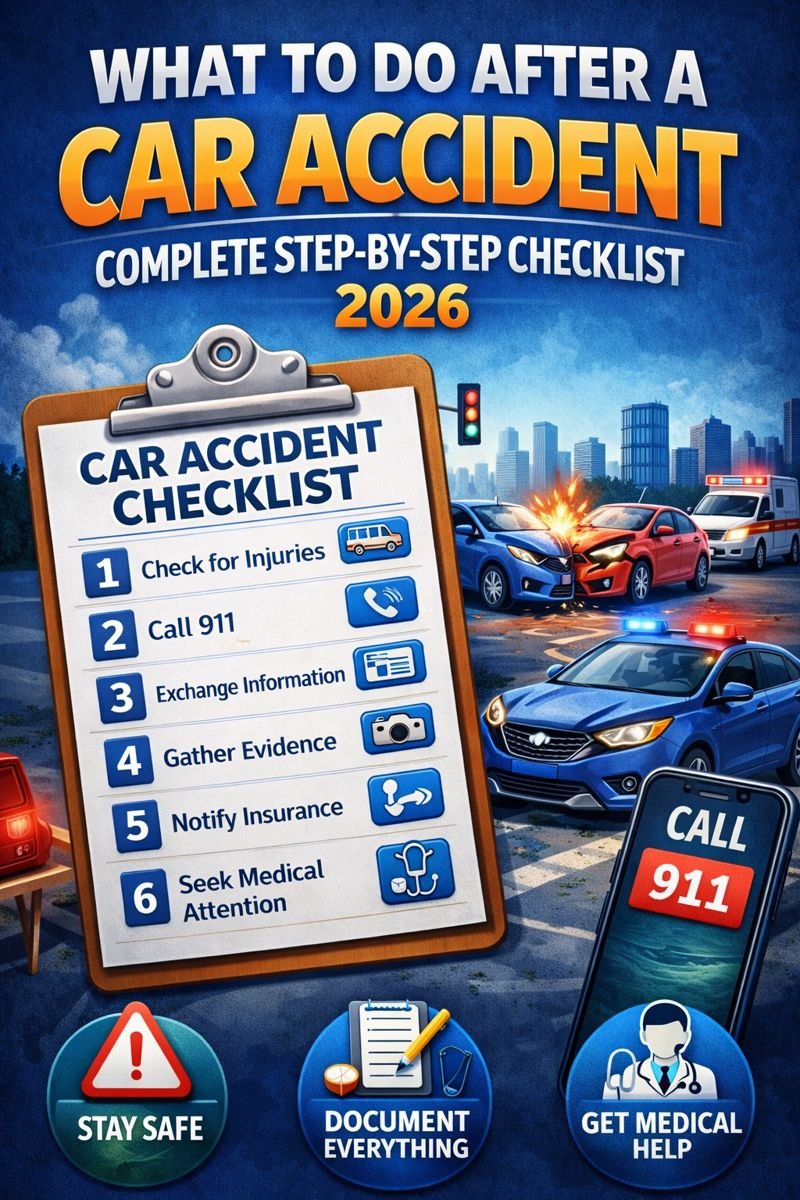
What to Do After a Car Accident: Complete Step-by-Step Checklist 2026
You're driving home from work. Traffic light turns green. You start moving forward. Then—CRASH.
Your heart's racing. Your hands are shaking. You're not sure if you're hurt. The other driver is getting out of their car. Your phone is buzzing with notifications.
What do you do now?
If you're reading this after an accident just happened, take a deep breath. You're going to be okay. This guide will walk you through exactly what to do, step by step, to protect yourself, your health, and your legal rights.
If you're reading this before an accident (smart move), bookmark this page or print it out. Keep it in your glove box. When an accident happens—and statistically, it probably will at some point—you'll be glad you prepared.
The Sobering Reality: Car Accidents in America 2026
Before we dive into what to do, let's talk about why this matters.
According to the latest data from the National Highway Traffic Safety Administration (NHTSA), traffic fatalities in the first half of 2026 have shown encouraging trends, with an estimated 8.2% decline compared to 2025. An estimated 17,140 people lost their lives in motor vehicle crashes from January through June 2026, down from 18,680 during the same period in 2025.
But here's the thing: while deaths are declining, accidents aren't.
Over 380,000 traffic crashes still occur annually in states like Florida alone. The National Safety Council reports that approximately 40,000 Americans still die in car accidents each year, with millions more injured.
Translation? You have about a 1 in 77 chance of dying in a car accident during your lifetime. But you have a much, much higher chance of being involved in one—and what you do in those critical first minutes can make the difference between a minor inconvenience and a financial nightmare.
The good news? Traffic deaths are at their lowest mid-year fatality rate since 2014, thanks to better safety technology, stricter DUI enforcement, and increased seatbelt use. But distracted driving, speeding, and aggressive driving are still major problems in 2026.
Bottom line: Knowing what to do after an accident isn't paranoia—it's preparation.
What Changed in 2026: New Laws and Tech You Need to Know
Digital Evidence Is Now King
In 2026, your smartphone isn't just a phone—it's the most powerful evidence-gathering tool you have. Dashboard camera footage, smartphone apps that automatically detect crashes, and GPS data are now routinely accepted in court and by insurance companies.
State-Specific Changes to Watch
Florida's 14-Day Medical Rule Still in Effect: If you're in Florida, you must see a doctor within 14 days of your accident to qualify for Personal Injury Protection (PIP) benefits. Miss this deadline and your insurance company can legally deny your entire claim—even if you're seriously hurt.
Louisiana's New Comparative Fault Law (Effective January 2026): Louisiana just switched to a modified comparative negligence system with a 51% bar. If you're found 51% or more at fault, you get nothing. This makes documentation at the scene even more critical for Louisiana drivers.
Mandatory Crash Detection in New Vehicles: Many 2026 model vehicles now come with automatic crash detection that contacts emergency services. If your car has this feature, it may have already called 911 before you even think to.
The Rise of Accident Documentation Apps
In 2026, there are dozens of free smartphone apps specifically designed to help you document accidents. We'll talk about the best ones later, but apps like WreckCheck, AxiKit, and iWrecked can guide you through the process step-by-step, even when you're shaken up.
At the Scene: What to Do in the First 5 Minutes
These first few minutes are critical. Your adrenaline is pumping, you might be in shock, and you're probably not thinking clearly. That's normal. Follow these steps in order.
Step 1: DO NOT LEAVE THE SCENE (This Is Critical)
Stop your vehicle immediately. Turn off the engine.
Leaving the scene of an accident—even a minor fender-bender—is a crime in all 50 states. It's called "hit and run," and penalties can include:
- Jail time (up to 1 year for property damage, up to 15 years if someone was injured)
- License suspension
- Massive fines ($5,000-$20,000+)
- A permanent criminal record
Even if you're scared, even if you think it was your fault, even if you don't have insurance—stay at the scene. The consequences of leaving are always worse than staying.
Exception: If you're in immediate danger (fire, traffic, aggressive other driver), move to a safe location nearby, but stay in the general area.
Step 2: Check for Injuries (Yours and Others)
Before you do anything else, check yourself and your passengers:
Ask yourself:
- Can I move my arms and legs?
- Am I bleeding?
- Does my chest, neck, or back hurt?
- Am I dizzy or confused?
- Can I breathe normally?
Important: Just because you feel okay doesn't mean you're not injured. Adrenaline masks pain. Internal injuries, whiplash, and concussions often don't show symptoms for hours or even days.
Check your passengers:
- "Are you okay?"
- "Does anything hurt?"
- "Can you move?"
If anyone is seriously injured:
- Call 911 immediately
- Do NOT move them unless there's fire or immediate danger
- Keep them still and calm
- If they're unconscious, check for breathing
Then check the other vehicle(s):
- Approach carefully (watch for traffic)
- Ask if they're injured
- If they say yes, call 911 even if you already did
Step 3: Move to Safety (If Possible)
If the accident is minor (fender-bender, no injuries, vehicles still drivable), move your car to the side of the road or a parking lot.
Why?
- Prevents additional accidents (secondary collisions are common)
- Keeps traffic flowing
- Makes it safer for emergency responders
How:
- Turn on your hazard lights (all vehicles)
- If you have road flares or warning triangles, set them up 100+ feet behind the accident
- Carefully move vehicles to the shoulder, median, or side street
- If your car won't move, stay inside with your seatbelt on until help arrives (unless there's fire)
Before you move your car, take quick photos of where the vehicles are positioned. Insurance companies need to see the point of impact and vehicle positions.
In some states (like California, Texas) you're legally required to move your vehicle if it's drivable and there are no injuries. Check your state's laws.
Step 4: Call 911 (Even for "Minor" Accidents)
Here's what most people get wrong: they think they only need to call police for "serious" accidents.
Wrong.
You should call police for ANY accident where:
- Anyone is injured (even slightly)
- Any vehicle is not drivable
- You suspect the other driver is drunk, drugged, or impaired
- The other driver doesn't have insurance
- There's more than $1,000 in damage (varies by state—some states require police reports for as little as $500 in damage)
- You're on a highway or interstate
- The other driver is acting aggressive, threatening, or strange
- You just want an official record (this is always smart)
When you call 911, stay calm and provide:
- Your exact location (use GPS or nearby street signs/mile markers)
- Number of vehicles involved
- Whether anyone is injured
- Whether vehicles are blocking traffic
- If there are any hazards (fuel leak, fire, downed power lines)
Police might not come if it's a minor accident in a busy city. That's okay—ask how to file an accident report online or at the station later.
Step 5: Exchange Information (What You Need from the Other Driver)
While you're waiting for police, exchange information with the other driver. Be polite and calm, even if you're angry.
What to get from the other driver:
Personal Information:
- Full legal name
- Phone number
- Address
Driver's License:
- License number
- State issued
- Take a photo of the license (front and back)
Insurance Information:
- Insurance company name
- Policy number
- Phone number for claims
- Take a photo of the insurance card
Vehicle Information:
- Make, model, year, color
- License plate number (and state)
- VIN (Vehicle Identification Number—found on dashboard near windshield)
What to give them:
- The same information about yourself
- DO NOT give them more than necessary
- Be polite but brief
Step 6: What NOT to Say (This Is Critical)
This is where most people screw up and destroy their own case.
NEVER say these phrases:
❌ "I'm so sorry, this was my fault" ❌ "I wasn't paying attention" ❌ "I'm fine, don't worry about it" ❌ "I don't think we need to call the police" ❌ "Let's just handle this ourselves without insurance"
Why not?
Because anything you say can be used against you by the insurance company. Even saying "I'm sorry" can be interpreted as admitting fault—and that can cost you thousands of dollars.
What TO say instead:
✅ "Are you okay?" ✅ "Let's exchange information" ✅ "I'll let the police and insurance companies figure out what happened" ✅ "I'd prefer not to discuss the details right now"
Remember: You're shaken up, you might be injured, and you don't have all the facts yet. There's no reason to make statements about who was at fault—that's what police reports and insurance investigators are for.
If the other driver asks you directly, "Was this your fault?"
Your response: "I'd prefer to let the police and insurance companies determine that. Let's just make sure everyone is okay and exchange information."
Step 7: Document EVERYTHING (Your Phone Is Your Best Friend)
This is 2026. Your smartphone is the most powerful evidence-gathering tool ever created. Use it.
Photos to take (take MORE than you think you need):
Wide shots:
- The entire accident scene from multiple angles
- All vehicles involved
- Road conditions (wet, icy, potholes)
- Traffic signs and signals
- Skid marks or debris
- Street signs and landmarks (to show location)
Close-up shots:
- Every scratch, dent, and crumple on YOUR vehicle
- Every scratch, dent, and crumple on the OTHER vehicle(s)
- License plates of all vehicles
- VIN numbers visible through windshields
- Broken glass, car parts, or debris
- Any fluid leaks (oil, coolant, transmission fluid)
Damage to other property:
- Guardrails, fences, mailboxes
- Traffic signals or signs
- Buildings or landscaping
Inside your car:
- Deployed airbags
- Damage to steering wheel, dashboard
- Your odometer (shows mileage at time of accident)
- Any personal property that was damaged
Your injuries:
- Visible cuts, bruises, scrapes
- Swelling or redness
- Take these photos ASAP and again each day for a week (injuries often get worse over time)
Environmental conditions:
- Weather (sunny, rainy, foggy)
- Lighting (bright, dusk, dark)
- Road surface (dry, wet, icy)
Pro tip: Take a video walkthrough of the scene while narrating what you see. This creates a timestamp and provides context that photos alone can't capture.
Use Your Voice Recorder:
Immediately record yourself describing:
- What you were doing before the accident
- What you saw happen
- What you felt (impact, airbag deployment)
- What you heard (screeching tires, crash sound)
- Your injuries and pain level
Do this while it's fresh in your memory. Your brain will start forgetting details within hours.
Step 8: Get Witness Information
If anyone saw the accident, get their contact information:
What to get from witnesses:
- Full name
- Phone number
- Email address
- What they saw (ask them to describe it briefly)
- Where they were when they saw it
How to ask: "Excuse me, did you see what happened? Would you be willing to give me your contact information in case the insurance company needs a statement?"
Most people are happy to help if you're polite.
Pro tip: If witnesses are willing, use your phone to record a brief audio or video statement right there. Ask them:
- "What's your name?"
- "Where were you when the accident happened?"
- "What did you see?"
- "Who do you think was at fault?" (optional, but can be powerful)
Just make sure you get their permission to record first.
Step 9: Talk to the Police When They Arrive
When police arrive, cooperate fully and be polite.
What to do:
- Tell the officer what happened, but stick to facts
- Don't speculate about speed, distances, or things you didn't directly observe
- If you don't remember something, say "I don't remember" instead of guessing
- Don't argue with the other driver's version of events—let the officer sort it out
What to get from police:
- Officer's name and badge number
- Police report number (or case number)
- How to get a copy of the police report (usually available online after 3-7 days)
Important: The police report isn't always accurate. Officers sometimes make mistakes or misunderstand what happened. That's why YOUR documentation (photos, videos, witness statements) is so important.
After You Leave the Scene: Next 24 Hours
You've left the accident scene. You're home (or at the hospital). Your adrenaline is wearing off. Now what?
Step 10: See a Doctor IMMEDIATELY (Even If You Feel Fine)
This is the #1 mistake people make.
"I felt fine at the scene, so I didn't go to the doctor. Three days later, my neck was killing me. The insurance company said my injuries weren't from the accident."
Sound familiar?
Why you MUST see a doctor within 24 hours:
-
Some injuries don't show symptoms immediately:
- Whiplash (can take 24-72 hours)
- Concussions (symptoms can be delayed)
- Internal bleeding (can be life-threatening)
- Soft tissue injuries (pain gets worse over time)
- Spinal injuries (numbness or tingling may develop later)
-
Insurance companies will use any delay against you:
- "If you were really hurt, why didn't you see a doctor right away?"
- They'll claim your injuries happened somewhere else
- In Florida, waiting more than 14 days means you lose ALL PIP benefits
-
You're creating a medical record:
- This is legal evidence that your injuries were caused by the accident
- The sooner you see a doctor, the stronger your case
Where to go:
- Emergency room (if you have ANY pain, dizziness, confusion, or visible injuries)
- Urgent care center (for moderate injuries)
- Your primary doctor (schedule appointment same day if possible)
- DO NOT wait for a "lawyer's doctor" or "preferred provider"—that looks like fraud
What to tell the doctor: "I was in a car accident yesterday. I'd like a full examination even though I feel okay right now. I want to make sure I don't have any hidden injuries."
Be honest about ALL symptoms, even minor ones:
- Headache
- Neck stiffness
- Back pain
- Shoulder pain
- Tingling in arms or legs
- Dizziness
- Nausea
- Trouble concentrating
- Sleep problems
Follow all treatment recommendations:
- Take prescribed medications
- Attend all follow-up appointments
- Do physical therapy if recommended
- Keep all receipts and medical records
Why? Because if you don't follow doctor's orders, the insurance company will argue you weren't really hurt.
Step 11: Report the Accident to YOUR Insurance Company
Most insurance policies require you to report accidents within 24-72 hours, even if the accident wasn't your fault.
Call your insurance company and report:
- Date, time, and location of accident
- Basic facts of what happened
- Other driver's information
- Police report number
- Whether you've been injured
What NOT to do:
- ❌ Don't give a detailed recorded statement yet (talk to a lawyer first)
- ❌ Don't admit fault
- ❌ Don't sign anything without reading it carefully
- ❌ Don't accept a settlement offer (way too early)
Ask your insurance company:
- "What are my next steps?"
- "Do I need to get repair estimates?"
- "What is my deductible?"
- "Am I covered if the other driver was uninsured?"
- "Should I use your recommended repair shop, or can I choose my own?"
Step 12: DO NOT Talk to the Other Driver's Insurance Company (Yet)
Within hours of the accident, you'll probably get a call from the other driver's insurance company.
They'll sound very friendly:
"Hi, I'm calling from XYZ Insurance. We're so sorry to hear about your accident. We just want to get a quick statement from you about what happened so we can process your claim faster and get you taken care of."
This is a trap.
Why? Because insurance adjusters are trained to:
- Get you to admit fault ("You didn't see the stop sign?")
- Get you to minimize your injuries ("So you're feeling okay then?")
- Get you to say something inconsistent with your police report
- Lock you into a statement before you know the full extent of your injuries
- Record everything you say to use against you later
What to say instead:
"I appreciate you calling, but I'm not comfortable giving a statement right now. I'm still dealing with the aftermath of the accident and seeing doctors. I'll be in touch with you or my attorney once I've had time to fully understand my situation."
If they push back:
"I understand you have a job to do, but I have rights too. I'm not required to give you a statement right now, and I'm choosing not to. Please contact my attorney." (Even if you don't have one yet)
If they try the guilt trip:
"Well, we can't process your claim without a statement..."
Your response: "That's fine. I'll wait until I have legal representation before giving any statements."
Trust me on this: Insurance adjusters are not your friends. Their job is to pay you as little as possible. Anything you say WILL be used to reduce or deny your claim.
Step 13: Start a Daily Pain and Symptom Journal
Starting TODAY, keep a journal (digital or paper) documenting:
Daily symptoms:
- Pain level (1-10 scale) for each body part
- New symptoms that develop
- How symptoms change throughout the day
- Medications you're taking and whether they help
How the injuries affect your daily life:
- Tasks you can't do (can't pick up your kid, can't work, can't exercise)
- Activities you had to cancel (missed work, couldn't go to your kid's game)
- Sleep disruption (can't sleep on your side, wake up in pain)
- Emotional impact (anxiety about driving, depression, stress)
Medical appointments:
- Date and doctor seen
- What was discussed
- Treatment provided
- Instructions given
- Cost (keep receipts!)
Work impact:
- Days missed
- Hours reduced
- Tasks you can't perform
- Income lost
Example entry:
January 23, 2026
Woke up with 7/10 neck pain, worse than yesterday. Took ibuprofen at 8am. Pain decreased to 5/10 by noon. Couldn't turn my head to check blind spot while driving—had to turn my whole body. Scary. Missed daughter's soccer game because sitting hurts too much. Felt guilty. Saw Dr. Martinez for follow-up—he prescribed physical therapy 3x/week. Cost: $40 copay.
Why this matters:
When you're negotiating a settlement 6 months from now, you won't remember these details. But a detailed journal creates a timeline that proves your injuries were real, significant, and directly affected your life.
Insurance companies hate detailed journals because they make it much harder to lowball you.
Days 2-7: Building Your Case
Step 14: Get a Copy of the Police Report
Most police reports are available 3-7 days after the accident.
How to get it:
- Go online to your local police department's website (many cities now have online portals)
- Call the records department and request it
- Visit the station in person
Cost: Usually $5-$25
Read it carefully and look for:
- Errors in facts (wrong street names, wrong vehicle descriptions)
- Who the officer determined was at fault
- Whether any citations were issued
- Witness statements
- Diagram of the accident
If there are errors:
Contact the police department and ask how to submit a correction. Some departments allow this; others don't. Either way, document the errors in writing.
Step 15: Get Repair Estimates (Don't Repair Yet!)
Get at least 2-3 estimates for vehicle repairs from different body shops.
Why multiple estimates?
- Insurance companies often lowball the damage
- Having multiple estimates proves the actual repair cost
- Some shops are better than others at finding hidden damage
What to tell the body shop: "I was in an accident and need a detailed estimate. Please check for frame damage and any hidden issues, not just cosmetic damage."
Important: Don't start repairs until your insurance company (or the other driver's insurance) has inspected the damage and approved the repairs.
Why? Because if you repair it first, the insurance company will argue they can't verify the damage and may refuse to pay.
Step 16: Organize All Your Documents
Create a dedicated file (physical or digital) with everything related to the accident:
Documents to keep:
- Police report
- Photos and videos of accident scene
- Photos and videos of injuries
- Witness contact information and statements
- Insurance cards (yours and other driver's)
- Repair estimates
- Medical bills and records
- Prescription receipts
- Pay stubs showing lost wages
- Your daily pain journal
- All correspondence with insurance companies
- Towing and rental car receipts
Pro tip: Scan everything and save it to cloud storage (Google Drive, Dropbox, iCloud). If your house floods or your car is stolen, you'll still have copies.
Step 17: Check Your Own Insurance Coverage
Pull out your insurance policy and review:
What coverage do you have?
Liability Coverage:
- This pays for damage you cause to others
- Minimum required varies by state ($25,000-$50,000 typically)
Collision Coverage:
- This pays to fix YOUR car, regardless of fault
- You pay a deductible first (usually $500-$1,000)
Comprehensive Coverage:
- Pays for non-accident damage (theft, vandalism, hail, hitting a deer)
Personal Injury Protection (PIP) / Medical Payments (MedPay):
- Pays YOUR medical bills regardless of fault
- Florida, Michigan, and other no-fault states require this
- Typical limits: $2,500-$10,000
Uninsured/Underinsured Motorist Coverage (UM/UIM):
- Pays YOU if the other driver has no insurance or not enough insurance
- This is HUGE—13-15% of drivers are uninsured
- Many states require it, but coverage limits vary
Understanding what you have helps you know:
- Whether you can afford to wait for the other insurance company
- Whether you should file under your own collision coverage
- What medical bills will be covered
- Whether you need additional attorneys
If the other driver has no insurance:
This is where UM/UIM coverage saves you. Your own insurance pays for your damages (minus deductible), then goes after the uninsured driver to recover their costs.
If you don't have UM/UIM coverage:
You can sue the other driver personally, but good luck collecting. Most uninsured drivers have no assets.
Week 2-4: Dealing with Insurance Companies
Step 18: Understand How Insurance Claims Work
Here's what most people don't understand: Insurance companies are for-profit businesses. Their goal is to pay you as little as possible while staying barely legal.
The insurance claims process:
Step 1: You file a claim
- You call and report the accident
- They assign you a claim number and adjuster
Step 2: Investigation
- Adjuster reviews police report
- Adjuster may inspect vehicle damage
- Adjuster may request statement from you
- Adjuster determines fault (their version of it)
Step 3: Valuation
- Adjuster calculates how much they think your claim is worth
- This is almost always lowball
Step 4: Settlement offer
- They make an initial offer
- This offer is usually 30-50% of what your case is worth
Step 5: Negotiation
- You counter their offer
- They counter your counter
- This goes back and forth
Step 6: Settlement or lawsuit
- You either reach agreement or file a lawsuit
Timeline: Minor accidents can settle in 1-3 months. Serious injuries can take 12-24 months or longer.
Important facts:
- Insurance adjusters have quotas and bonuses for saving money
- Their first offer is almost NEVER their best offer
- They're betting you don't know what your case is worth
- They're betting you're desperate and will take quick money
- They're trained in negotiation tactics
Step 19: The Settlement Offer Trap
Let's say it's been two weeks since your accident. You're still seeing doctors. Your neck hurts every day. You've missed a week of work.
The insurance adjuster calls:
"Good news! We've reviewed your claim and we'd like to offer you $5,000 to settle everything. This will cover your medical bills and give you some extra for your pain and suffering. All you have to do is sign this release and we'll send you a check right away!"
STOP. DO NOT SIGN ANYTHING.
Here's why this is a trap:
-
You don't know the full extent of your injuries yet
- What if you need surgery in 3 months?
- What if your pain gets worse?
- What if you develop chronic headaches?
-
Once you sign a release, you can NEVER go back
- Even if you need $50,000 in future medical care
- Even if you can't work for a year
- You signed away your rights forever
-
$5,000 is probably a fraction of what your case is worth
- If they're offering $5,000 two weeks in, your case is probably worth $15,000-$30,000+
- They're betting you don't know this
Red flags in early settlement offers:
- It comes before you've finished medical treatment
- They pressure you to accept quickly ("This offer expires in 48 hours")
- They say things like "This is the best we can do" (it's not)
- They don't explain how they calculated the amount
- The release form has broad language that releases them from everything forever
What to do instead:
"Thank you for the offer, but I'm still receiving medical treatment. I'm not ready to settle until I know the full extent of my injuries and my total medical costs. I'll be in touch when I reach maximum medical improvement."
Step 20: The Recorded Statement Trap
The adjuster will ask you to give a "recorded statement" about the accident.
Why they want this:
- To lock you into a version of events
- To get you to admit fault or partial fault
- To get you to minimize your injuries
- To catch you in inconsistencies
- To use your own words against you later
Example of how they'll trick you:
Adjuster: "So you were looking at your phone when the accident happened?"
You: "No, I had just put my phone down like 5 seconds before."
Adjuster: "Okay, so you were using your phone right before the crash?"
You: "Well, I mean, I was changing the song on Spotify, but I wasn't looking at it when we hit."
Later in court: "The plaintiff admitted they were using their phone immediately prior to the collision..."
See how that works?
You are NOT required to give the other driver's insurance company a recorded statement. Period. It's that simple.
What to say:
"I'm not comfortable giving a recorded statement at this time. If you need information, you can get it from the police report or I can provide a written summary. Otherwise, please contact my attorney."
Your own insurance company is different:
Your own policy may require you to cooperate with their investigation, which might include a recorded statement. That's usually okay because they're on your side (mostly).
But even then, be careful:
- Stick to facts
- Don't speculate
- Don't admit fault
- If you don't remember, say so
When to Hire an Attorney (And How to Find a Good One)
You Probably Don't Need an Attorney If:
- Your injuries were very minor (couple days of soreness, no medical treatment needed)
- Vehicle damage was minimal
- You only missed a day or two of work
- The other driver clearly was 100% at fault
- Their insurance company is being reasonable
- Total value of claim is under $5,000
In these cases, you can probably handle it yourself and keep the full settlement instead of paying attorney fees (typically 33-40%).
You NEED an Attorney If:
Your injuries are serious:
- You needed surgery
- You have permanent scarring or disfigurement
- You can't return to work
- You'll need ongoing medical treatment
- Your medical bills exceed $10,000
Liability is disputed:
- The other driver claims YOU were at fault
- There are no witnesses
- The police report is unclear or wrong
- Multiple vehicles were involved
The insurance company is playing games:
- Denying your claim entirely
- Offering unreasonably low settlements
- Delaying without good reason
- Requesting excessive documentation
- Pressuring you to settle quickly
Special circumstances:
- The other driver was uninsured
- A commercial vehicle was involved (truck, bus, company car)
- A government vehicle was involved
- You were hit as a pedestrian or cyclist
- Rideshare accident (Uber/Lyft)
- The accident involved a drunk driver
Why hire an attorney?
Studies consistently show that accident victims who hire attorneys recover 3.5 times more on average than those who don't—even after paying attorney fees.
Example:
- Without attorney: Insurance offers $20,000, you keep $20,000
- With attorney: Insurance offers $75,000, attorney takes 33% ($24,750), you keep $50,250
You net $30,250 MORE even after paying the attorney.
Why? Because attorneys:
- Know the actual value of your case
- Know how to negotiate with insurance adjusters
- Have relationships with medical experts
- Are willing to file a lawsuit if necessary
- Prevent you from making costly mistakes
How to Find a Good Car Accident Attorney in 2026
Look for:
Specialization:
- Personal injury law only (not a "general practice" attorney who does divorces, wills, and DUIs)
- Focus on car accidents specifically
- Member of trial lawyer associations (like AAJ or state trial lawyer groups)
Experience:
- At least 5-10 years handling car accident cases
- Has taken cases to trial (not just settled everything)
- Has handled cases similar to yours
Fee structure:
- Works on contingency (no upfront costs)
- Typical fee is 33-40% of settlement
- You pay nothing unless you win
- Make sure "costs" (filing fees, expert fees) are clearly explained
Communication:
- Returns calls promptly
- Explains things in plain English
- Makes you feel heard and respected
- Assigns you a real person to work with (not dumped on paralegals)
Reputation:
- Good online reviews (but read critically—some are fake)
- Ask friends/family for referrals
- Check their standing with the state bar association
- Look for awards or peer recognition
Red flags:
❌ Guarantees a specific settlement amount (impossible to predict)
❌ Requires money upfront
❌ Pressure tactics ("Sign today or we can't help you")
❌ Poor communication or unprofessional
❌ Never tried a case in court
Questions to ask during free consultation:
- "How many car accident cases have you handled?"
- "What's your success rate?"
- "What do you think my case is worth?" (Good attorneys will give a range, not a specific number)
- "What percentage fee do you charge?"
- "Who will actually be working on my case?" (You want the attorney, not just a paralegal)
- "How often will you update me on my case?"
- "What are my chances if we have to go to trial?"
- "Can you provide references from past clients?"
Where to find attorneys:
- American Association for Justice attorney locator
- State bar association referral services
- [Martindale-Hubbell](https://www.martin</parameter> <parameter name="new_str">Where to find attorneys:
- American Association for Justice attorney locator
- State bar association referral services
- Martindale-Hubbell attorney ratings
- Avvo lawyer directory with peer reviews
- Personal referrals from friends/family
- Local trial lawyer associations
Free consultations are standard: Most personal injury attorneys offer free initial consultations. Take advantage of this—meet with 2-3 attorneys before deciding.
Using Technology: Best Apps and Tools for 2026
Your smartphone is the most powerful tool you have after an accident. Here are the best apps specifically designed for accident documentation and recovery in 2026:
Accident Documentation Apps
1. WreckCheck (Free)
- Step-by-step guide through the accident scene
- Automatic location and timestamp on all photos
- Creates a PDF report you can email to insurance/attorney
- Stores all documentation in one place
- Available for iOS and Android
2. AxiKit Auto Accident App (Free)
- Guides you through what to do at the scene
- Information exchange forms built-in
- Witness statement recording
- Automatic police contact finder based on location
3. iWrecked (Free)
- Insurance card storage (have it ready before you need it)
- Accident scene checklist
- Photo organization
- Sends reports directly to your insurance company
4. Accident Sketch ($4.99)
- Draw accident diagrams on your phone
- Add vehicle positions, skid marks, debris
- Export professional-looking diagrams for police/insurance
Safety and Emergency Apps
5. Crash Detection (Built into most smartphones)
- iPhone 14+ and Apple Watch Series 8+: Automatic crash detection calls 911
- Pixel phones with Android: Car crash detection in Personal Safety app
- Samsung Galaxy: Car mode with crash detection
6. RapidSOS (Free)
- Enhanced 911 calling
- Sends your exact GPS location to emergency services
- Can include medical information automatically
Medical Tracking Apps
7. MyPainDiary (Free)
- Track daily pain levels
- Document symptoms
- Export reports for doctors and attorneys
- Visual charts show pain trends over time
8. CareZone (Free)
- Track all medications
- Set medication reminders
- Store all medical documents and bills
- Share with doctors or attorneys
Document Organization Apps
9. CamScanner (Free with premium options)
- Turn phone photos into PDF documents
- Scan medical bills, police reports, receipts
- Cloud storage and organization
- Share documents easily
10. Evernote (Free with premium options)
- Keep all accident-related notes in one place
- Store photos, documents, and audio recordings
- Tag and organize everything
- Accessible from any device
Dashcam Apps and Hardware
Best Dashcam Apps (turn your old phone into a dashcam):
11. AutoGuard Dash Cam (Free, Android)
- Continuous recording with GPS
- Automatic accident detection and video locking
- Upload to cloud storage
12. Nexar AI Dashcam (Free, iOS/Android)
- AI-powered incident detection
- Automatic cloud backup
- Shares footage with insurance companies
Best Dedicated Dashcams for 2026:
13. Garmin Dash Cam 67W ($229)
- 1440p resolution
- 180-degree viewing angle
- Voice control
- Automatic incident detection
14. Vantrue N4 Pro ($299)
- 4K front camera + 1080p interior + 1080p rear
- IR night vision
- Parking mode surveillance
Why you need a dashcam in 2026:
- Provides indisputable video evidence
- Prevents insurance fraud (staged accidents)
- Can reduce your insurance rates (some companies offer discounts)
- Average cost of a good dashcam: $100-300
- Average value if it proves you weren't at fault: priceless
State-Specific Accident Requirements
Requirements vary dramatically by state. Here's what you need to know for major states:
California
- Police report required: Only if injuries or damage over $1,000
- Report accident to DMV: Within 10 days if anyone injured or damage over $1,000 (Form SR-1)
- Statute of limitations: 2 years for injury claims
- Comparative negligence: Pure comparative (can recover even if 99% at fault)
- Minimum insurance: $15,000/$30,000/$5,000
- More info: California DMV Accident Reporting
Texas
- Police report required: If anyone injured or damage over $1,000
- Report accident to police: Immediately if injuries; within 10 days to TxDOT if damage over $1,000 (Form CR-2)
- Statute of limitations: 2 years
- Comparative negligence: Modified comparative (51% bar)
- Minimum insurance: $30,000/$60,000/$25,000
- More info: Texas DOT Crash Reports
Florida
- Police report required: If injuries, death, or vehicle towed
- Report to DMV: Within 10 days if injuries/death or damage over $500 (Form 90010)
- Statute of limitations: 2 years (reduced from 4 years in 2023)
- Fault system: No-fault (PIP required)
- 14-day medical rule: Must see doctor within 14 days to qualify for PIP
- Minimum insurance: $10,000 PIP + $10,000 property damage
- More info: Florida DHSMV Crash Reports
New York
- Police report required: If anyone injured or damage appears over $1,000
- Report to DMV: Within 10 days if anyone injured (Form MV-104)
- Statute of limitations: 3 years for injury
- Fault system: No-fault (up to $50,000 in medical)
- Comparative negligence: Pure comparative
- Minimum insurance: $25,000/$50,000/$10,000 + $50,000 PIP
- More info: NY DMV Accident Information
Illinois
- Police report required: If anyone injured, killed, or damage over $1,500 ($500 if uninsured driver)
- Report to police: Immediately if injuries; within 4 days if only property damage
- Statute of limitations: 2 years
- Comparative negligence: Modified comparative (51% bar)
- Minimum insurance: $25,000/$50,000/$20,000
- More info: Illinois DOT Crash Reporting
Louisiana (NEW LAW 2026)
- Police report required: If anyone injured or damage appears substantial
- Report to OMV: Within 24 hours if anyone injured or killed, or damage over $500
- Statute of limitations: 1 year for injury (shortest in nation!)
- Comparative negligence: Modified comparative (51% bar) - NEW as of January 1, 2026
- Minimum insurance: $15,000/$30,000/$25,000
- CRITICAL: If you're 51% or more at fault (starting 2026), you get ZERO
- More info: Louisiana OMV Crash Reporting
Check your state's specific requirements: Insurance Information Institute State Requirements
Common Mistakes That Cost You Thousands
Let's talk about the expensive mistakes people make after accidents:
Mistake #1: Delaying Medical Treatment
The scenario: You feel okay at the scene. A little sore, but nothing major. You go home and take some ibuprofen. Three days later, your neck is killing you.
The problem: The insurance company will argue your injury wasn't caused by the accident. "If you were really hurt, you would've gone to the doctor immediately."
The cost: Insurance may deny your entire injury claim. You're stuck with thousands in medical bills.
The fix: See a doctor within 24 hours, even if you feel fine. In Florida, it's legally required within 14 days.
Mistake #2: Posting on Social Media
The scenario: You post a photo on Instagram at your friend's birthday party two weeks after the accident. You're smiling and appear to be having fun.
The problem: Insurance company's investigator finds the photo. They argue: "If you're hurt so badly, how were you partying?"
The cost: Your pain and suffering claim gets slashed by 50% or more.
The fix:
- Set all social media to private
- Don't post photos of yourself doing any physical activities
- Don't discuss the accident online
- Don't accept friend requests from people you don't know (could be investigators)
- Assume anything you post will be seen by the insurance company
Mistake #3: Giving a Recorded Statement Too Soon
The scenario: The adjuster calls the day after the accident. You're helpful and give a detailed recorded statement. You say you "feel okay" because you're trying to be polite.
The problem: They use your statement to argue you weren't injured. "The plaintiff stated they felt 'okay' the day after the accident."
The cost: Your injury claim gets denied or drastically reduced.
The fix: Don't give recorded statements to the other driver's insurance company. If you must talk to your own insurance, stick to basic facts only.
Mistake #4: Accepting the First Settlement Offer
The scenario: Three weeks after the accident, insurance offers you $8,000. You think "Wow, that's a lot!" and accept.
The problem: Your case was actually worth $30,000. You left $22,000 on the table.
The cost: You can never go back and ask for more. Even if you need surgery next month.
The fix: Never accept the first offer. Counter-offer or consult an attorney first.
Mistake #5: Signing a Broad Medical Release
The scenario: Insurance asks you to sign a "medical authorization" so they can get your medical records from the accident.
The problem: The authorization is worded so broadly that it gives them access to your ENTIRE medical history—including unrelated conditions from 10 years ago.
The cost: They find you had back pain 5 years ago and argue your current injury is pre-existing. Your claim gets denied.
The fix: Have an attorney review any authorization before signing. Limit it to records related to this accident only.
Mistake #6: Not Following Doctor's Orders
The scenario: Your doctor recommends 6 weeks of physical therapy. After 2 weeks, you feel better and stop going.
The problem: Insurance argues you weren't really hurt. "If the plaintiff was truly injured, they would've completed treatment."
The cost: Your claim value drops by 40-60%.
The fix: Complete all recommended treatment. If you genuinely feel better and want to stop, get written clearance from your doctor first.
Mistake #7: Lying or Exaggerating
The scenario: You say your back pain is "10 out of 10" when it's really more like a 6. Or you claim you can't lift your arm when you actually can.
The problem: Insurance investigators use video surveillance. They film you lifting groceries out of your car.
The cost: Your entire claim gets denied for fraud. You might even face criminal charges.
The fix: Be completely honest. The truth is always enough. Exaggeration never helps and almost always hurts.
Special Situations
What If You Hit a Parked Car and No One's Around?
You are legally required to:
- Stop and try to find the owner
- If you can't find them, leave a note with your name, address, phone, and insurance info
- Report the accident to your insurance company
- In some states, report to police
Don't drive away. That's hit-and-run, even if it's just a parked car. Penalties include fines up to $5,000, license suspension, and possible jail time.
Your insurance: Your collision coverage (if you have it) will pay for your car. Their car should be covered by your property damage liability.
What If You Hit a Deer or Animal?
What to do:
- Pull over safely
- Call police (many areas require reporting animal strikes)
- Don't approach the animal (injured deer can be dangerous)
- Take photos of damage
- File a claim under your comprehensive coverage (NOT collision)
Insurance: Comprehensive coverage pays for animal strikes. There's usually no fault assigned, so no rate increase.
No comprehensive coverage: You pay out of pocket.
What If the Accident Happened in a Parking Lot?
Parking lot accidents are tricky because normal traffic laws don't always apply.
General rules:
- Moving vehicle vs. parked vehicle = moving vehicle is usually at fault
- Two moving vehicles = fault depends on specific situation
- Backing out = usually at fault if you hit someone
What to do:
- Follow all the same steps (call police, exchange info, document)
- Police may not come for parking lot accidents, but call anyway
- Look for security cameras—parking lots often have them
What If You Were Hit as a Pedestrian or Cyclist?
Immediate steps:
- Call 911 (injuries to pedestrians/cyclists are often serious)
- Don't move if you're seriously hurt
- Get driver's information if you can
- Get witness information (critical for pedestrian/cyclist accidents)
- Take photos of the intersection, crosswalk, traffic signals
Legal issues:
- Drivers owe a high duty of care to pedestrians
- Even if you were jaywalking, you might still recover (depending on state)
- Medical bills are often much higher
- Settlements are typically much larger
You almost certainly need an attorney for pedestrian/cyclist accidents. These cases are complex.
What If the Other Driver Was Drunk?
At the scene:
- Tell police if you smell alcohol or the driver seems impaired
- Note slurred speech, bloodshot eyes, difficulty walking
- Police will conduct sobriety tests and possibly arrest
Legal implications:
- DUI driver is almost always 100% at fault
- You may be entitled to punitive damages (extra money to punish them)
- Criminal case against driver is separate from your civil claim
- DUI conviction makes your civil case much stronger
Insurance:
- Some insurance policies exclude coverage for DUI accidents (rare but exists)
- If their insurance denies coverage, your UM/UIM coverage may apply
What If You Were in an Uber or Lyft?
Rideshare accidents are complicated because multiple insurance policies may apply:
Phase 1: Driver is offline
- Driver's personal insurance only
- Uber/Lyft provides no coverage
Phase 2: Driver is online but no ride accepted
- Uber/Lyft provides contingent coverage: $50,000/$100,000 liability
- Only applies if driver's personal insurance denies claim
Phase 3: Ride accepted or passenger in vehicle
- Uber/Lyft provides $1 million liability coverage
- This is when you want to be riding (insurance-wise)
Who to sue:
- The at-fault driver
- Uber/Lyft (if their driver was at fault)
- Your own insurance (UM/UIM if other driver had no insurance)
You definitely need an attorney for rideshare accidents. These are very complex.
Your Rights After an Accident
Let's be clear about what you're entitled to:
You Have the Right To:
✅ Choose your own doctor
- Insurance can't force you to see their doctor
- They can request an "independent medical examination" (IME), but you choose your primary treatment
✅ Choose your own repair shop
- Insurance can't force you to use their "preferred" shop
- Get multiple estimates and choose who you want
✅ Refuse to give a recorded statement to the other driver's insurance
- You're not legally required to talk to them at all
- They'll try to make you think you have to—you don't
✅ Hire an attorney
- They can't penalize you for getting legal help
- Attorney-client privilege protects your conversations
✅ Take your time to evaluate your injuries
- Don't let them rush you into settling
- You control the timeline (within statute of limitations)
✅ Reject low settlement offers
- First offer is almost always low
- You can negotiate or go to court
✅ Review all documents before signing
- Never sign anything you don't understand
- Take documents home, read carefully, or have attorney review
You Are NOT Required To:
❌ Give a statement to the other driver's insurance
❌ Settle your claim quickly
❌ Accept their first offer
❌ Use their recommended doctors or repair shops
❌ Provide access to your entire medical history
❌ Continue negotiating if their offers are unreasonable
❌ Feel guilty for making a claim (you're entitled to compensation!)
Insurance Company Tactics to Watch For
Insurance companies use predictable tactics. Knowing them helps you avoid falling for them:
Tactic #1: The Sympathy Play
"I'm so sorry this happened to you. I want to help you get through this as quickly as possible."
What they really mean: "I want to settle this cheap and fast before you realize what it's worth."
Tactic #2: The Delay Game
They request document after document, take weeks to respond, "need more time" to review, etc.
Goal: Frustrate you into accepting a low offer just to be done with it.
Counter: Set deadlines. "I need a response by [date] or I'll be consulting an attorney."
Tactic #3: The Lowball-Highball
First offer: $5,000 Second offer: $15,000 "See how much we increased our offer! We're really trying to be fair here!"
Reality: Your case is probably worth $40,000. They're still way low.
Tactic #4: The Blame Game
"Well, you were speeding too, so you're partially at fault."
Goal: Reduce their payment by claiming you share blame.
Counter: Stick to facts. Make them prove their allegations.
Tactic #5: The "Independent" Medical Exam
"We just need you to see our doctor for an independent evaluation."
Reality: It's not independent. This is a doctor they pay regularly who almost always says you're not hurt.
What to do: You usually have to go (contractually), but bring someone with you, record everything (if legal in your state), and get a copy of the report.
Tactic #6: The Surveillance Threat
"We have investigators watching you."
Goal: Scare you into staying home and not living your life.
Reality: They might actually be watching (if your claim is large enough), but you shouldn't let it control you.
What to do: Just don't lie or exaggerate. Live your normal life within your medical restrictions.
Tactic #7: The Policy Limit Lie
"Our insured only has $25,000 in coverage, so that's the absolute maximum we can pay."
Sometimes true, sometimes a lie. Make them prove it by providing a certified copy of the policy declarations page.
Final Checklist: Did You Do Everything?
Use this checklist to make sure you've covered all bases:
Immediately After Accident:
- ☐ Called 911 if anyone injured
- ☐ Moved to safety if possible
- ☐ Exchanged information with other driver
- ☐ Took photos/videos of scene, damage, injuries
- ☐ Got witness contact information
- ☐ Got police report number
- ☐ Did NOT admit fault
- ☐ Did NOT sign anything at scene
Within 24 Hours:
- ☐ Saw a doctor (ER, urgent care, or primary doctor)
- ☐ Reported accident to YOUR insurance company
- ☐ Started pain/symptom journal
- ☐ Organized all documents and photos
Within One Week:
- ☐ Obtained copy of police report
- ☐ Got 2-3 repair estimates
- ☐ Reviewed your insurance coverage
- ☐ Declined to give recorded statement to other insurance
- ☐ Followed up with doctor as recommended
- ☐ Kept all receipts and medical records
Within One Month:
- ☐ Continued medical treatment as prescribed
- ☐ Documented all expenses (medical, repairs, lost wages)
- ☐ Consulted with attorney (if injuries are serious)
- ☐ Avoided social media posts about accident
- ☐ Avoided contact with other driver
- ☐ Did NOT accept early settlement offer
Ongoing:
- ☐ Attend all medical appointments
- ☐ Follow all treatment recommendations
- ☐ Update pain journal daily
- ☐ Save all receipts and bills
- ☐ Track all time missed from work
- ☐ Communicate only through attorney (if you hired one)
Conclusion: You've Got This
Car accidents are stressful, scary, and overwhelming. But you now know more about what to do after an accident than 95% of drivers on the road.
Remember the most important points:
- Stay calm and stay at the scene
- See a doctor within 24 hours (no exceptions)
- Document everything with photos and notes
- Don't talk to the other driver's insurance without an attorney
- Don't accept the first settlement offer
- Be honest but protect your rights
You're not trying to "get rich" from an accident. You're trying to get fair compensation for:
- Medical bills you didn't ask for
- Time lost from work you couldn't avoid
- Pain and suffering you didn't deserve
- A life disrupted through no fault of your own
The insurance company will try to pay you as little as possible. That's their job. Your job is to make sure you get every dollar you're entitled to—nothing more, nothing less.
If you're dealing with an accident right now, you're going to get through this. Follow the steps in this guide, advocate for yourself, and don't be afraid to ask for help when you need it.
Drive safe out there.
Additional Resources
National Organizations:
- National Highway Traffic Safety Administration - Safety standards, crash data, vehicle recalls
- Insurance Information Institute - Consumer insurance information and state requirements
- National Safety Council - Safety statistics and defensive driving courses
Legal Resources:
- American Bar Association - Find a lawyer, legal help
- National Association of Consumer Advocates - Consumer protection attorneys
- Your State Bar Association - Attorney referrals and discipline records
Government Resources:
- USA.gov - Federal government accident information
- Your state's Department of Motor Vehicles - Accident reporting requirements
- Your state's Department of Insurance - Insurance company complaints
Medical Resources:
- American College of Emergency Physicians - When to go to ER vs urgent care
- American Physical Therapy Association - Find a physical therapist
- Brain Injury Association of America - Resources for head injuries
Apps and Tools:
- WreckCheck - Free accident documentation app
- MyPainDiary - Free pain tracking
- CamScanner - Document scanning and organization
Disclaimer: This article provides general information only and does not constitute legal or medical advice. Laws vary by state and change frequently. For advice specific to your situation, consult with a licensed attorney in your state and see a qualified medical professional. This article was last updated January 2026.
Keywords: car accident checklist, what to do after car accident, car crash steps 2026, accident documentation, insurance claim help, post-accident guide, car accident rights, Florida 14-day rule, Louisiana comparative fault 2026, accident attorney when to hire, traffic accident report, personal injury protection
Sources: National Highway Traffic Safety Administration (NHTSA) 2026 mid-year traffic data, National Safety Council Injury Facts, state DMV accident reporting requirements, Insurance Information Institute state insurance data, Louisiana Act 422 (2024), Florida HB 837 (2023)
Legal Disclaimer
This article provides general legal information only and does not constitute legal advice. Every accident case is unique and outcomes may vary. For specific legal guidance regarding your personal injury or accident claim, please consult with a qualified attorney licensed in your jurisdiction. Use of this website does not create an attorney-client relationship.