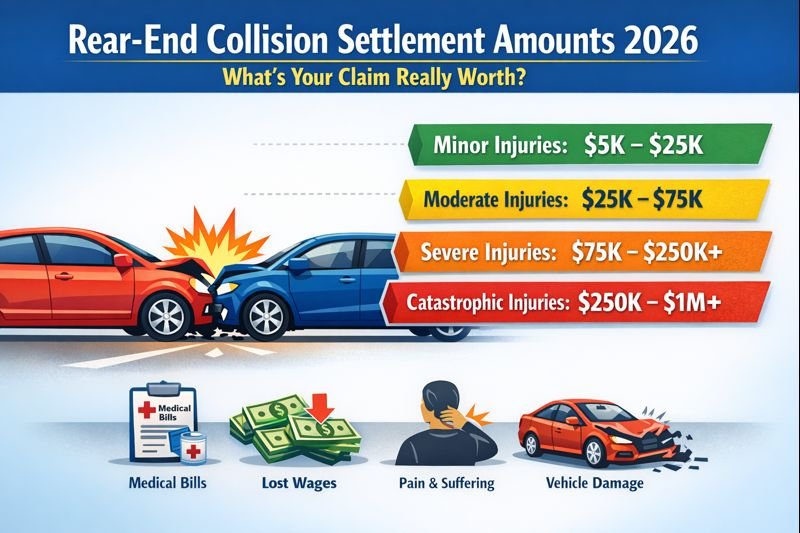
Rear-End Collision Settlement Amounts 2026: What's Your Claim Really Worth?
Last Updated: January 19, 2026
If you've been hit from behind in a rear-end collision, you're probably wondering: "How much is my settlement worth?" Rear-end accidents account for approximately 29% of all car crashes in the United States, making them the most common type of vehicle collision. The average rear-end collision settlement ranges from $15,000 to $30,000 for minor to moderate injuries, but severe cases can exceed $100,000 or even reach into the millions.
Understanding what your rear-end collision claim is worth helps you negotiate effectively with insurance companies and avoid accepting lowball settlement offers. This comprehensive guide breaks down actual settlement amounts by injury type, reveals the key factors that increase your payout, and provides real case examples from 2026 to help you value your claim accurately.
Understanding Rear-End Collision Liability in 2026
In the vast majority of rear-end collisions, the driver who hit you from behind is considered at fault. Traffic laws across all 50 states require drivers to maintain a safe following distance and control their speed to avoid rear-ending the vehicle ahead. This legal presumption of fault makes rear-end collision cases generally easier to prove than other accident types.
Why Rear Drivers Are Almost Always Liable
The trailing driver has the legal duty to:
- Maintain adequate following distance (typically 3-4 seconds)
- Monitor traffic conditions ahead
- Brake in time to avoid collision
- Adjust speed for weather and road conditions
- Avoid distracted driving behaviors
Common causes of rear-end collisions that establish clear fault include:
- Distracted driving (texting, phone calls, eating)
- Tailgating (following too closely)
- Speeding (unable to stop in time)
- Drunk or impaired driving
- Drowsy driving (delayed reaction time)
- Aggressive driving (road rage incidents)
- Mechanical failure (brake failure, though this may shift liability to maintenance providers)
Rare Exceptions Where You Might Share Fault
While uncommon, you could be found partially responsible if you:
- Reversed suddenly without warning
- Had non-functioning brake lights
- Brake-checked the rear driver intentionally
- Made an unsafe lane change immediately before impact
- Were driving under the influence
Even in these scenarios, the rear driver typically bears the majority of fault. Most states apply comparative negligence rules, meaning your settlement is reduced by your percentage of fault rather than eliminated entirely.
Average Rear-End Collision Settlement Amounts by Injury Severity
Settlement values vary dramatically based on the type and severity of injuries sustained. Here's what you can realistically expect in 2026 based on current data and case outcomes.
Minor Injuries: $2,500 - $25,000
Typical Injuries:
- Whiplash and neck strain
- Soft tissue injuries
- Minor back pain
- Bruising and contusions
- Headaches
- Minor cuts and scrapes
Medical Treatment:
- Emergency room evaluation: $1,500-$3,500
- Chiropractic care (6-12 weeks): $2,000-$5,000
- Physical therapy (4-8 weeks): $1,500-$4,000
- Pain medication and muscle relaxants: $200-$500
- Follow-up doctor visits: $500-$1,500
Settlement Range Factors: Minor injury settlements typically represent 1.5 to 3 times medical expenses plus lost wages. Cases settle higher when:
- Treatment was immediate and consistent
- Clear documentation of pain and limitations
- Physician confirms injury was accident-caused
- You missed work for recovery
- Activities of daily living were impacted
Real Example - Minor Whiplash Settlement:
- 34-year-old administrative assistant
- Rear-ended at traffic light
- Diagnosed with cervical strain
- Total medical bills: $6,800
- Lost wages (1 week): $1,100
- Settlement: $18,500
- Breakdown: Medical ($6,800) + Wages ($1,100) + Pain/Suffering ($10,600)
Moderate Injuries: $25,000 - $100,000
Typical Injuries:
- Herniated or bulging discs
- Fractured ribs or sternum
- Shoulder injuries (torn rotator cuff)
- Knee injuries
- Facial fractures
- Moderate concussions
- Severe whiplash requiring injections
Medical Treatment:
- Emergency room and diagnostics: $5,000-$10,000
- MRI and advanced imaging: $2,000-$5,000
- Orthopedic specialist care: $3,000-$8,000
- Epidural injections: $2,000-$5,000 per injection
- Physical therapy (3-6 months): $5,000-$12,000
- Surgery (if required): $30,000-$80,000
- Pain management: $2,000-$6,000
Settlement Range Factors: Moderate injury cases typically settle for 3 to 5 times medical expenses. Higher settlements occur when:
- Surgery was required
- Multiple medical specialists involved
- Extended time off work (1-3 months)
- Permanent restrictions or scarring
- Age of victim (younger victims receive higher settlements for long-term impact)
Real Example - Herniated Disc Settlement:
- 45-year-old construction worker
- Rear-ended on highway at 45 mph
- L4-L5 disc herniation requiring surgery
- Total medical bills: $58,000
- Lost wages (4 months): $18,000
- Future medical care estimate: $12,000
- Permanent lifting restrictions
- Settlement: $185,000
- Multiplier used: 3.2x medical + economic losses
Severe and Catastrophic Injuries: $100,000 - $1,000,000+
Typical Injuries:
- Traumatic brain injury (TBI)
- Spinal cord injuries
- Paralysis (paraplegia or quadriplegia)
- Multiple fractures requiring extensive surgery
- Severe burns (if vehicles caught fire)
- Loss of limbs
- Permanent cognitive impairment
- Chronic pain syndrome
Medical Treatment:
- Emergency trauma care: $50,000-$200,000
- ICU hospitalization: $10,000-$30,000 per day
- Multiple surgeries: $100,000-$500,000
- Inpatient rehabilitation (months): $50,000-$200,000
- Home modifications: $30,000-$150,000
- Medical equipment: $20,000-$100,000
- Lifetime care costs: $1,000,000-$5,000,000+
Settlement Range Factors: Catastrophic injury settlements account for:
- All current and future medical expenses
- Total lost earning capacity over lifetime
- Cost of ongoing care and assistance
- Reduced life expectancy impacts
- Loss of quality of life
- Spouse's loss of consortium claim
- Pain and suffering (often valued at 5-10x economic damages)
Real Example - Spinal Cord Injury Settlement:
- 28-year-old teacher
- Rear-ended by distracted driver at 60 mph
- Incomplete spinal cord injury (T12 level)
- Permanent lower body weakness, uses wheelchair intermittently
- Current medical expenses: $380,000
- Projected lifetime medical care: $2,400,000
- Lost earning capacity: $1,800,000
- Home modifications: $85,000
- Settlement: $4,200,000
- Insurance: $1M policy + excess coverage + defendant's assets
Top 10 Factors That Determine Your Rear-End Settlement Value
1. Severity and Permanence of Injuries
Insurance companies pay more for injuries that permanently alter your life. Temporary injuries that fully heal receive lower settlements than permanent disabilities.
Documentation That Increases Value:
- Physician statements on permanence
- Functional capacity evaluations
- Before/after activity comparisons
- Impact on career and hobbies
- Psychological evaluations for emotional trauma
2. Total Medical Expenses (Past and Future)
Every dollar spent on medical treatment strengthens your claim. However, treatment must be reasonable, necessary, and directly related to the accident.
Medical Expenses That Count:
- Emergency room visits
- Hospital stays
- All doctor appointments
- Physical therapy sessions
- Chiropractic care
- Prescription medications
- Medical equipment
- Home health care
- Future surgeries and treatment
Red Flags Insurance Companies Look For:
- Gaps in treatment (suggests injuries aren't serious)
- Alternative medicine without MD referral
- Treatment inconsistent with diagnosed injury
- Excessive or unnecessary care
- Pre-existing condition treatment
3. Lost Income and Earning Capacity
Rear-end collisions can impact your ability to earn income both immediately and long-term.
Short-Term Lost Wages:
- Days missed from work
- Sick leave and vacation time used
- Reduced hours during recovery
- Missed overtime opportunities
- Lost bonuses or commissions
Long-Term Earning Impact:
- Inability to perform job duties
- Need for career change
- Lost promotion opportunities
- Reduced retirement contributions
- Loss of professional credentials or licenses
Proving Lost Wages:
- Employer verification letters
- Pay stubs and tax returns
- Time sheets showing missed work
- Medical work restrictions
- Vocational expert testimony
4. Quality and Consistency of Medical Documentation
Your medical records tell the story of your injuries. Thorough documentation dramatically increases settlement value.
Essential Medical Documentation:
- Detailed emergency room reports
- Physician notes from every visit
- Diagnostic imaging results (X-rays, MRI, CT scans)
- Physical therapy progress notes
- Pain level assessments
- Functional limitation reports
- Treatment plans and prognosis
- Causation statements (injury caused by accident)
Common Documentation Mistakes:
- Waiting days or weeks to seek treatment
- Missing scheduled appointments
- Not reporting all symptoms to doctors
- Stopping treatment before reaching maximum medical improvement
- Failing to follow prescribed treatment plans
5. Clear Proof of Liability
Even though rear drivers are presumed at fault, strong evidence eliminates any doubt and prevents insurance companies from disputing liability.
Powerful Liability Evidence:
- Police accident report citing rear driver
- Photos of vehicle damage (rear of your car, front of their car)
- Witness statements
- Traffic camera or surveillance footage
- Dashcam video
- Skid marks and accident scene evidence
- Admission of fault by other driver
- Citation issued to rear driver
6. Insurance Policy Limits
Your settlement cannot exceed the at-fault driver's insurance coverage limits, regardless of injury severity.
Typical Insurance Limits:
- State minimum coverage: $25,000-$50,000 (varies by state)
- Standard policies: $100,000-$300,000
- High-limit policies: $500,000-$1,000,000
- Commercial vehicles: $1,000,000+
When Insurance Is Insufficient:
- Your underinsured motorist (UIM) coverage
- At-fault driver's personal assets
- Multiple liable parties
- Umbrella insurance policies
7. Pre-Existing Conditions and Prior Injuries
Insurance companies scrutinize your medical history to find pre-existing conditions they can blame for your current pain.
How Pre-Existing Conditions Impact Settlements: If you had prior back problems, insurers argue your herniated disc was pre-existing, not accident-caused. However, if the accident aggravated or worsened your condition, you're still entitled to compensation for the exacerbation.
Defending Against Pre-Existing Condition Arguments:
- Medical records showing you were asymptomatic before accident
- Physician testimony on accident causation
- Comparison of pre and post-accident diagnostic imaging
- Documentation of increased pain and limitations
- Treatment records showing condition worsened after collision
8. Your Age and Occupation
Younger victims and high-income earners typically receive larger settlements because they face longer periods of lost earning capacity.
Age Impact Examples:
- 25-year-old with permanent injury: 40+ years of lost earnings
- 60-year-old with same injury: 5-10 years of lost earnings
- Result: Younger victim's settlement may be 4-5x higher for economic damages
Occupation Impact:
- High-income professional ($150K/year): Larger wage loss claims
- Physical laborer unable to return to work: Total disability claim
- Self-employed business owner: Business valuation and income loss analysis
9. Comparative Negligence and Shared Fault
If you bear any responsibility for the accident, your settlement is reduced by your percentage of fault in most states.
State Comparative Negligence Rules:
Pure Comparative Negligence (13 states): Your settlement is reduced by your fault percentage, even if you're 99% responsible.
- Example: $100,000 settlement, you're 30% at fault = $70,000 recovery
Modified Comparative Negligence (33 states): You can only recover if you're less than 50% or 51% at fault (varies by state).
- Example: If you're 50% at fault in a 50% bar state, you recover nothing
Contributory Negligence (4 states + DC): If you're even 1% at fault, you may be completely barred from recovery.
- States: Alabama, Maryland, North Carolina, Virginia, Washington DC
10. Legal Representation Quality
Hiring an experienced personal injury attorney significantly increases settlement amounts. Studies consistently show that accident victims with lawyers receive settlements 3.5 times higher than those who negotiate alone.
What Attorneys Provide:
- Accurate claim valuation
- Professional investigation and evidence gathering
- Expert witness coordination
- Aggressive negotiation with insurance adjusters
- Trial preparation and readiness
- Protection from insurance company tactics
Attorney Contingency Fees:
- Typical fee: 33% of settlement (before litigation)
- Litigation fee: 40% (if lawsuit filed)
- No upfront costs
- No fees unless you recover compensation
State-by-State Rear-End Collision Settlement Considerations
Settlement values and legal procedures vary significantly by state. Understanding your state's specific laws helps set realistic expectations.
California Rear-End Collision Settlements
Negligence System: Pure comparative negligence Average Settlement Range: $18,000 - $45,000 (moderate injuries) Statute of Limitations: 2 years from accident date Minimum Insurance: $15,000 per person / $30,000 per accident
California-Specific Factors:
- High cost of living increases medical expenses and lost wages
- Los Angeles and San Francisco juries award higher verdicts
- Proposition 213 limits uninsured drivers' ability to recover non-economic damages
- High-value cases more common due to expensive medical care
Texas Rear-End Collision Settlements
Negligence System: Modified comparative negligence (51% bar) Average Settlement Range: $15,000 - $35,000 (moderate injuries) Statute of Limitations: 2 years from accident date Minimum Insurance: $30,000 per person / $60,000 per accident
Texas-Specific Factors:
- No-fault rule does not apply (Texas is a tort state)
- Caps on non-economic damages in medical malpractice but not car accidents
- Strong legal precedent favoring rear driver liability
- Uninsured motorist rate higher than national average
Florida Rear-End Collision Settlements
Negligence System: Pure comparative negligence + No-Fault PIP Average Settlement Range: $12,000 - $30,000 (moderate injuries) Statute of Limitations: 4 years from accident date Minimum Insurance: $10,000 PIP coverage required
Florida-Specific Factors:
- No-fault PIP coverage pays first $10,000 regardless of fault
- Must meet "serious injury threshold" to sue for pain and suffering
- Serious injuries include: permanent injury, significant scarring, death
- PIP covers 80% medical bills and 60% lost wages up to policy limits
New York Rear-End Collision Settlements
Negligence System: Pure comparative negligence + No-Fault Average Settlement Range: $10,000 - $40,000 (moderate injuries) Statute of Limitations: 3 years from accident date Minimum Insurance: $50,000 per person / $100,000 per accident + $50,000 no-fault
New York-Specific Factors:
- No-fault insurance covers medical bills and lost wages up to $50,000
- "Serious injury" threshold required to sue: fractures, permanent limitation, significant disfigurement, death
- New York City settlements typically higher due to expensive medical care
- Strong consumer protection laws favor injury victims
Illinois Rear-End Collision Settlements
Negligence System: Modified comparative negligence (51% bar) Average Settlement Range: $16,000 - $38,000 (moderate injuries) Statute of Limitations: 2 years from accident date Minimum Insurance: $25,000 per person / $50,000 per accident
Illinois-Specific Factors:
- Chicago juries known for higher awards
- Strong legal precedent on rear driver liability
- Collateral source rule allows introduction of actual medical bills (not reduced amounts)
- Uninsured motorist coverage required unless rejected in writing
Real Rear-End Collision Settlement Examples from 2026
Case Study 1: Minor Rear-End at Stop Sign - $14,500
Accident Details:
- 42-year-old accountant
- Stopped at stop sign, rear-ended by distracted driver checking phone
- Low-speed impact (estimated 10-15 mph)
- Police report cited rear driver for following too closely
Injuries Sustained:
- Whiplash (cervical strain)
- Lower back pain
- Headaches for 3 weeks
Medical Treatment:
- Emergency room visit: $2,400
- Follow-up with primary care: $350
- Chiropractic treatment (10 sessions): $1,200
- Physical therapy (8 sessions): $1,600
- Prescription pain medication: $150
- Total Medical Bills: $5,700
Lost Income:
- 3 days missed work: $950
Settlement Negotiation:
- Initial insurance offer: $7,500
- Demand letter sent: $22,000
- Counteroffer: $11,000
- Final settlement: $14,500
- Time to settle: 4 months
Settlement Breakdown:
- Medical expenses: $5,700
- Lost wages: $950
- Pain and suffering: $7,850
- Total: $14,500 (2.5x medical multiplier)
Case Study 2: Highway Rear-End with Herniated Disc - $87,000
Accident Details:
- 35-year-old nurse
- Rear-ended on highway during rush hour traffic
- Impact speed estimated 35-40 mph
- Rear driver admitted to looking at GPS and not seeing traffic slow
Injuries Sustained:
- C5-C6 herniated disc
- Lumbar strain
- Right shoulder contusion
- Post-traumatic stress (fear of driving)
Medical Treatment:
- Ambulance transport: $1,800
- Emergency room: $4,500
- MRI cervical spine: $2,800
- Orthopedic specialist (6 visits): $2,400
- Epidural steroid injections (3): $9,000
- Physical therapy (5 months): $8,500
- Pain management: $3,200
- Ongoing chiropractic care: $2,400
- Total Medical Bills: $34,600
Lost Income:
- 8 weeks off work: $12,800
- Light duty restrictions (4 weeks reduced hours): $2,400
- Total Lost Wages: $15,200
Settlement Negotiation:
- Initial insurance offer: $45,000
- Attorney retained
- Demand letter with medical records: $135,000
- Insurance counteroffer: $62,000
- Mediation scheduled
- Final settlement: $87,000
- Time to settle: 11 months
Settlement Breakdown:
- Medical expenses: $34,600
- Lost wages: $15,200
- Pain and suffering: $37,200
- Total: $87,000 (1.75x total damages multiplier)
Key Success Factors:
- Immediate medical attention established causation
- MRI provided objective proof of herniation
- Consistent treatment with no gaps
- Attorney negotiated medical bill reductions from $34,600 to $26,000
- Client's net recovery: $61,000 after attorney fees (33%) and reduced medical bills
Case Study 3: Chain Reaction Rear-End - $165,000
Accident Details:
- 50-year-old high school teacher
- Stopped in traffic, rear-ended by pickup truck
- Impact pushed victim's car into vehicle ahead
- Two separate points of impact (rear and front)
- Rear driver was texting
Injuries Sustained:
- L4-L5 and L5-S1 disc herniations
- Fractured rib
- Severe whiplash
- Knee contusion
- Chronic pain syndrome
Medical Treatment:
- Emergency room and X-rays: $3,800
- MRI lumbar spine: $3,200
- Neurosurgeon consultations: $2,800
- Pain management (injections): $12,000
- Physical therapy (9 months): $14,500
- Lumbar microdiscectomy surgery: $48,000
- Post-surgical rehabilitation: $8,200
- Medications: $1,800
- Total Medical Bills: $94,300
Lost Income:
- Medical leave (4 months): $20,000
- Reduced capacity upon return (permanent restrictions): $8,000
- Total Lost Wages: $28,000
Future Damages:
- Projected future medical care: $25,000
- Permanent 15% impairment rating
- Cannot stand for extended periods (impacts teaching)
- Likely early retirement due to restrictions
Settlement Negotiation:
- Attorney hired immediately
- Policy limits: $100,000
- Underinsured motorist (UIM) claim filed with victim's insurance: $100,000
- Total available coverage: $200,000
- Initial combined offer: $110,000
- Attorney demand with life care plan: $285,000
- Insurance medical examination conducted
- Final settlement: $165,000 ($100,000 liability + $65,000 UIM)
- Time to settle: 18 months (waited for surgery outcome)
Settlement Breakdown:
- Medical expenses: $94,300
- Lost wages: $28,000
- Future medical care: $25,000
- Pain, suffering, and disability: $17,700
- Total: $165,000
Attorney Fee and Costs:
- Attorney contingency fee (33%): $54,450
- Case costs (experts, records): $3,200
- Medical liens negotiated from $94,300 to $58,000
- Client's Net Recovery: $49,350
Case Study 4: Catastrophic Rear-End by Commercial Truck - $2,100,000
Accident Details:
- 32-year-old software engineer
- Rear-ended by delivery truck at intersection
- Truck driver fell asleep after 14-hour shift
- Impact speed estimated 55 mph
- Victim's sedan severely crushed
Injuries Sustained:
- Traumatic brain injury (moderate TBI)
- Multiple spinal fractures (T11-T12)
- Fractured pelvis
- Internal injuries (spleen laceration)
- Post-traumatic stress disorder
- Permanent cognitive deficits
Medical Treatment:
- Life flight helicopter: $25,000
- Trauma surgery and ICU (12 days): $185,000
- Multiple surgeries: $95,000
- Inpatient rehabilitation (3 months): $120,000
- Ongoing neuropsychological care: $35,000
- Physical therapy and occupational therapy: $28,000
- Home modifications (wheelchair accessible): $45,000
- Assistive technology and equipment: $18,000
- Total Current Medical: $551,000
- Projected Lifetime Medical Care: $1,800,000
Lost Income and Earning Capacity:
- Cannot return to previous occupation
- Pre-injury salary: $125,000/year
- Current earning capacity: $40,000/year (limited work)
- Working years remaining: 33 years
- Lost Earning Capacity: $2,805,000
Settlement Negotiation:
- Attorney specialized in catastrophic injury hired
- Trucking company policy limits: $1,000,000
- Multiple liable parties identified:
- Truck driver (negligence)
- Trucking company (negligent hiring/training)
- Shipping company (forced unrealistic delivery schedules)
- Victim's underinsured motorist coverage: $500,000
- Life care plan prepared by medical experts
- Economic expert calculated earning loss
- Lawsuit filed
- Extensive discovery and depositions
- Mediation
- Final settlement: $2,100,000 ($1M truck policy + $500K UIM + $600K from shipping company)
- Time to settle: 2.5 years
Settlement Breakdown:
- Current medical expenses: $551,000
- Future medical care (present value): $980,000
- Lost earning capacity (present value): $485,000
- Pain, suffering, and loss of quality of life: $84,000
- Total: $2,100,000
Attorney Fee and Costs:
- Contingency fee (40% litigation): $840,000
- Expert witness fees and costs: $75,000
- Medical liens negotiated from $551,000 to $340,000
- Client's Net Recovery: $845,000 (still covers all future care and provides income replacement)
Common Insurance Company Tactics in Rear-End Collision Claims
Insurance adjusters use proven strategies to minimize payouts. Recognizing these tactics protects you from accepting unfair settlements.
Tactic 1: The Quick Settlement Offer
Within days of your accident, the insurance adjuster calls with a settlement offer that seems generous. They emphasize how quickly you'll receive payment and suggest you avoid the hassle of lawyers and negotiations.
Why This Is Dangerous:
- You don't yet know the full extent of your injuries
- Many injuries manifest days or weeks after the accident
- The offer typically represents 20-40% of true claim value
- Once you sign the release, you cannot reopen your claim
How to Respond:
- Politely decline and state you're still receiving medical treatment
- Never sign anything without understanding what you're agreeing to
- Consult with an attorney before accepting any offer
- Remember: The adjuster works for the insurance company, not you
Tactic 2: Blaming Pre-Existing Conditions
Adjusters request your complete medical history looking for any prior injuries or conditions they can blame for your current pain.
Common Arguments:
- "Your herniated disc is age-related degenerative disease, not from our client's impact"
- "You had back pain before this accident according to your 2019 records"
- "This is a pre-existing condition we won't pay for"
Effective Counterarguments:
- Many people have asymptomatic degenerative changes that cause no pain until traumatic injury
- If you were pain-free before the accident, the collision is the cause
- Aggravation of pre-existing condition is still compensable
- Medical expert testimony on causation defeats this argument
Tactic 3: Disputing Medical Necessity
Insurance companies challenge whether your treatment was necessary or related to the accident.
Common Disputes:
- "You didn't need that MRI; an X-ray was sufficient"
- "Physical therapy 3 times per week is excessive for soft tissue injury"
- "Chiropractic care isn't medically necessary"
- "That treatment is experimental and not covered"
How to Protect Yourself:
- Ensure every treatment is prescribed or recommended by a physician
- Get written medical opinions on treatment necessity
- Follow your doctor's treatment plan exactly
- Don't stop treatment prematurely to "save money"
- Document how each treatment improved your condition
Tactic 4: Surveillance and Social Media Monitoring
Insurance companies hire private investigators to surveil claimants and scour social media for evidence contradicting injury claims.
What They're Looking For:
- Photos of you engaging in physical activities
- Videos showing mobility inconsistent with claimed limitations
- Social media posts about feeling great or going to the gym
- Check-ins at locations suggesting you're not injured
Protecting Your Claim:
- Avoid all social media posting about your accident or recovery
- Set all accounts to maximum privacy
- Don't accept friend requests from people you don't know
- Assume you're being watched in public
- Never exaggerate your injuries but be honest about limitations
Tactic 5: Recorded Statement Traps
The adjuster calls requesting a recorded statement to "get your side of the story." They make it sound routine and helpful to your claim.
The Dangers:
- You may make statements that minimize your injuries before full diagnosis
- Questions are designed to elicit admissions of comparative fault
- Inconsistencies with later statements are used against you
- You may not remember details correctly in the stress of early aftermath
- Statements can be taken out of context
Best Practice:
- You're only required to report basic facts to your own insurance company
- Politely decline recorded statements to the other driver's insurance
- Provide only written statements reviewed by your attorney
- Never give a statement before consulting a lawyer
- If you must give a statement, keep answers brief and factual
Tactic 6: Lowball Offers with Pressure Deadlines
The adjuster makes an offer with a statement like: "This offer is only good for 48 hours, then we're reducing it."
Why This Is Manipulative:
- Creates artificial urgency to prevent you from seeking legal advice
- The deadline is usually not legally binding
- Designed to prevent you from understanding your claim's true value
- Forces decision before you've finished medical treatment
How to Respond:
- There's no legal requirement to accept a time-limited offer
- Settlement negotiations can continue indefinitely until statute of limitations
- Most states have 2-4 year statutes of limitations
- If the offer is fair, it will still be fair next week
- Never make rushed settlement decisions under pressure
Step-by-Step Process to Maximize Your Rear-End Collision Settlement
Step 1: Seek Immediate Medical Attention (Day 1)
Even if you feel fine immediately after the crash, visit an emergency room or urgent care within 24 hours.
Why This Is Critical:
- Adrenaline masks pain immediately after accidents
- Many injuries have delayed symptom onset
- Medical records establish causation linking injuries to the accident
- Gaps between accident and treatment suggest injuries aren't serious
- Insurance companies use treatment delays to dispute your claim
What to Tell Medical Providers:
- Describe all symptoms, even minor ones
- Explain the accident mechanism (rear-end impact)
- Report headaches, neck pain, back pain immediately
- Don't minimize your condition
- Follow all recommended treatment
Step 2: Document Everything (Days 1-7)
Thorough documentation provides the evidence foundation for your claim.
Photos to Take:
- All vehicle damage (multiple angles)
- Accident scene (street view, traffic signs, road conditions)
- Your injuries (bruises, cuts, swelling)
- Property damage (personal items in car)
- Other driver's vehicle damage
- License plates and insurance information
Information to Collect:
- Police report number and officer's information
- Other driver's contact and insurance information
- Witness names and phone numbers
- Weather and lighting conditions
- Your recollection of exactly what happened
Start a Daily Journal:
- Pain levels (1-10 scale)
- Activities you can't perform
- Sleep quality
- Mood and emotional state
- Medications taken
- How injuries impact work and family
Step 3: Report the Accident (Within 24-48 Hours)
Notify Your Insurance Company:
- Report the accident promptly (required by your policy)
- Provide only basic facts
- Don't give detailed recorded statements yet
- Don't admit fault or speculate about injuries
- Ask about your coverage (uninsured/underinsured motorist)
Do NOT Contact the Other Driver's Insurance:
- They will try to get you to make damaging statements
- You have no legal obligation to speak with them
- They're looking for ways to deny or minimize your claim
- Refer them to your attorney if you've hired one
Step 4: Follow Your Treatment Plan Religiously (Weeks 1-12+)
Critical Treatment Guidelines:
- Attend every scheduled medical appointment
- Follow all doctor recommendations exactly
- Complete prescribed physical therapy
- Take medications as directed
- Return for all follow-up visits
- Report new or worsening symptoms immediately
Treatment Mistakes That Hurt Your Claim:
- Missing appointments without medical reason
- Stopping treatment because you "feel better"
- Not following prescribed therapy
- Treating with providers not recommended by your doctor
- Creating treatment gaps that suggest recovery
Step 5: Consult with a Personal Injury Attorney (Week 1-4)
When to Hire an Attorney:
- Injuries requiring hospitalization or surgery
- Herniated discs or permanent injuries
- Disputed liability or comparative negligence
- Lost wages exceeding 2 weeks
- Insurance company denies your claim
- Settlement offer seems insufficient
- Multiple parties involved
- Commercial vehicles or trucks
What to Look For in an Attorney:
- Specializes in personal injury/car accidents
- Track record of settlements
-
Rear-End Collision Settlement Guide (Continued)
Step-by-Step Process to Maximize Your Rear-End Collision Settlement (Continued)
Step 5: Consult with a Personal Injury Attorney (Week 1-4) - Continued
What to Look For in an Attorney:
- Specializes in personal injury/car accidents
- Track record of settlements and verdicts in rear-end cases
- Works on contingency (no upfront fees)
- Communicates clearly and returns calls promptly
- Has resources to hire expert witnesses
- Willing to take your case to trial if necessary
- Positive client reviews and testimonials
Questions to Ask During Consultation:
- How many rear-end collision cases have you handled?
- What's your average settlement amount for cases like mine?
- What percentage do you charge? (Typically 33% pre-litigation, 40% if lawsuit filed)
- Who will handle my case day-to-day?
- How long do these cases typically take?
- What expenses will I be responsible for?
- Do you have trial experience?
Free Consultation Expectations: Most personal injury attorneys offer free initial consultations. Bring all documentation: police report, medical records, photos, insurance information, and correspondence. The attorney will evaluate your case and explain your options with no obligation.
Step 6: Reach Maximum Medical Improvement (Months 2-12+)
Don't rush to settle your claim before you've fully recovered or reached maximum medical improvement (MMI).
What Is Maximum Medical Improvement? MMI occurs when your condition has stabilized and further treatment won't significantly improve your condition. Your doctor determines when you've reached MMI.
Why Waiting for MMI Matters:
- You need to know the full extent of permanent injuries
- Future medical needs must be calculated accurately
- Settling too early means you can't reopen the claim for additional compensation
- Some injuries take months to fully manifest
- Surgery may become necessary after conservative treatment fails
Typical MMI Timelines:
- Minor soft tissue injuries: 6-12 weeks
- Moderate injuries with injections: 3-6 months
- Herniated discs requiring surgery: 6-12 months
- Severe injuries: 12-24+ months
- Catastrophic injuries: 18-36+ months (ongoing care)
Step 7: Calculate Your Total Damages
Before negotiating, determine the full value of your claim.
Economic Damages (Objective Financial Losses):
- Past medical expenses (all bills from accident date to present)
- Future medical expenses (projected ongoing care)
- Past lost wages (documented time off work)
- Future lost earning capacity (if unable to return to previous work)
- Out-of-pocket expenses (medications, travel to appointments, home care)
- Property damage (vehicle repair or total loss value)
Non-Economic Damages (Subjective Losses):
- Pain and suffering
- Emotional distress and mental anguish
- Loss of enjoyment of life
- Permanent disability or disfigurement
- Loss of consortium (spouse's claim for loss of companionship)
- Reduced quality of life
Calculating Non-Economic Damages: Most attorneys use one of two methods:
-
Multiplier Method: Multiply total medical expenses by 1.5 to 5
- Minor injuries: 1.5-2x multiplier
- Moderate injuries: 3-4x multiplier
- Severe injuries: 5-10x multiplier
-
Per Diem Method: Assign daily value to pain/suffering and multiply by recovery days
- Example: $200/day × 365 days of recovery = $73,000
Step 8: Send a Demand Letter
Your attorney drafts a comprehensive demand letter to the insurance company outlining your claim and requesting compensation.
Demand Letter Components:
- Detailed accident description with liability evidence
- Complete injury summary with medical documentation
- Itemized list of all medical treatment and expenses
- Lost wage documentation
- Impact statement on daily life and activities
- Legal argument establishing defendant's liability
- Calculation of total damages
- Settlement demand amount (typically 25-50% higher than expected settlement)
- Deadline for response (usually 30 days)
Supporting Documentation Included:
- Police accident report
- Medical records and bills
- Diagnostic imaging reports
- Employer wage verification
- Expert opinions (if applicable)
- Photos of injuries and damage
- Witness statements
- Daily pain journal excerpts
Step 9: Negotiate with Insurance Adjusters
Settlement negotiations typically involve multiple rounds of offers and counteroffers.
Typical Negotiation Timeline:
Week 1: Insurance company receives demand letter Week 2-4: Adjuster reviews claim and medical records Week 4-6: Initial settlement offer (usually 40-60% of demand) Week 6-8: Counteroffer from your attorney Week 8-12: Additional rounds of negotiation Week 12-16: Final settlement or litigation decision
Effective Negotiation Strategies:
- Never accept the first offer
- Justify every dollar requested with documentation
- Highlight strongest liability evidence
- Emphasize injury severity and permanence
- Reference comparable case settlements
- Express willingness to litigate if necessary
- Use medical experts to support injury claims
- Counter low offers with specific evidence they ignored
Red Flags to Watch For:
- Offers that barely cover medical bills
- Pressure to settle immediately
- Requests for excessive additional documentation (delay tactic)
- Unreasonable medical bill disputes
- Bad faith negotiation tactics
Step 10: File a Lawsuit if Necessary (Before Statute of Limitations)
If negotiations stall or the insurance company refuses fair settlement, filing a lawsuit may be necessary.
When to Consider Litigation:
- Settlement offers are unreasonably low
- Insurance company denies liability without basis
- Policy limits are insufficient (need to pursue defendant's assets)
- Severe injuries justify higher compensation than offered
- Bad faith insurance practices
- Multiple liable parties require formal legal process
Litigation Process Overview:
Phase 1: Filing (Month 1-2)
- Attorney files complaint in civil court
- Defendant served with lawsuit papers
- Defendant files answer to complaint
Phase 2: Discovery (Month 3-12)
- Both sides exchange evidence and information
- Depositions of parties and witnesses
- Medical examinations by defense doctors
- Expert witness disclosures
- Document production and interrogatories
Phase 3: Mediation (Month 12-18)
- Court-ordered or voluntary mediation
- Neutral mediator facilitates settlement discussions
- Most cases settle during mediation (approximately 90%)
Phase 4: Trial (Month 18-24+)
- Pre-trial motions and hearings
- Jury selection
- Opening statements
- Witness testimony and evidence presentation
- Closing arguments
- Jury deliberation and verdict
Litigation Advantages:
- Insurance companies take claims more seriously
- Access to formal discovery process
- Can pursue defendant's personal assets
- Jury verdict potential significantly higher than settlement
- Demonstrates your commitment to fair compensation
Litigation Considerations:
- Takes longer (1-3 years typically)
- Higher attorney fees (40% vs 33%)
- More stressful and time-consuming
- No guarantee of better outcome
- Risk of losing at trial
Step 11: Accept Settlement or Proceed to Trial
If settlement negotiations succeed, you'll finalize the agreement. If not, proceed to trial.
Settlement Finalization Process:
- Review settlement agreement carefully
- Understand what you're releasing (usually all claims against defendant)
- Confirm settlement amount and payment terms
- Sign release of all claims
- Insurance company issues payment (typically 2-4 weeks)
- Attorney pays medical liens and case costs
- You receive net settlement proceeds
Before Signing Settlement Agreement:
- Ensure amount covers all current and future damages
- Verify no outstanding medical bills will come due
- Confirm you understand you cannot reopen claim
- Ask attorney to explain any unclear terms
- Consider tax implications (most injury settlements are tax-free)
If Proceeding to Trial:
- Prepare for testimony
- Review all evidence with attorney
- Attend all court hearings
- Be present for entire trial
- Understand jury verdict is final (subject to appeals)
How to Avoid Settlement Mistakes That Cost You Thousands
Mistake 1: Accepting the First Settlement Offer
Insurance companies know most accident victims need money quickly and aren't familiar with claim values. First offers are deliberately low.
Why First Offers Are Low:
- Testing whether you know your claim's value
- Hoping you'll accept quickly to avoid attorney involvement
- Typically represent 20-50% of actual claim value
- Based on minimal investigation
- Don't account for future damages
What to Do Instead:
- Politely decline and state you're evaluating all damages
- Wait until reaching maximum medical improvement
- Consult with an attorney for accurate valuation
- Understand first offer is a starting point, not final offer
Mistake 2: Settling Before Knowing Full Injury Extent
Some injuries don't show symptoms for days or weeks after accidents. Settling prematurely prevents recovery for late-developing injuries.
Delayed Injury Examples:
- Herniated discs may not cause pain immediately
- Traumatic brain injuries can manifest gradually
- Internal injuries may worsen over time
- Soft tissue damage becomes apparent days later
- Psychological trauma develops weeks or months later
Protective Measures:
- Complete all diagnostic testing before settling
- Wait for doctor to confirm you've reached MMI
- Account for potential future medical needs
- Consider second medical opinions for serious injuries
- Never settle while still in active treatment
Mistake 3: Failing to Document Everything
Poor documentation is the top reason insurance companies successfully reduce settlements.
Documentation Failures:
- No photos of vehicle damage or injuries
- Gaps in medical treatment records
- Missing receipts for out-of-pocket expenses
- No written witness statements
- Failing to maintain daily pain journal
- Not documenting impact on daily activities
Comprehensive Documentation Checklist:
- ✓ Accident scene photos (multiple angles)
- ✓ Vehicle damage photos
- ✓ Injury photos (immediate and throughout recovery)
- ✓ Police report
- ✓ All medical records and bills
- ✓ Prescription receipts
- ✓ Employer lost wage verification
- ✓ Daily pain and limitation journal
- ✓ Witness contact information and statements
- ✓ Insurance correspondence
- ✓ Before/after quality of life comparison
Mistake 4: Giving Recorded Statements to Insurance
Recorded statements seem harmless but are designed to gather evidence against your claim.
How Insurance Uses Recorded Statements:
- Finding inconsistencies to attack credibility
- Getting you to minimize injuries before full diagnosis
- Eliciting admissions of comparative fault
- Documenting pain levels that seem manageable
- Creating record before you understand claim value
What to Say When Asked:
- "I'm not comfortable giving a recorded statement at this time."
- "I'd like to consult with an attorney first."
- "I'll provide written answers to specific questions."
- To your own insurance: Provide only basic facts required by policy
Mistake 5: Waiting Too Long to File Your Claim
Every state has a statute of limitations deadline for filing lawsuits. Missing this deadline bars you from any recovery.
State-by-State Statute of Limitations for Car Accidents:
- 1 year: Kentucky, Louisiana, Tennessee
- 2 years: California, Colorado, Florida, Georgia, Illinois, Maryland, Massachusetts, Michigan, Missouri, Nevada, New Jersey, New York, Ohio, Oregon, Pennsylvania, Texas, Virginia, Washington
- 3 years: Arizona, Arkansas, Connecticut, Delaware, Idaho, Indiana, Iowa, Kansas, Mississippi, Montana, New Hampshire, New Mexico, Oklahoma, Rhode Island, South Carolina, Utah, Vermont, West Virginia, Wisconsin, Wyoming
- 4 years: Alabama, Maine
- 6 years: North Carolina, North Dakota
Important Deadline Notes:
- Statute runs from accident date, not injury discovery
- Minors may have extended deadlines
- Cases against government entities often have shorter deadlines (6 months)
- Don't wait until the last minute—gather evidence early
Mistake 6: Not Hiring an Attorney for Serious Injuries
While minor fender-benders might not require legal representation, moderate to severe injuries almost always benefit from attorney involvement.
Studies Show Victims with Attorneys Receive:
- 3.5 times higher settlements on average
- More accurate injury valuations
- Protection from insurance company tactics
- Better medical lien negotiations
- Access to expert witnesses and investigators
When You Absolutely Need an Attorney:
- Injuries requiring surgery or hospitalization
- Permanent disabilities or scarring
- Lost wages exceeding $5,000
- Disputed liability
- Multiple responsible parties
- Commercial vehicles involved
- Insurance company denies claim
- Settlement offers seem unreasonably low
Mistake 7: Posting on Social Media
Insurance companies actively monitor claimants' social media for evidence contradicting injury claims.
Posts That Damage Claims:
- Photos showing physical activities
- Check-ins at gyms, sporting events, or travel destinations
- Comments about feeling great or recovered
- Videos showing mobility inconsistent with claimed limitations
- Posts about the accident or lawsuit
Social Media Best Practices:
- Set all accounts to maximum privacy
- Don't post anything about your accident or injuries
- Don't accept friend requests from strangers
- Assume insurers are watching
- Ask friends/family not to tag you in photos
- Consider avoiding social media entirely until case settles
Mistake 8: Exaggerating or Lying About Injuries
While you should never minimize your injuries, exaggeration or dishonesty destroys credibility and can result in claim denial.
Credibility Killers:
- Claiming injuries you don't have
- Exaggerating pain levels to doctors
- Reporting activities you can't perform when you actually can
- Lying about pre-existing conditions
- Fabricating symptoms
How to Be Honest and Effective:
- Describe injuries accurately to medical providers
- Be specific about limitations
- Don't downplay pain but don't exaggerate
- Disclose pre-existing conditions (they're discoverable anyway)
- Trust that legitimate injuries will be compensated fairly
Frequently Asked Questions About Rear-End Collision Settlements
How long does it take to settle a rear-end collision claim?
Settlement timelines vary significantly based on injury severity and negotiation complexity:
- Minor injuries: 2-6 months
- Moderate injuries: 6-12 months
- Severe injuries: 12-24 months
- Litigation cases: 18-36+ months
The key factor is reaching maximum medical improvement. Never rush settlement just to receive payment quickly—you can't reopen the claim later.
Can I sue if I was rear-ended?
Yes, you can file a lawsuit against the driver who rear-ended you. In most rear-end collisions, the trailing driver is considered at fault for failing to maintain safe following distance. However, many cases settle without filing a lawsuit through insurance negotiations.
What if the other driver doesn't have insurance?
If the at-fault driver is uninsured, you have several options:
- Uninsured motorist (UM) coverage: Your own insurance pays up to your UM policy limits
- Sue the driver directly: Pursue their personal assets (often impractical if they couldn't afford insurance)
- MedPay coverage: Your policy may cover medical bills regardless of fault
- Health insurance: Use your health insurance for medical treatment
Many states require UM coverage for this reason.
How much should I expect from a rear-end collision settlement?
Average settlements range from $15,000-$30,000 for minor to moderate injuries, but severe cases can exceed $100,000. Your settlement depends on:
- Injury severity and permanence
- Total medical expenses
- Lost wages and earning capacity
- Pain and suffering
- Available insurance coverage
- Quality of evidence and documentation
Do I need a lawyer for a rear-end collision?
For minor injuries with clear liability and medical bills under $5,000, you may successfully negotiate your own settlement. However, you should consult an attorney if you have:
- Serious or permanent injuries
- Medical bills exceeding $10,000
- Lost wages beyond 2 weeks
- Disputed liability
- Settlement offers that seem unfair
- Surgery or ongoing treatment needs
Most personal injury attorneys work on contingency (no upfront fees) and offer free consultations.
What is my rear-end collision claim worth?
Calculate your claim value by totaling:
Economic Damages:
- All medical bills (past and future)
- Lost wages (past and future)
- Property damage
- Out-of-pocket expenses
Non-Economic Damages:
- Pain and suffering (typically 1.5-5x medical bills)
- Emotional distress
- Loss of quality of life
- Permanent disability
For an accurate valuation, consult with an experienced personal injury attorney who can review your specific circumstances.
Can I get a settlement if I have pre-existing injuries?
Yes. You can still recover compensation even with pre-existing conditions. If the rear-end collision aggravated, worsened, or activated a dormant condition, you're entitled to compensation for the exacerbation.
The key is demonstrating the accident made your condition worse through:
- Medical records showing you were asymptomatic before the crash
- Doctor testimony on accident causation
- Comparative imaging studies
- Increased treatment needs post-accident
What if I was partially at fault for the rear-end collision?
Most states apply comparative negligence, reducing your settlement by your percentage of fault rather than barring recovery entirely. For example:
- Total damages: $50,000
- You're 20% at fault: You receive $40,000
- You're 40% at fault: You receive $30,000
Some states bar recovery if you're 50% or more at fault. A few states (Alabama, Maryland, North Carolina, Virginia, DC) use contributory negligence, potentially barring any recovery if you're even 1% at fault.
How are rear-end collision settlements paid out?
After signing the settlement agreement and release, the insurance company typically issues payment within 2-4 weeks. The check is usually made out to you and your attorney (if represented).
Your attorney then:
- Deposits the check in a trust account
- Pays medical liens and case costs
- Deducts the contingency fee (typically 33-40%)
- Issues you the remaining balance
For structured settlements in catastrophic injury cases, payments may be made over time rather than in a lump sum.
Are rear-end collision settlements taxable?
Generally, no. Compensation for physical injuries and medical expenses is not taxable income under IRS rules. However:
- Tax-free: Medical expenses, pain and suffering, property damage
- Potentially taxable: Punitive damages, emotional distress without physical injury, lost wages (subject to employment taxes)
Consult a tax professional about your specific settlement, especially for large awards.
Take Action: Next Steps After a Rear-End Collision
If you've been rear-ended, protect your rights and maximize your settlement by following these immediate action steps:
Within 24 Hours:
- Seek medical evaluation (emergency room or urgent care)
- Document the accident scene and vehicle damage with photos
- Report the accident to your insurance company
- Start a daily pain and symptom journal
- Preserve all evidence (don't repair vehicle yet)
Within 1 Week:
- Obtain the police accident report
- Follow up with your primary care physician
- Collect witness contact information
- Organize all accident-related documentation
- Consult with a personal injury attorney (free consultations)
Within 1 Month:
- Begin recommended medical treatment
- Keep detailed records of all medical appointments
- Document lost wages with employer verification
- Avoid discussing the accident on social media
- Decline recorded statements to other driver's insurance
Remember: You have rights as an accident victim. Don't let insurance companies take advantage of your unfamiliarity with the claims process. Knowledge is power in settlement negotiations.
Your rear-end collision settlement should fully compensate you for all damages—medical expenses, lost income, pain and suffering, and reduced quality of life. By understanding settlement values, avoiding common mistakes, and partnering with an experienced attorney for serious injuries, you maximize your chances of receiving fair compensation.
Disclaimer: This article provides general information about rear-end collision settlements and is not legal advice. Settlement values vary significantly based on individual circumstances. For advice about your specific situation, consult with a licensed personal injury attorney in your state. Statutes of limitations, insurance requirements, and negligence laws vary by jurisdiction.
Legal Disclaimer
This article provides general legal information only and does not constitute legal advice. Every accident case is unique and outcomes may vary. For specific legal guidance regarding your personal injury or accident claim, please consult with a qualified attorney licensed in your jurisdiction. Use of this website does not create an attorney-client relationship.