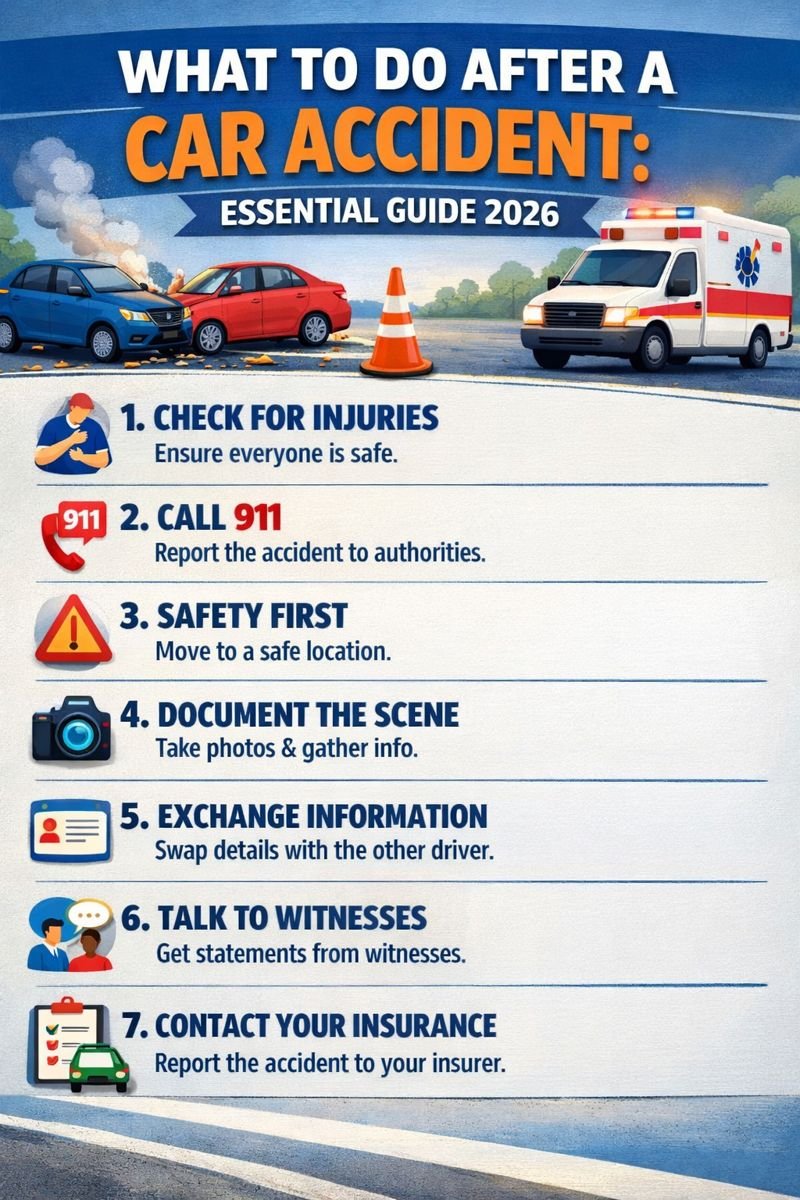
What to Do After a Car Accident: Essential Guide 2026
You're driving home. The light turns green. You move forward. Then—CRASH.
Your heart races. Hands shake. The other driver exits their car. What do you do now?
According to the National Highway Traffic Safety Administration (NHTSA), traffic fatalities declined 8.2% in early 2026, with 17,140 deaths reported from January through June. While deaths are decreasing, over 380,000 crashes still occur annually in states like Florida alone.
Bottom line: You have a 1 in 77 lifetime chance of dying in a car accident, but a much higher chance of being involved in one. What you do in the first minutes can mean the difference between a minor issue and a financial disaster.
At the Scene: Critical First Steps (0-30 Minutes)
1. NEVER Leave the Scene
Leaving an accident scene—even a fender-bender—is a crime in all 50 states. Penalties include:
- Jail time (up to 15 years if injuries involved)
- License suspension
- Fines up to $20,000
- Permanent criminal record
Action: Stop immediately. Turn off your engine. Stay calm.
2. Check for Injuries
Before anything else, assess yourself and passengers:
Ask yourself:
- Can I move my arms and legs?
- Am I bleeding or in pain?
- Am I dizzy or confused?
Important: Adrenaline masks pain. Whiplash, concussions, and internal injuries often appear hours or days later.
If anyone is seriously injured:
- Call 911 immediately
- Don't move them unless there's fire or danger
- Keep them calm and still
3. Move to Safety (If Possible)
For minor accidents with no injuries and drivable vehicles:
- Turn on hazard lights
- Move cars to the shoulder or parking lot
- Set up warning triangles 100+ feet behind
Before moving: Take quick photos of vehicle positions.
Note: California and Texas legally require you to move drivable vehicles.
4. Call 911 (Even for "Minor" Accidents)
Call police for ANY accident involving:
- Injuries (even slight)
- Non-drivable vehicles
- Suspected impaired drivers
- Uninsured drivers
- Damage over $1,000 (varies by state)
- Highway/interstate locations
- Aggressive behavior
When calling 911, provide:
- Exact location (use GPS)
- Number of vehicles
- Injury status
- Traffic hazards
5. Exchange Information
Get from the other driver:
Personal Information:
- Full name, phone, address
Driver's License:
- License number and state
- Take photo of license (front/back)
Insurance:
- Company name, policy number
- Take photo of insurance card
Vehicle:
- Make, model, year, color
- License plate and state
- VIN (visible through windshield)
6. What NOT to Say (Critical!)
NEVER say:
- ❌ "I'm sorry, this was my fault"
- ❌ "I wasn't paying attention"
- ❌ "I'm fine, don't worry"
- ❌ "Let's handle this without insurance"
Why? Anything you say can be used against you by insurance companies. Even "I'm sorry" can be interpreted as admitting fault.
Instead, say:
- ✅ "Are you okay?"
- ✅ "Let's exchange information"
- ✅ "I'll let police and insurance determine what happened"
7. Document EVERYTHING
Your smartphone is your most powerful evidence tool.
Photos to take:
Wide shots:
- Entire accident scene from multiple angles
- All vehicles involved
- Road conditions, traffic signs, skid marks
- Street signs (to show location)
Close-ups:
- Every scratch and dent on ALL vehicles
- License plates and VINs
- Broken glass, debris, fluid leaks
- Deployed airbags
- Your visible injuries
Pro tip: Record a video walkthrough while narrating what you see. This creates a timestamp and context.
8. Get Witness Information
If anyone saw the accident:
- Full name and phone number
- Brief description of what they saw
- Where they were standing
How to ask: "Excuse me, did you see what happened? Can I get your contact information for insurance purposes?"
Bonus: Record a brief video statement if they're willing (ask permission first).
9. Talk to Police
When officers arrive:
- Cooperate fully and be polite
- Stick to facts only
- Don't speculate about speed or distances
- Say "I don't remember" instead of guessing
Get from police:
- Officer's name and badge number
- Police report number
- How to obtain the report (usually online in 3-7 days)
After Leaving the Scene: Next 24-48 Hours
10. See a Doctor IMMEDIATELY
This is the #1 mistake people make.
Why you MUST see a doctor within 24 hours:
-
Delayed injuries are common:
- Whiplash (24-72 hours)
- Concussions (delayed symptoms)
- Internal bleeding (life-threatening)
- Soft tissue injuries (worsen over time)
-
Insurance will use delays against you:
- "If you were hurt, why didn't you see a doctor immediately?"
- They'll claim injuries happened elsewhere
-
Florida's 14-Day Rule:
- Must see doctor within 14 days or lose ALL PIP benefits
- This applies to Florida residents
Where to go:
- Emergency room (any pain, dizziness, visible injuries)
- Urgent care (moderate injuries)
- Primary doctor (same-day appointment)
What to tell the doctor: "I was in a car accident yesterday. I want a full examination even though I feel okay."
Be honest about ALL symptoms:
- Headache, neck/back pain
- Tingling, dizziness, nausea
- Trouble concentrating, sleep problems
Follow all treatment: Take medications, attend appointments, complete physical therapy. Insurance will argue you weren't hurt if you don't follow doctor's orders.
11. Report to YOUR Insurance
Most policies require reporting within 24-72 hours, even if not your fault.
Call and report:
- Date, time, location
- Basic facts
- Other driver's information
- Police report number
- Injuries
What NOT to do:
- ❌ Don't give detailed recorded statements yet
- ❌ Don't admit fault
- ❌ Don't sign anything without reading
- ❌ Don't accept settlement offers (too early)
12. DO NOT Talk to Other Driver's Insurance (Yet)
Within hours, you'll likely receive a friendly call from the other insurance company:
"We're so sorry about your accident. We just need a quick statement to process your claim faster..."
This is a trap.
Insurance adjusters are trained to:
- Get you to admit fault
- Minimize your injuries
- Lock you into statements before you know injury extent
- Record everything to use against you
What to say: "I appreciate the call, but I'm not comfortable giving a statement right now. I'm still seeing doctors. I'll contact you or my attorney once I understand my situation."
Remember: You are NOT legally required to give them a statement.
13. Start a Daily Journal
Document daily:
Symptoms:
- Pain levels (1-10 scale) for each body part
- New symptoms
- Medication effectiveness
Life Impact:
- Tasks you can't do (can't pick up kids, can't work)
- Activities canceled (missed work, events)
- Sleep disruption
- Emotional impact (driving anxiety, depression)
Example entry:
January 23, 2026 - Woke with 7/10 neck pain, worse than yesterday. Took ibuprofen at 8am. Couldn't turn head to check blind spot—had to turn whole body. Scary. Missed daughter's soccer game because sitting hurts. Saw Dr. Martinez—prescribed PT 3x/week. Cost: $40 copay.
Why it matters: Six months from now, you won't remember these details. A detailed journal proves your injuries were real and significant.
Days 2-7: Building Your Case
14. Get Police Report
Available 3-7 days after accident.
How to get:
- Online through police department website
- Call records department
- Visit station in person
- Cost: Usually $5-$25
Review for:
- Errors in facts
- Fault determination
- Citations issued
- Witness statements
15. Get Repair Estimates
Obtain 2-3 estimates from different body shops.
Tell them: "I need a detailed estimate. Please check for frame damage and hidden issues, not just cosmetic damage."
Important: Don't start repairs until insurance inspects and approves.
16. Organize Documents
Create a dedicated file with:
- Police report
- All photos/videos
- Witness information
- Insurance cards
- Medical bills and records
- Prescription receipts
- Pay stubs (lost wages)
- Daily pain journal
- All insurance correspondence
Pro tip: Scan everything and save to cloud storage (Google Drive, Dropbox).
When to Hire an Attorney
You DON'T Need an Attorney If:
- Very minor injuries (no medical treatment)
- Minimal vehicle damage
- Other driver clearly 100% at fault
- Insurance being reasonable
- Claim value under $5,000
You NEED an Attorney If:
Serious injuries:
- Surgery needed
- Permanent scarring
- Can't return to work
- Medical bills over $10,000
Disputed liability:
- Other driver claims you're at fault
- No witnesses
- Police report unclear
Insurance problems:
- Denying claim
- Unreasonably low offers
- Excessive delays
- Pressure to settle quickly
Special circumstances:
- Uninsured driver
- Commercial vehicle (truck, bus)
- Government vehicle
- Pedestrian/cyclist accident
- Rideshare (Uber/Lyft)
- Drunk driver
Why hire an attorney?
Studies show accident victims with attorneys recover 3.5 times more on average—even after paying fees.
Example:
- Without attorney: $20,000 settlement, keep $20,000
- With attorney: $75,000 settlement, attorney takes 33% ($24,750), keep $50,250
- You net $30,250 MORE
How to Find a Good Attorney
Look for:
- Specialization: Personal injury only (not general practice)
- Experience: 5-10+ years handling car accidents
- Fee structure: Contingency (no upfront costs, 33-40% of settlement)
- Communication: Returns calls promptly, explains clearly
- Reputation: Good reviews, bar association standing
Questions to ask:
- How many car accident cases have you handled?
- What's your success rate?
- What do you think my case is worth?
- What percentage fee do you charge?
- Who will work on my case?
- How often will you update me?
Red flags:
- ❌ Guarantees specific amounts
- ❌ Requires money upfront
- ❌ Pressure tactics
- ❌ Poor communication
- ❌ Never tried cases in court
Where to find attorneys:
- American Association for Justice
- State bar association referrals
- Martindale-Hubbell ratings
- Avvo lawyer directory
- Personal referrals
Free consultations are standard. Meet with 2-3 attorneys before deciding.
State-Specific Requirements (Key States)
California
- Report required: If injuries or damage over $1,000
- Report to DMV: Within 10 days (Form SR-1)
- Statute of limitations: 2 years
- Minimum insurance: $15,000/$30,000/$5,000
Texas
- Report required: If injuries or damage over $1,000
- Report to TxDOT: Within 10 days (Form CR-2)
- Statute of limitations: 2 years
- Minimum insurance: $30,000/$60,000/$25,000
Florida
- 14-Day Rule: Must see doctor within 14 days for PIP benefits
- Report to DMV: Within 10 days if injuries/death (Form 90010)
- Statute of limitations: 2 years (reduced from 4 in 2023)
- Minimum insurance: $10,000 PIP + $10,000 property damage
Louisiana (NEW LAW 2026)
- Comparative fault: 51% bar (if 51%+ at fault, you get NOTHING)
- Report to OMV: Within 24 hours if injuries
- Statute of limitations: 1 year (shortest in nation!)
- Minimum insurance: $15,000/$30,000/$25,000
Check your state's specific requirements at Insurance Information Institute.
Common Costly Mistakes
Mistake #1: Delaying Medical Treatment
Problem: Insurance argues injury wasn't from accident. Fix: See doctor within 24 hours, even if you feel fine.
Mistake #2: Posting on Social Media
Problem: Photos of you "having fun" used to deny claims. Fix: Set accounts to private. Don't post any physical activities.
Mistake #3: Accepting First Offer
Problem: Offers are typically 30-50% of actual value. Fix: Never accept first offer. Counter or consult attorney.
Mistake #4: Not Following Doctor's Orders
Problem: Insurance claims you weren't really hurt. Fix: Complete all recommended treatment.
Mistake #5: Lying or Exaggerating
Problem: Video surveillance catches you. Entire claim denied for fraud. Fix: Be completely honest. Truth is always enough.
Your Legal Rights
You Have the Right To:
✅ Choose your own doctor ✅ Choose your own repair shop ✅ Refuse recorded statements to other insurance ✅ Hire an attorney ✅ Take time to evaluate injuries ✅ Reject low settlement offers ✅ Review all documents before signing
You Are NOT Required To:
❌ Give statements to other driver's insurance ❌ Settle quickly ❌ Accept first offers ❌ Use their recommended doctors/shops ❌ Provide entire medical history
Quick Action Checklist
Immediately: ☐ Stay at scene ☐ Call 911 if injuries ☐ Move to safety ☐ Exchange information ☐ Take photos/videos ☐ Get witness info ☐ Don't admit fault
Within 24 Hours: ☐ See a doctor ☐ Report to YOUR insurance ☐ Start pain journal ☐ Organize documents
Within One Week: ☐ Get police report ☐ Get repair estimates ☐ Review insurance coverage ☐ Decline other insurance recorded statement ☐ Follow up with doctor
Ongoing: ☐ Attend all medical appointments ☐ Update pain journal daily ☐ Save all receipts ☐ Track missed work ☐ Avoid social media posts
Need Legal Help?
If you've been in a car accident and need experienced legal representation, LA Law Injury & Accident Attorney can help.
Why Choose Us:
- ✅ Over 20 years of experience
- ✅ Specialized in car accident cases
- ✅ Free consultation
- ✅ No fees unless we win
- ✅ Available 24/7
Contact Us Today: 📞 Call: 877-USA-TOP-LAW (877-872-8675) 📍 Location: 6125 Washington Blvd #300, Culver City, CA 90232 🌐 Website: lawaccidents.com
"You Don't Pay Unless We Win!"
Final Thoughts
Car accidents are overwhelming, but you now know exactly what to do. Remember:
- Stay calm and stay at the scene
- See a doctor within 24 hours (no exceptions)
- Document everything with photos
- Don't talk to other insurance without attorney
- Don't accept the first settlement offer
- Be honest but protect your rights
You're not trying to "get rich"—you're seeking fair compensation for medical bills, lost work, pain, and a disrupted life you didn't deserve.
Drive safe out there.
Additional Resources
National Organizations:
- NHTSA - National Highway Traffic Safety Administration
- Insurance Information Institute
- National Safety Council
Legal Resources:
- American Bar Association - Find a Lawyer
- Your State Bar Association
Government Resources:
- USA.gov - Accidents and Safety
- Your State DMV
- Your State Insurance Department
Disclaimer: This article provides general information only and does not constitute legal or medical advice. Laws vary by state and change frequently. For advice specific to your situation, consult with a licensed attorney. Last updated January 2026.
Keywords: car accident checklist, what to do after car accident, car crash guide 2026, accident documentation, insurance claim help, California car accident lawyer, personal injury attorney
Legal Disclaimer
This article provides general legal information only and does not constitute legal advice. Every accident case is unique and outcomes may vary. For specific legal guidance regarding your personal injury or accident claim, please consult with a qualified attorney licensed in your jurisdiction. Use of this website does not create an attorney-client relationship.