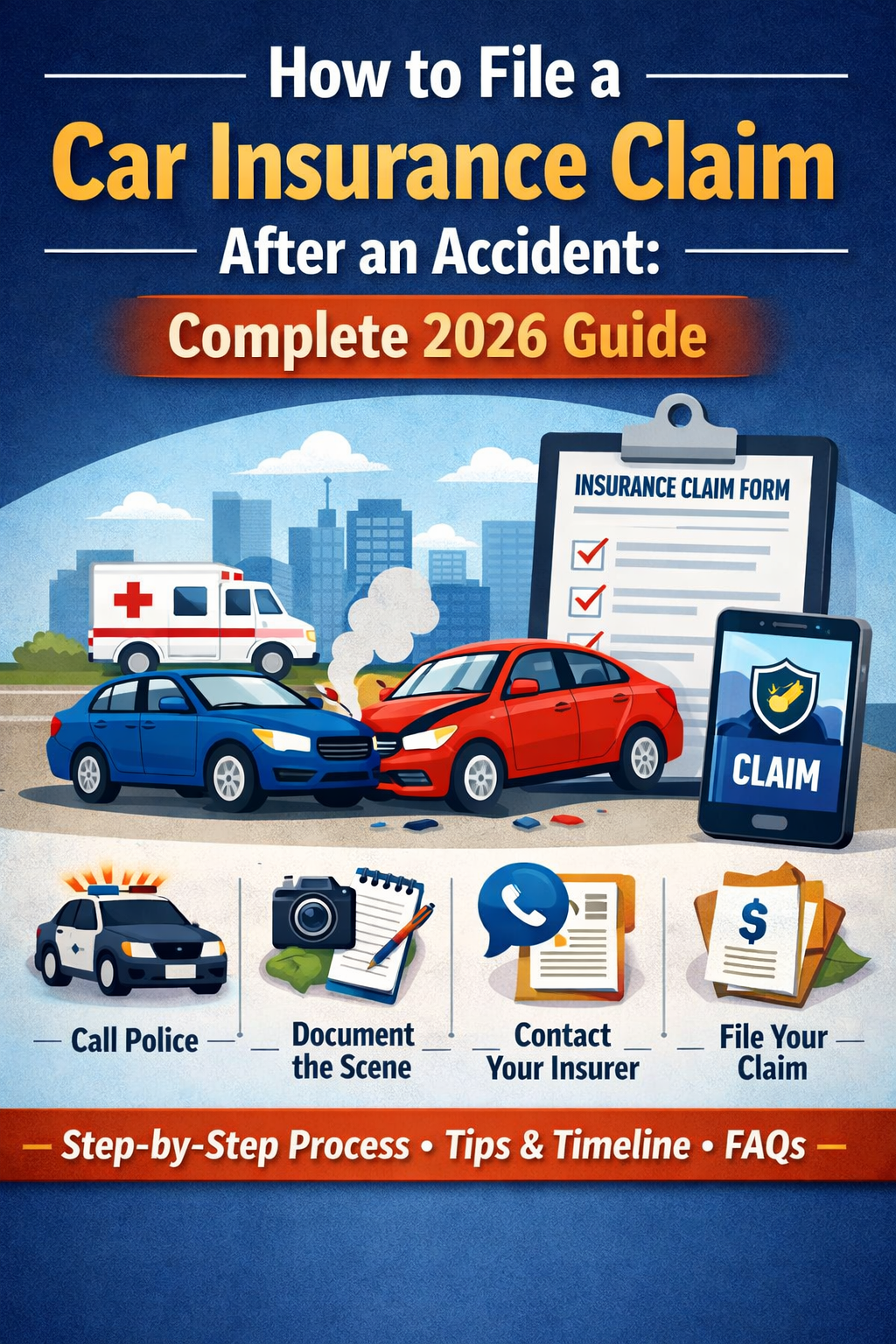
How to File a Car Insurance Claim After an Accident: Complete 2026 Guide (+ Settlement Tips)
Getting into a car accident is stressful enough—but navigating the car accident claim process doesn't have to be. Whether you're dealing with a minor fender-bender or a serious collision, understanding the insurance claim process for car accidents can mean the difference between a quick settlement and months of frustration.
This comprehensive guide walks you through every step of how to file a car insurance claim, from the moment of impact to final settlement, with expert insights that can help maximize your compensation.
Table of Contents
- Immediate Steps at the Accident Scene
- Understanding the Auto Insurance Claim Process
- How to File Your Claim: Step-by-Step
- What Information You'll Need
- Timeline: What to Expect
- Common Mistakes That Hurt Your Claim
- When to Hire an Attorney
- State-Specific Requirements
- Frequently Asked Questions
<a name="immediate-steps"></a>1. Immediate Steps at the Accident Scene (Critical First 30 Minutes)
The car accident insurance claim process actually begins at the accident scene. What you do in these first crucial minutes can significantly impact your claim's success.
Essential Actions (In Order of Priority):
Safety First (Minutes 1-5):
- Check for injuries—yours and others'
- Move to a safe location if possible
- Call 911 if there are injuries or significant property damage
- Turn on hazard lights and set up warning triangles
Document Everything (Minutes 5-20):
- Take photos from multiple angles (vehicles, damage, road conditions, traffic signs, skid marks)
- Record video if possible—walk around the scene narrating what you see
- Get the other driver's information (name, phone, insurance company, policy number, license plate)
- Collect witness names and contact information
- Note time, date, weather conditions, and exact location
Initial Report (Minutes 20-30):
- File a police report (required in most states for claims over $1,000)
- Get the police report number
- DO NOT admit fault or apologize excessively
- Avoid discussing settlement at the scene
💡 Pro Tip: Use your phone's voice recorder to dictate details while they're fresh in your memory. These notes can be invaluable later in the car accident claim procedure.
For a complete checklist of what to do immediately after an accident, read our What to Do After a Car Accident: Complete Step-by-Step Checklist 2026.
<a name="understanding-process"></a>2. Understanding the Auto Insurance Claim Process
Before diving into how to file car accident claim paperwork, it's essential to understand what type of claim you're filing.
Types of Car Insurance Claims
| Claim Type | When to Use | Who Pays | Average Processing Time |
|---|---|---|---|
| First-Party Claim | You file with YOUR insurance | Your insurer | 7-14 days |
| Third-Party Claim | You file with OTHER DRIVER's insurance | Other driver's insurer | 30-60 days |
| Uninsured Motorist Claim | Other driver has no insurance | Your insurer (UM coverage) | 30-90 days |
| Collision Coverage Claim | You were at fault or unsure | Your insurer | 14-30 days |
| Comprehensive Claim | Non-collision damage (theft, weather) | Your insurer | 7-21 days |
Key Insurance Terms You Need to Know
Deductible: The amount you pay out-of-pocket before insurance kicks in. Common deductibles range from $250 to $1,000.
Subrogation: When your insurance company pays your claim, then seeks reimbursement from the at-fault driver's insurance.
Diminished Value: The reduced resale value of your vehicle after an accident, even after repairs. Learn more about calculating this in our Car Accident Settlement Calculator 2026.
Comparative Negligence: How fault is divided in states where you can still recover damages even if partially at fault.
<a name="filing-steps"></a>3. How to File Your Claim: Step-by-Step Guide
Now let's break down exactly how to file insurance claim car accident paperwork with precision.
Step 1: Notify Your Insurance Company (Within 24-72 Hours)
How to report:
- Call your insurance company's claims department
- Use their mobile app (most major insurers have this)
- Report online through their website
- Have your policy number ready
What to say:
"I was involved in a car accident on [date] at [location].
I'd like to file a claim. Here's what happened..."
What NOT to say:
- "It was totally my fault" (even if you think it was)
- "I feel fine" (injuries may appear later)
- Accept any settlement offer immediately
⚠️ Critical: Even if you plan to file a third-party claim with the other driver's insurance, you MUST notify your own insurance company. Failure to do so could violate your policy terms.
Step 2: File the Official Claim
Required Information for Filing:
✅ Accident Details:
- Date, time, and location
- Police report number
- Description of how the accident occurred
- Weather and road conditions
✅ Driver Information:
- All drivers' names, addresses, phone numbers
- License numbers and states
- Insurance companies and policy numbers
✅ Vehicle Information:
- Make, model, year, VIN
- License plate numbers
- Estimated damage
✅ Witness Information:
- Names and contact details
- Brief statement of what they saw
✅ Documentation:
- Photos and videos
- Medical records (if injured)
- Repair estimates
Step 3: Work with the Insurance Adjuster
Within 24-48 hours of filing an insurance claim, an adjuster will be assigned to your case.
What the adjuster will do:
- Review your claim and documentation
- Inspect vehicle damage (in-person or via photos)
- Interview you about the accident
- Contact witnesses
- Review police reports
- Determine fault and liability
- Calculate the settlement amount
Your responsibilities:
- Respond promptly to all requests
- Provide additional documentation if requested
- Allow vehicle inspection
- Be honest but don't over-explain
- Keep records of all communications
Red Flags to Watch For:
- Adjuster pressuring you to settle quickly
- Offering lowball settlements without explanation
- Asking you to sign medical releases (consult attorney first)
- Requesting recorded statements without preparation
Step 4: Get Damage Assessments
For Vehicle Damage:
- Insurance company's approved repair shop (may be required)
- Your chosen repair shop (get multiple estimates)
- Independent appraisal if you disagree with insurer's estimate
For Injuries:
- See a doctor immediately (within 72 hours)
- Follow all treatment recommendations
- Keep all medical bills and records
- Document how injuries affect daily life
💰 Settlement Impact: Delaying medical treatment can reduce your settlement by 30-50%. Insurance companies argue that serious injuries require immediate treatment.
For understanding how injuries impact your settlement value, check our guide: How Much Can I Sue for a Car Accident Injury in 2026?
Step 5: Negotiate the Settlement
Initial Offer Strategy:
- First offers are typically 40-60% of actual claim value
- Don't accept the first offer unless it's exceptional
- Counter with documented justification
- Be prepared to negotiate 2-4 rounds
What to include in your demand:
- Property damage (vehicle repair/replacement)
- Medical expenses (current and future)
- Lost wages
- Pain and suffering
- Diminished vehicle value
- Rental car expenses
- Other out-of-pocket costs
Step 6: Close the Claim
Before accepting final settlement:
- Ensure all damages are covered
- Understand what you're releasing (future claims?)
- Review settlement agreement carefully
- Get everything in writing
- Consider attorney review for claims over $10,000
Payment methods:
- Direct deposit (fastest—3-5 business days)
- Check (7-14 business days)
- Payment to lienholders if applicable
<a name="required-information"></a>4. What Information You'll Need to File a Claim
Having organized documentation speeds up the car insurance claim process significantly. Here's your complete checklist:
Documentation Checklist
📋 Accident Scene Documentation:
- [ ] Photos of all vehicles (all angles)
- [ ] Photos of accident scene (skid marks, debris, traffic signs)
- [ ] Photos of injuries (if visible)
- [ ] Video footage if available
- [ ] Dashcam footage (if equipped)
- [ ] Police report number and copy
- [ ] Officer's name and badge number
📋 Driver & Vehicle Information:
- [ ] Other driver's name, address, phone
- [ ] Other driver's license number and state
- [ ] Other driver's insurance company and policy number
- [ ] Your vehicle's VIN, registration, insurance info
- [ ] Other vehicle's VIN, license plate, make/model
📋 Witness Information:
- [ ] Names and contact details of all witnesses
- [ ] Written or recorded statements (if possible)
- [ ] Witness positions relative to accident
📋 Medical Documentation:
- [ ] Emergency room records
- [ ] Doctor's notes and diagnoses
- [ ] Treatment plans
- [ ] Prescriptions and pharmacy receipts
- [ ] Physical therapy records
- [ ] Medical bills (all providers)
- [ ] Mileage logs for medical appointments
📋 Financial Documentation:
- [ ] Repair estimates (minimum 2-3)
- [ ] Rental car receipts
- [ ] Towing and storage receipts
- [ ] Lost wage documentation (pay stubs, employer letter)
- [ ] Property damage receipts (personal items)
📋 Communication Records:
- [ ] Log of all calls with insurance companies (date, time, person, summary)
- [ ] Copies of all emails
- [ ] Copies of all letters sent/received
- [ ] Claim number(s)
<a name="timeline"></a>5. Timeline: What to Expect in the Car Accident Insurance Claim Process
Understanding realistic timelines helps manage expectations during the car accident insurance process.
Typical Claim Timeline
| Phase | Timeframe | What Happens |
|---|---|---|
| Immediate (Day 0-1) | 24 hours | Report accident to insurance company |
| Initial Review (Day 1-7) | 1 week | Adjuster assigned, preliminary investigation begins |
| Investigation (Week 1-4) | 2-4 weeks | Vehicle inspection, statement collection, police report review |
| Liability Determination (Week 2-6) | 2-6 weeks | Fault assessed, coverage confirmed |
| Damage Assessment (Week 2-8) | 2-8 weeks | Repair estimates, medical bills reviewed |
| Negotiation (Week 4-12) | 1-3 months | Settlement offers, counteroffers |
| Settlement (Week 8-16) | 2-4 months | Agreement reached, payment processed |
Factors That Speed Up Your Claim
✅ Fast-Track Your Claim (Days to Weeks):
- Clear liability (other driver obviously at fault)
- Minor property damage only
- No injuries
- All documentation complete
- Both parties have insurance
- No disputes about facts
⏱️ Average Timeline Scenarios:
Simple rear-end collision, no injuries:
- First-party claim: 7-14 days
- Third-party claim: 30-45 days
Moderate accident with soft tissue injuries:
- Settlement timeline: 3-6 months
- (Wait until medical treatment complete)
Serious accident with significant injuries:
- Settlement timeline: 6-24 months
- May require litigation
Disputed liability or uninsured motorist:
- Settlement timeline: 6-18 months
- Often requires attorney involvement
State-Mandated Response Times
Many states require insurers to respond within specific timeframes:
| State | Acknowledgment | Investigation | Payment After Settlement |
|---|---|---|---|
| California | 15 days | 40 days to accept/deny | 30 days |
| New York | 15 days | 30 days | 30 days |
| Texas | 15 days | 15 days | 5 business days |
| Florida | 14 days | 30 days | 20 days |
| Pennsylvania | 15 days | 30 days | 30 days |
⚠️ Important: If your insurance company violates these timeframes, you may have grounds for a bad faith claim. Document all delays.
<a name="common-mistakes"></a>6. Common Mistakes That Destroy Your Car Accident Claim
Avoid these critical errors that reduce or eliminate compensation:
❌ Mistake #1: Delaying Medical Treatment
The Problem: Insurance companies argue that serious injuries require immediate treatment. A gap of even 3-5 days can be used against you.
The Solution: See a doctor within 72 hours, even if you "feel fine." Many injuries (whiplash, concussions, soft tissue damage) don't show immediate symptoms.
Real Impact: Claims with delayed treatment settle for 40-60% less on average.
❌ Mistake #2: Giving Recorded Statements Unprepared
The Problem: Adjusters are trained to ask questions that minimize your claim. Your recorded statement can be used against you.
What they're fishing for:
- Admissions of fault
- Inconsistencies with police report
- Downplaying injuries
- Pre-existing conditions
The Solution:
- Politely decline or request time to prepare
- Consult with an attorney first for significant claims
- If you must give a statement, stick to facts only
- Never speculate or guess
❌ Mistake #3: Accepting the First Settlement Offer
The Problem: Initial offers average 40-60% of actual claim value. Insurance companies hope you'll accept quickly due to financial pressure.
The Solution:
- Calculate your actual damages first (use our Car Accident Settlement Calculator)
- Counter with documented justification
- Be patient—most claims settle for 2-3x the initial offer
Example:
- Initial offer: $8,000
- Actual damages: $22,000
- After negotiation: $18,500
❌ Mistake #4: Posting on Social Media
The Problem: Insurance companies routinely monitor claimants' social media. A single photo can destroy your claim.
What they look for:
- Photos showing physical activity (contradicts injury claims)
- Check-ins at gyms, events, trips
- Posts about the accident
- Comments that could indicate fault
The Solution:
- Set all accounts to private immediately
- Don't post anything about the accident or injuries
- Don't accept friend requests from strangers
- Tell friends/family not to tag you
Real Case: Woman claimed severe back injury preventing work. Posted photos from zip-lining vacation. Claim denied.
❌ Mistake #5: Not Documenting Everything
The Problem: Memory fades. Without documentation, it's your word against the insurance company's.
The Solution: Create a claim file with:
- Photo journal of injuries (weekly for visible injuries)
- Pain diary (daily notes on pain levels, limitations)
- Expense tracker (every medical visit, medication, mileage)
- Communication log (all calls, emails with insurers)
❌ Mistake #6: Signing Medical Authorizations Too Broadly
The Problem: Insurers may request authorization to access ALL your medical records, including unrelated pre-existing conditions they can use against you.
The Solution:
- Limit authorizations to accident-related records only
- Specify date ranges
- Have an attorney review before signing
- Never sign blanket authorizations
❌ Mistake #7: Handling Major Claims Without Legal Help
The Problem: Insurance companies have teams of lawyers and adjusters. You're at a disadvantage.
When you NEED an attorney:
- Injuries requiring surgery or ongoing treatment
- Permanent disability or disfigurement
- Disputed liability (each party blames the other)
- Claims over $25,000
- Dealing with commercial vehicles or trucks
- Insurance company denies claim or acts in bad faith
- Multiple parties involved
For guidance on finding the right legal help, see our article: Trucking Crash Lawyer: Your Complete Guide to Hiring the Right Attorney in 2026
Statistics: Represented claimants receive settlements 3.5x higher on average than unrepresented claimants, even after attorney fees.
<a name="when-to-hire"></a>7. When to Hire an Attorney for Your Car Accident Claim
Not every car accident claim procedure requires legal representation, but knowing when to hire can dramatically impact your settlement.
Hire an Attorney Immediately If:
🚨 Serious Injuries Present:
- Fractures or broken bones
- Traumatic brain injury (TBI)
- Spinal cord injuries
- Severe burns
- Amputations
- Scarring or disfigurement
- Injuries requiring surgery
- Permanent disability
🚨 Liability Is Disputed:
- Other driver denies fault
- No police report was filed
- Witness statements conflict
- Multiple vehicles involved
- Unclear accident circumstances
🚨 Complex Claims:
- Commercial truck accidents
- Government vehicles involved
- Defective auto parts suspected
- DUI driver involved
- Hit-and-run accident
- Rideshare (Uber/Lyft) accidents
🚨 Insurance Problems:
- Claim was denied
- Offered settlement is unreasonably low
- Adjuster is unresponsive
- Bad faith insurance practices suspected
- Policy limits disputes
- Multiple insurance policies involved
🚨 Significant Damages:
- Medical bills exceed $10,000
- Expected future medical treatment
- Long-term disability or lost earning capacity
- Emotional trauma or PTSD
- Property damage exceeding $15,000
Consider an Attorney If:
⚖️ You're uncomfortable negotiating ⚖️ You don't understand the legal process ⚖️ You have pre-existing injuries ⚖️ You're being pressured to settle quickly ⚖️ The at-fault driver is uninsured/underinsured ⚖️ Lost wages exceed 4 weeks
You Probably Don't Need an Attorney If:
✅ Minor property damage only (under $5,000) ✅ No injuries whatsoever ✅ Clear liability (obviously other driver's fault) ✅ Insurance company offers fair settlement quickly ✅ No disputes about facts or coverage
How Attorneys Charge (Contingency Fees)
Most personal injury attorneys work on contingency:
| Settlement Stage | Typical Attorney Fee |
|---|---|
| Pre-litigation settlement | 33.3% (1/3) |
| After lawsuit filed | 40% |
| After trial | 40-45% |
Example:
- Settlement: $60,000
- Attorney fee (33%): $20,000
- Your net: $40,000
Without attorney:
- Insurance offer: $18,000
- Your net: $18,000
You gained $22,000 by hiring representation, even after fees.
💡 Free Consultations: Most car accident attorneys offer free initial consultations. There's no risk in getting a professional opinion on your case value.
<a name="state-requirements"></a>8. State-Specific Requirements for Filing Car Insurance Claims
The car collision insurance procedure varies significantly by state. Here's what you need to know:
At-Fault vs. No-Fault States
At-Fault States (Tort States): The driver who caused the accident is financially responsible. You file a claim against the at-fault driver's insurance.
No-Fault States: You file with your own insurance (PIP coverage) regardless of who caused the accident, unless injuries meet the state's "serious injury threshold."
No-Fault States (As of 2026):
- Florida
- Hawaii
- Kansas
- Kentucky
- Massachusetts
- Michigan
- Minnesota
- New Jersey
- New York
- North Dakota
- Pennsylvania
- Utah
State-by-State Claim Filing Deadlines
| State | Personal Injury Statute of Limitations | Property Damage Statute of Limitations |
|---|---|---|
| California | 2 years | 3 years |
| Texas | 2 years | 2 years |
| Florida | 4 years | 4 years |
| New York | 3 years | 3 years |
| Pennsylvania | 2 years | 2 years |
| Illinois | 2 years | 5 years |
| Ohio | 2 years | 4 years |
| Georgia | 2 years | 4 years |
| North Carolina | 3 years | 3 years |
| Michigan | 3 years | 3 years |
⚠️ Critical: These are deadlines to FILE A LAWSUIT, not insurance claims. File insurance claims within days, but be aware of litigation deadlines if negotiations fail.
Minimum Required Insurance by State (Top 10 Most Populous)
Understanding minimum coverage helps you know what you're working with:
| State | Minimum Liability Coverage | Uninsured Motorist Coverage |
|---|---|---|
| California | 15/30/5 | Optional |
| Texas | 30/60/25 | Optional |
| Florida | 10/20/10 + $10k PIP | Optional |
| New York | 25/50/10 + $50k PIP | 25/50/10 (required) |
| Pennsylvania | 15/30/5 + $5k PIP | Optional |
| Illinois | 25/50/20 | 25/50/20 (required) |
| Ohio | 25/50/25 | Optional |
| Georgia | 25/50/25 | Optional |
| North Carolina | 30/60/25 | 30/60/25 (required) |
| Michigan | PIP + 50/100/10 | Required |
Format: Bodily Injury per person/per accident/Property Damage (in thousands)
Special State Requirements
California:
- Must report accidents causing injury or death within 10 days (SR-1 form)
- Must exchange information at scene (VC 16025)
New York:
- No-fault PIP covers first $50,000 in medical bills
- Must file MV-104 form for accidents with injury, death, or damage over $1,000
Florida:
- Must report crashes involving injury, death, or property damage over $500
- PIP covers 80% of medical bills, 60% of lost wages
Texas:
- Police report required if damage exceeds $1,000
- Accident must be reported to TxDOT within 10 days
<a name="faq"></a>9. Frequently Asked Questions About Filing Car Insurance Claims
How long do I have to file a car insurance claim after an accident?
Insurance companies: Most require notification within 24-72 hours, though policies typically allow up to 1 year. However, delayed reporting can lead to claim denial.
Best practice: Report to your insurer within 24 hours, even if you're not at fault. This protects you and doesn't mean you're admitting fault.
Legal deadlines (statutes of limitations): Range from 2-6 years depending on your state, but this is for lawsuits, not insurance claims.
Should I file with my insurance or the other driver's insurance?
File with the other driver's insurance (third-party claim) if:
- They were clearly at fault
- They have adequate insurance coverage
- You want to avoid your rates increasing
- You don't want to pay your deductible
File with your own insurance (first-party claim) if:
- Fault is unclear or disputed
- The other driver is uninsured/underinsured
- You need faster payment
- You have collision coverage
Best strategy: Notify both insurers. Let them determine fault and handle subrogation.
Will filing a claim raise my insurance rates?
Generally NO if:
- You're 0% at fault
- You're filing a comprehensive claim (not collision)
- It's your first claim in 3-5 years
Generally YES if:
- You're 50% or more at fault
- You've filed multiple claims
- The payout exceeds $2,000-$5,000
Average rate increases:
- At-fault accident: 20-50% increase
- Not-at-fault accident: 0-12% increase (varies by state and insurer)
What if the other driver doesn't have insurance?
Options:
- Uninsured Motorist (UM) Coverage: File with your own insurance if you have UM coverage
- Collision Coverage: Use your collision coverage, pay deductible
- Sue the Driver Personally: File a lawsuit (may be difficult to collect)
- State Victim Compensation Funds: Some states offer limited assistance
According to the Insurance Research Council, approximately 13% of drivers are uninsured nationwide (up to 25% in some states like Florida and New Mexico).
Can I choose my own repair shop?
Yes, in most states. You have the right to choose your repair shop, though:
Insurance-preferred shops:
- May offer guaranteed warranties
- Usually have direct billing arrangements
- Faster claims processing
Your chosen shop:
- You trust the quality
- May cost more out-of-pocket initially
- Insurance must still pay reasonable costs
Best practice: Get estimates from both and compare. For rear-end collision specifics, check our guide on Rear-End Collision Settlement Amounts 2026.
What is "subrogation" and how does it affect me?
Subrogation is when your insurance company pays your claim, then recovers the money from the at-fault driver's insurance.
How it affects you:
- You get paid faster (don't wait for the other insurance)
- Your deductible may be reimbursed later
- You may need to cooperate with your insurer's recovery efforts
- If your insurer recovers money, you may get your deductible back
Should I get a lawyer for a minor accident?
Probably not if:
- Property damage only, under $5,000
- No injuries whatsoever
- Clear liability
- Insurance offers reasonable settlement quickly
Consider a lawyer if:
- Any injury, even minor (soft tissue, whiplash)
- Medical bills exceed $2,500
- You're uncomfortable negotiating
- Insurance company is difficult
Free consultations mean there's no harm in getting a professional opinion. Most personal injury attorneys will honestly tell you if your case doesn't need representation.
How is "pain and suffering" calculated?
Two main methods:
1. Multiplier Method:
- Special damages (medical bills + lost wages) × multiplier (1.5 to 5)
- Minor soft tissue: 1.5-2x
- Moderate injuries: 2-3x
- Severe/permanent: 3-5x+
Example:
- Medical bills: $15,000
- Lost wages: $5,000
- Total special damages: $20,000
- Multiplier (moderate): 3x
- Pain and suffering: $60,000
- Total claim: $80,000
2. Per Diem Method:
- Daily rate × number of days in pain
- Often uses your daily wage rate
Both methods are starting points for negotiation. Learn more about calculating your complete settlement in our Car Accident Settlement Calculator 2026: What's Your Claim Really Worth?
What if I was partially at fault?
Depends on your state's law:
Pure Contributory Negligence (4 states: AL, DC, MD, NC, VA):
- If you're even 1% at fault, you recover NOTHING
- Harshest rule in the country
Modified Comparative Negligence (33 states):
- You can recover if you're less than 50% (or 51%) at fault
- Your recovery is reduced by your fault percentage
- Example: $100,000 settlement × 30% your fault = $70,000 recovery
Pure Comparative Negligence (13 states):
- You can recover even if 99% at fault
- Recovery reduced by your fault percentage
- Example: $100,000 settlement × 90% your fault = $10,000 recovery
How long does it take to get paid after settling?
Typical payment timeline:
- Direct deposit: 3-5 business days after signing release
- Physical check: 7-14 business days
- Large settlements: May take 30 days (multiple approval levels)
If payment is delayed beyond stated timeframe:
- Contact your adjuster immediately
- Document the delay
- Check your state's prompt payment laws
- May be grounds for bad faith claim or interest
Can I reopen a claim after settling?
Generally NO. When you sign a release, you're giving up the right to future claims related to that accident.
Exceptions:
- Fraud by the insurance company
- Mutual mistake about the extent of injuries
- Release was signed under duress
- New injuries discovered that were unknown and unknowable at settlement
This is why it's critical to:
- Complete all medical treatment before settling
- Understand what you're releasing
- Consult an attorney for significant injuries
- Never rush settlement if healing is incomplete
What if the insurance company denies my claim?
Common denial reasons:
- Late reporting
- Policy exclusions
- Lapsed coverage
- Coverage limits exceeded
- Disputed liability
Steps to take:
- Request written explanation of denial reasons
- Review your policy carefully
- Gather additional evidence addressing denial reasons
- File internal appeal with insurance company
- Contact your state's Department of Insurance
- Consult an attorney about bad faith claim
- Consider litigation if denial is improper
Resources:
- National Association of Insurance Commissioners
- Your state's Department of Insurance website
- Free consultation with personal injury attorney
Final Thoughts: Maximizing Your Car Accident Insurance Claim
Successfully navigating the car accident claim process requires preparation, documentation, and strategic decision-making. Remember these key principles:
✅ Act Quickly: Report within 24 hours, document everything at the scene, seek medical care immediately.
✅ Document Thoroughly: Photos, medical records, receipts, communication logs—if it's not documented, it doesn't exist.
✅ Don't Rush: The first offer is rarely the best offer. Calculate your actual damages before negotiating.
✅ Protect Your Claim: Avoid social media, don't give recorded statements unprepared, and never admit fault.
✅ Know When to Get Help: For serious injuries, disputed liability, or claims over $10,000, consult an attorney.
✅ Understand Your Rights: Know your state's laws, coverage requirements, and deadlines.
The difference between a mediocre settlement and maximum compensation often comes down to knowledge and preparation. Armed with the information in this guide, you're now equipped to handle the auto insurance claim process confidently and effectively.
Additional Resources
Internal Resources from LawAccidents.com:
- What to Do After a Car Accident: Essential Guide 2026 - Immediate action steps for the accident scene
- Car Accident Settlement Calculator 2026 - Calculate what your claim is really worth
- Rear-End Collision Settlement Amounts 2026 - Specific guidance for rear-end accidents
- How Much Can I Sue for a Car Accident Injury? - Understanding injury claim values
External Resources:
- National Highway Traffic Safety Administration (NHTSA) - Safety data and accident statistics
- Insurance Information Institute - Consumer insurance education
- National Association of Insurance Commissioners - State insurance department contacts
- American Bar Association - Accident Claims - Legal resources and attorney referrals
About This Guide
This comprehensive guide to filing car insurance claims after an accident was created to provide real, actionable value to accident victims navigating one of life's most stressful situations. The information is current as of 2026 and based on standard insurance practices, state laws, and industry data.
Legal Disclaimer: This guide is for informational purposes only and does not constitute legal advice. Insurance laws and claim procedures vary by state and individual circumstances. For specific legal advice about your claim, consult with a qualified attorney in your jurisdiction.
Last Updated: February 2026
Was this guide helpful? For more essential legal resources and guides, visit LawAccidents.com - your complete resource for car accident claims, settlements, and legal guidance.
Legal Disclaimer
This article provides general legal information only and does not constitute legal advice. Every accident case is unique and outcomes may vary. For specific legal guidance regarding your personal injury or accident claim, please consult with a qualified attorney licensed in your jurisdiction. Use of this website does not create an attorney-client relationship.