12 Mistakes That Can Quietly Wreck Your Car Accident Claim
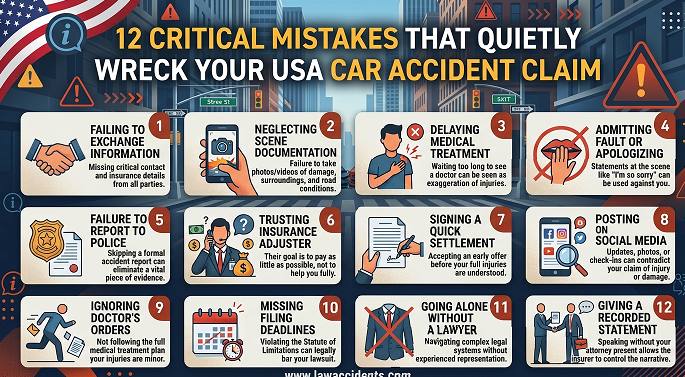
12 Mistakes That Can Quietly Wreck Your Car Accident Claim
You did nothing wrong. The other driver ran the light, or rear-ended you at a stop sign, or drifted into your lane. And yet, months later, the insurance company is offering you a fraction of what your medical bills actually cost — and you can't figure out why.
Nine times out of ten, the answer isn't that your case was weak. It's that somewhere in the first few days or weeks, a small, ordinary-seeming decision handed the adjuster a reason to discount your claim. Insurance adjusters aren't evaluating your case on fairness. They're trained to look for specific gaps — in your medical records, your statements, your documentation — that justify a lower number. This guide walks through the mistakes that create those gaps, in the order they typically happen, from the scene of the crash to the moment you're deciding whether to accept an offer.
1. Not Calling the Police — Even for a "Minor" Accident
It's tempting to skip this step when the damage looks small and everyone seems fine. But a police report is often the single most persuasive piece of evidence in a claim, because it's created by a neutral third party at the scene, before either driver has had time to reconsider their story.
Without one, your case can come down to your word against the other driver's — and if their account shifts later ("I thought I had the right of way," "the light was still yellow"), you have nothing independent to point to. Most states require you to report an accident above a certain damage or injury threshold anyway; check your state's specific reporting requirement, since thresholds vary.
What to do instead: Call 911 or the non-emergency police line at the scene, even for a fender-bender. If officers say a report "isn't necessary" for property-damage-only accidents in your state, ask how to file one yourself — most states let you self-report online within a set number of days.
2. Skipping the Medical Exam Because You "Feel Fine"
This is the single most common — and most costly — mistake. Adrenaline is a genuine painkiller. Soft-tissue injuries, whiplash, and even some concussions frequently don't produce noticeable symptoms for 24 to 72 hours, sometimes longer.
Here's the problem that creates: insurance companies look for a documented, unbroken line between the crash and your injury. If your first medical visit is five days later, an adjuster will argue — sometimes successfully — that something else caused your pain in that gap. It doesn't matter if that's medically implausible. It matters that it's arguable, and "arguable" is enough to justify cutting your settlement.
What to do instead: Get evaluated the same day, even if that just means an urgent care visit rather than an ER trip. If new symptoms appear days later, see a doctor immediately and tell them specifically that it's related to the accident — that sentence needs to be in the chart.
3. Giving a Recorded Statement to the Other Driver's Insurer
Shortly after a crash, you may get a call from the at-fault driver's insurance company asking to "get your side of the story" on a recorded line. It sounds routine. It is not neutral.
These calls are conducted by professionals trained to ask questions in a way that produces useful admissions — "How are you feeling today?" invites "I'm okay" on record, which later gets used to argue you weren't seriously hurt. "Can you walk me through what happened?" invites hedging language ("I think," "maybe," "it happened pretty fast") that gets replayed later to suggest uncertainty about fault.
What to do instead: You're generally not obligated to give a recorded statement to the other party's insurer (your own insurer's cooperation clause is a different matter — check your policy). It's reasonable to say: "I'll provide documentation, but I'm not comfortable giving a recorded statement right now." If you've hired an attorney, all such requests should go through them.
4. Posting About the Accident — or Anything Physical — on Social Media
Claims adjusters routinely check claimants' public social media. This isn't a rumor; it's a documented part of standard claims investigation practice. A photo of you at a birthday party three weeks after your crash, smiling and standing normally, can be introduced as evidence that your injuries are less severe than you're claiming — even if you were in pain the entire time and left early.
It doesn't have to be about the accident directly. "Went for a short walk today, feeling a little better" is exactly the kind of post that gets screenshotted into a claims file.
What to do instead: Set accounts to private and, ideally, pause posting about your activities and health until your claim resolves. Ask friends not to tag you in posts during this period.
5. Waiting Too Long to Start — or Continue — Treatment
Gaps in treatment are one of the most common reasons adjusters reduce a settlement offer, and one of the easiest to accidentally create. Real life gets in the way: work schedules, childcare, a physical therapy copay you didn't budget for, or simply feeling like you're "handling it."
Each gap becomes a talking point: "The claimant went eight weeks without treatment — clearly the injury wasn't serious enough to require ongoing care." It doesn't matter that the real reason was a scheduling conflict.
What to do instead: If you have to miss or delay an appointment, document why (a text to your doctor's office, a note in your own records) and reschedule as soon as possible. If cost is the barrier, ask your provider about liens or deferred payment — many personal injury-focused clinics work this way specifically because they understand this timing problem.
6. Not Documenting Lost Income Properly
"I missed about two weeks of work" is a claim. A letter from your employer stating your exact dates missed, your hourly or salary rate, and total wages lost is proof. Insurers pay proof, not claims.
This mistake is especially costly for self-employed people, freelancers, tipped workers, and anyone paid partly in commission or overtime — all of which are harder to document after the fact and easy for an adjuster to dispute or minimize if you didn't track them contemporaneously.
What to do instead: Request a formal wage-loss letter from your employer on company letterhead as soon as you know you'll miss work. If you're self-employed, save invoices, canceled contracts, or client communications showing income you couldn't earn because of your injury.
7. Signing a Medical Records Release That's Broader Than Necessary
Insurers will often send a "medical authorization" form that, if signed as written, gives them access to your entire medical history — not just records related to the crash. This isn't an accident. If you had a prior back complaint five years ago, even an unrelated one, it becomes ammunition to argue your current injury is "pre-existing" rather than caused by the accident.
What to do instead: Read any authorization before signing, and where possible, limit it to records related to the accident and treatment dates in question. If a broad release is genuinely required for your claim, understand what you're releasing before you sign it.
8. Accepting the First Settlement Offer
Initial offers are calculated to be low — that's not cynicism, it's simply how claims are typically evaluated internally: adjusters often have authority to settle within a range, and the opening number in that range is rarely the top of it. Many claimants accept quickly because they're dealing with mounting bills and want the situation over.
The problem is that once you sign a release, the claim is closed permanently — even if you later discover the injury requires surgery, or symptoms that seemed minor turn out to be lasting.
What to do instead: Don't accept or reject a first offer on the spot. Get it in writing, take time to compare it against your actual documented losses (all medical bills, lost wages, and a reasonable estimate for pain and suffering), and respond with a counter grounded in your documentation rather than accepting or refusing based on gut feeling alone.
9. Settling Before Reaching Maximum Medical Improvement (MMI)
MMI is the point where your doctor determines your condition has stabilized — either fully healed or as healed as it's going to get. Settling before this point means guessing at future costs, and once you settle, you can't come back and ask for more if it turns out you needed additional surgery or ongoing therapy.
What to do instead: In general, avoid finalizing a settlement until your treating physician can speak to whether your condition has stabilized, unless a statute of limitations deadline is genuinely forcing your hand — in which case a lawsuit may need to be filed to preserve your rights even while treatment or negotiation continues.
10. Not Knowing Your Own Policy's Coverage
Many drivers don't know whether they carry uninsured/underinsured motorist (UM/UIM) coverage, or what their MedPay or PIP limits actually are, until after a serious crash — sometimes only when they discover the at-fault driver's coverage won't cover their bills.
What to do instead: Pull your declarations page today, before you need it. Know your UM/UIM limits, MedPay/PIP limits, and rental reimbursement coverage. This single step can be the difference between a covered gap and an uncovered one after a serious crash.
11. Missing the Statute of Limitations — or the Much Shorter Government Claim Deadline
Every state sets a deadline for filing a personal injury lawsuit, typically two to three years from the date of the crash, though this varies by state and by claim type. Miss it, and you generally lose the right to sue entirely, regardless of how strong your case was.
There's a much narrower trap here that catches people off guard: if a government vehicle or a road defect was involved, most states require a formal notice of claim within a far shorter window — sometimes as little as 60 to 180 days. This deadline is easy to miss because it doesn't feel like "the" deadline; it feels like paperwork.
What to do instead: Confirm your state's statute of limitations and, separately, ask specifically whether any government entity was involved in your accident (a city bus, a pothole, a malfunctioning traffic signal) — that question alone can save a claim.
12. Negotiating a Serious Injury Claim Without Help
Not every accident needs a lawyer. A low-speed fender-bender with no injuries and clear fault often resolves fine without one. But once an injury requires ongoing treatment, involves any dispute over fault, or the offer doesn't come close to covering your actual bills, the calculation changes — attorneys typically work on contingency, meaning there's no upfront cost, and studies of claims data have generally shown represented claimants recover more, even after fees, than unrepresented ones in comparable cases.
What to do instead: A free consultation costs nothing and gives you a second opinion on whether you're being offered a fair number — even if you decide not to hire anyone.
The Pattern Behind All Twelve
Look back at this list and a pattern emerges: almost none of these mistakes involve doing something wrong. They involve not documenting something, or not knowing something, at the moment it mattered most. Insurance companies aren't necessarily acting in bad faith when they use these gaps — they're applying a consistent process to every claim that crosses their desk. Your job isn't to out-argue that process. It's to not hand it a gap to work with in the first place.
This article is for general informational purposes only and does not constitute legal advice. Insurance practices and legal deadlines vary by state and by the specific facts of your case. If you have questions about a specific accident, consult a licensed attorney in your state.
Comments (0)