Volkswagen Recalls 208,724 U.S. Vehicles Over Steering Bolt Failure — Check Your VIN Now
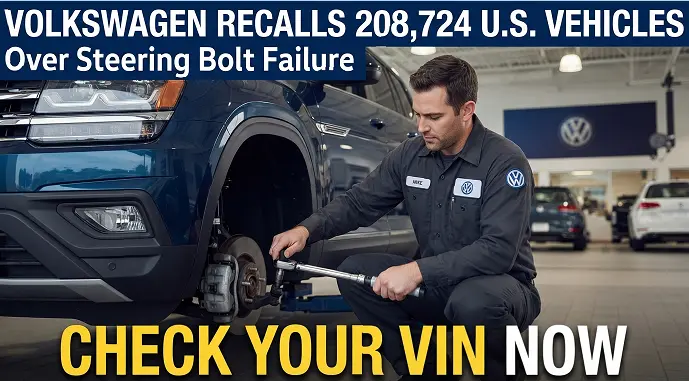
Volkswagen Recalls 208,724 U.S. Vehicles Over Steering Bolt Failure — Check Your VIN Now
Newsroom · Not a law firm · Published September 18, 2026 · Updated regularly as new information becomes available
Quick facts
- What: Volkswagen Group of America is recalling 208,724 vehicles in the United States over a steering rack mounting bolt that can corrode and break.
- Models affected: Certain 2018 Volkswagen Tiguan, 2018–2019 Volkswagen Atlas, and 2019–2021 Audi Q3 vehicles.
- The risk: A broken bolt can leave the steering rack attached at only one point, which NHTSA says can lead to a loss of steering control and a higher risk of a crash.
- The fix: Dealers will replace the right-side steering rack mounting bolt with a corrosion-resistant version, free of charge.
- What to do right now: Look up your 17-character VIN at NHTSA.gov/recalls to confirm whether your specific vehicle is included.
What happened
On Friday, September 18, 2026, the National Highway Traffic Safety Administration (NHTSA) confirmed that Volkswagen Group of America is recalling more than 208,000 vehicles sold under the Volkswagen and Audi brands. The problem centers on a single bolt — the right-side bolt that mounts the steering rack to the front subframe — that can corrode over time, snap, and compromise a driver's ability to steer.
According to reporting based on the NHTSA filing, the recall covers certain model-year 2018 Tiguan, 2018–2019 Atlas, and 2019–2021 Audi Q3 vehicles. Volkswagen has said dealers will inspect and replace the affected bolt with a more corrosion-resistant version at no cost to owners.
This is not a case of a brand-new defect showing up in current-year vehicles. The vehicles involved are between five and eight years old, which is a reminder that recall risk doesn't disappear once a car is out of its original warranty period — corrosion-related defects, in particular, often take years of real-world exposure to moisture, road salt, and temperature cycling before they surface.
Why this recall took nearly two years to reach owners
Recalls like this one rarely start with a single dramatic event. Automakers are legally required to investigate safety complaints and report to NHTSA once they determine a defect exists, but building that case can take a long time — and in this instance, it did.
Based on the manufacturer's own account of the investigation timeline:
- October 2024: Volkswagen received its first report of the issue from a market outside North America — a vehicle with a corroded steering rack bolt and a fractured housing.
- Through January 2025: The company ran a cross-functional investigation involving engineering, supplier, production, and materials specialists. Examining the returned parts confirmed a corrosion-driven fracture at the bolt head, and engineers began studying how moisture was reaching the mounting area in the first place.
- August 2025 and December 2025: Additional field reports came in, while Volkswagen continued evaluating alternative bolt coatings.
- September 2025: Volkswagen settled on a remedy — a bolt treated with a highly corrosion-resistant polymer coating.
- August 2026: A further review found that a fractured steering rack housing might not be obvious to the driver right away, which raised the safety stakes and helped finalize the decision to recall.
Volkswagen has said the underlying production condition was phased out between June 2018 and July 2021, which lines up with the affected model years. Owner notification letters are expected to go out around November 10, 2026, but VINs are already searchable in NHTSA's public database ahead of that mailing — which is exactly why checking your VIN now, rather than waiting for a letter, matters.
How the defect actually works
It helps to understand what's physically happening inside the front end of an affected vehicle, because the failure mode explains both the danger and the warning signs.
The steering rack — the mechanical unit that translates the turning of your steering wheel into the left-right movement of your front wheels — is bolted to the front subframe at two mounting points. On the affected vehicles, moisture can work its way into the area around the right-side mounting bolt. Over years of exposure, that moisture drives corrosion in the bolt itself.
If the bolt corrodes enough, it can fracture. When that happens, the steering rack doesn't necessarily fall off completely — it usually remains attached at the other mounting point. But with only one bolt holding a component that's designed to be secured at two points, the rack housing is under abnormal stress every time you turn the wheel. Continue driving in that condition, and the housing itself can eventually crack, at which point the vehicle can lose effective steering control.
NHTSA and Volkswagen have flagged that this kind of failure is most likely to become apparent during parking maneuvers or low-speed turns, when steering effort and wheel angle are at their highest — not necessarily at highway speed.
Warning signs to watch for
Volkswagen's filing notes that drivers may get an early warning before a full failure occurs. If you own one of the affected models, pay attention to:
- A metallic rattling, clunking, or knocking noise coming from the front axle area, especially when turning
- Looser, vaguer, or inconsistent steering feel, particularly at low speeds or while parking
- Any unusual vibration through the steering wheel during turns
- Uneven or unexpected tire wear on the front axle (a secondary sign of a steering geometry problem)
None of these symptoms are unique to this specific defect — they can indicate several different suspension or steering issues. But if you drive an affected Tiguan, Atlas, or Q3 and notice any of them, treat it as a reason to get the vehicle inspected promptly rather than waiting for your official recall letter.
Which vehicles are affected
The recall spans three model lines across two brands. Based on the U.S. unit breakdown reported alongside the recall:
| Brand / Model | Model Years | Approx. U.S. Units Affected |
|---|---|---|
| Volkswagen Atlas | 2018–2019 | ~82,601 |
| Volkswagen Tiguan | 2018 | ~85,713 |
| Audi Q3 | 2019–2021 | ~40,410 |
| Total | 208,724 |
Not every vehicle within these model years is necessarily affected — recalls are typically tied to specific production date ranges and build plants, not an entire model year across the board. That's exactly why NHTSA requires a VIN-specific lookup rather than a blanket "if you own a 2018 Tiguan, you're affected" rule. Two vehicles of the identical trim and model year, built weeks apart, can fall on opposite sides of a recall population.
How to check your VIN right now
You don't need to wait for a letter in the mail, and you don't need to go through a dealership to find out if your car is included. NHTSA's recall lookup tool is free, official, and takes under a minute.
- Find your 17-character VIN. It's on your vehicle registration, insurance card, dashboard (visible through the windshield on the driver's side), or driver-side door jamb sticker.
- Go to NHTSA.gov/recalls.
- Enter your VIN in the search field. Do not enter your license plate number — the tool searches by VIN only.
- Review the results. If your vehicle has an open recall, it will list the campaign, a description of the defect, and the remedy.
- If it's included, contact an authorized Volkswagen or Audi dealer to schedule the free repair. You can also call Volkswagen customer service or use the "find a dealer" tool on VW.com or Audi.com.
You can also sign up for free ongoing recall alerts tied to your VIN through NHTSA's SaferCar mobile app or its email alert system, so you're notified automatically if new recalls are issued for your vehicle in the future.
What the remedy involves
For vehicles confirmed to be in the recall population, the repair itself is described as straightforward: dealers will remove the existing right-side steering rack mounting bolt and replace it with a version that uses a more durable, corrosion-resistant polymer coating. Volkswagen has said this work will be performed at no cost to the owner, regardless of the vehicle's age, mileage, or warranty status — this is a legal requirement under federal recall law, not a courtesy.
Typical turnaround for a bolt-replacement recall like this is well under a full day at the dealership, though exact timing will depend on parts availability and how backed up a given service department is once notification letters go out broadly in November.
If a dealer tells you they cannot perform a recall repair or tries to charge you for it, that is worth escalating — first to Volkswagen customer service, and if unresolved, to NHTSA directly through its Vehicle Safety Hotline.
What to do if you already had a steering-related incident
Recalls are sometimes announced after owners have already experienced symptoms — or, in rarer cases, after a crash. If you believe a steering failure in an affected Tiguan, Atlas, or Audi Q3 contributed to a crash, near-miss, or vehicle damage, a few practical steps matter regardless of what you decide to do next:
- Do not have the vehicle repaired or scrapped before documenting the damage. Photograph the steering rack area, the bolt (if visible or retrievable), and any related front-end damage before any repair work is done.
- Keep your repair and maintenance records. These help establish the vehicle's condition and history.
- File a complaint with NHTSA at NHTSA.gov, even if you're not sure the recall applies — consumer complaints are part of how future recalls and investigations get triggered.
- Report the incident to your insurer as you would with any collision or vehicle-damage claim.
- If a crash occurred, request the police report and any dashcam or nearby surveillance footage before it's overwritten or deleted.
This is general, practical guidance — not legal advice, and not an evaluation of any individual case. Whether a vehicle defect contributed to a specific crash, and what legal options that might create, depends on facts, timing, and the law of the state where the incident occurred. If you're weighing next steps after a crash potentially tied to this recall, an attorney licensed in your state — not a manufacturer's customer service line — is the appropriate source for advice specific to your situation. Your state bar association's official lawyer referral directory is a good starting point for finding one.
How this recall compares to VW's recent history
This isn't Volkswagen's first steering-related recall in recent years, and it's useful context for understanding how the automaker — and NHTSA — have handled similar issues:
- In late 2020, VW recalled certain 2021 Atlas and Atlas Cross Sport vehicles after steering knuckles were found to have been damaged during production, with owners advised not to drive affected vehicles until they were inspected.
- In 2025, a much smaller recall covered a batch of 2025 Tiguan vehicles over a loose tie-rod bolt on the rear axle — a different component, but a related theme of fastener integrity in the steering and suspension system.
- Separately, Audi has recalled certain 2025 Q5, Q5 Sportback, SQ5, and SQ5 Sportback vehicles over seat belts that may not properly restrain occupants in a crash — an unrelated defect, but one that shows the broader Volkswagen Group has had several open safety campaigns running concurrently in 2025 and 2026.
None of this means Volkswagen vehicles are unusually unsafe compared to other automakers — recalls are common across the entire industry, and the existence of a recall is generally a sign the regulatory system is working as intended, not evidence of unusual negligence. But it does underscore why checking your specific VIN — rather than assuming "my car's fine" based on brand reputation alone — is worth the sixty seconds it takes.
Understanding the recall process: what NHTSA does and doesn't do
For readers less familiar with how U.S. vehicle recalls work, a few things are worth clarifying:
NHTSA doesn't "issue" most recalls — manufacturers do. In the large majority of cases, an automaker identifies a safety defect (often through its own investigation, sometimes prompted by consumer complaints or field data) and voluntarily notifies NHTSA, as Volkswagen did here. NHTSA's role is to review the notification, ensure the manufacturer's proposed remedy and owner communication are adequate, and make the information public. NHTSA can also compel a recall through a formal investigation and order, but that's a smaller share of overall recall activity.
Recalls are legally required to be free. Under the National Traffic and Motor Vehicle Safety Act, manufacturers must remedy safety defects at no cost to the owner. This applies even to used vehicles, out-of-warranty vehicles, and vehicles that have changed hands multiple times since the original sale — which is why checking your VIN matters even if you bought your Tiguan, Atlas, or Q3 secondhand and have no relationship with the original owner.
There's no expiration date on getting a recall fixed. Unlike a warranty claim, an open safety recall generally doesn't expire. If your vehicle has an open recall from years ago that was never addressed, it's still your right to get it repaired for free today.
Not every recalled VIN gets the same defect. As noted above, production date ranges and build variations mean the affected population within a model year is often narrower than "every 2018 Tiguan." Always confirm with your specific VIN rather than assuming based on the model year alone.
Frequently asked questions
Is it safe to keep driving my Tiguan, Atlas, or Audi Q3 in the meantime? Volkswagen has not issued a "do not drive" advisory for this recall, unlike some steering-related recalls in the past that did carry that warning. That said, if you notice any of the warning signs described above — rattling from the front end, looser steering, unusual vibration — treat it seriously and have the vehicle inspected promptly rather than waiting for your official notification letter.
My car is a 2018 Tiguan, but NHTSA's tool says it's not part of the recall. Is that a mistake? Not necessarily. As explained above, recall populations are usually tied to specific production windows, not an entire model year. If your VIN comes back clear, that's the authoritative answer — the VIN-specific database, not the model year alone, determines whether your car is included.
Will this recall affect my vehicle's resale value? Historically, recalls that are promptly and fully repaired have limited long-term effect on resale value, especially once the repair is documented in the vehicle's service history. Buyers and dealers can and often do check a VIN's recall status, so having the free repair completed — and keeping the paperwork — is generally in your interest whether or not you plan to sell.
What if I already paid to have a similar repair done out of pocket, before this recall was announced? If you paid for a repair addressing the same condition covered by this recall before the recall was announced, you may be entitled to reimbursement. Manufacturers are generally required to reimburse owners for qualifying pre-recall repairs under certain conditions and timeframes. Contact Volkswagen customer service directly, keep your original repair invoice, and ask specifically about their reimbursement process for this campaign.
Does this recall cover vehicles in Canada or other countries? This article covers the U.S. recall population reported to NHTSA. Volkswagen has said the first report that triggered this investigation actually came from a market outside North America, which suggests related campaigns may exist or follow in other countries. Owners outside the U.S. should check with their national transport safety authority (for example, Transport Canada) directly.
How to stay ahead of future recalls
Beyond this specific campaign, a few habits are worth building into how you maintain any vehicle:
- Check your VIN on NHTSA.gov/recalls every few months, especially for vehicles more than five years old, when corrosion- and fatigue-related defects become more likely to surface.
- Register your vehicle with the manufacturer if you bought it used — original-owner registration doesn't automatically transfer, and manufacturers rely partly on their own records to send notification letters.
- Don't ignore unusual noises or handling changes, even minor ones. Many recall-worthy defects announce themselves first as a sound or a feel, long before a failure.
- Keep repair and recall paperwork in one place — it matters for resale, for insurance, and for any future claim involving the vehicle.
Sources and further reading
- NHTSA — Official Recall Search Tool (search by VIN)
- NHTSA — Vehicle Safety Hotline and Consumer Complaint Portal
- Reuters, "Volkswagen to recall over 208,700 US vehicles over steering rack bolt defect, NHTSA says," September 18, 2026
- autoevolution, "Volkswagen and Audi SUVs Recalled for Corroding Steering Rack Bolts, Over 208k Vehicles Affected," September 18, 2026
- Volkswagen of America — Recall and Safety Information
- Audi USA — Recall Information
This article is for general information only and reflects publicly reported details as of September 18, 2026. Recall details, timelines, and affected VIN populations can be updated by the manufacturer or NHTSA after publication — always confirm current status directly through NHTSA.gov/recalls using your own VIN. LawAccidents.com is a news and information publication. It is not a law firm and does not provide legal advice. If you need advice about a specific crash or legal claim, consult a licensed attorney in your state.
Frequently asked questions
Q: Is it safe to keep driving my Tiguan, Atlas, or Audi Q3 in the meantime?
A: Volkswagen has not issued a "do not drive" advisory for this recall. If you notice rattling from the front end, looser steering, or unusual vibration, have the vehicle inspected promptly rather than waiting for your notification letter.
Q: My car is a 2018 Tiguan but NHTSA's tool says it's not included. Is that a mistake?
A: Not necessarily. Recall populations are usually tied to specific production windows, not an entire model year. Your VIN result is the authoritative answer, not the model year alone.
Q: Will this recall affect my car's resale value?
A: Recalls that are promptly and fully repaired, with the repair documented in service history, generally have limited long-term effect on resale value.
Comments (0)