Average Car Accident Settlement in Texas 2026: Real Numbers & Payout Factors
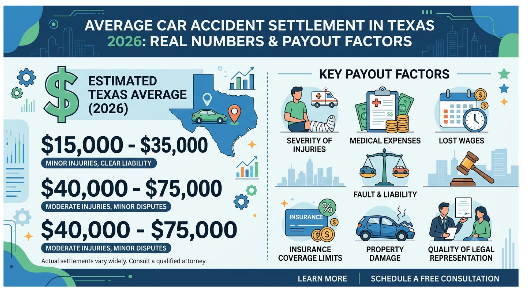
Short answer: Most Texas car accident settlements in 2026 land somewhere between $15,000 and $75,000, with several published law-firm reports putting the statewide average near $22,000–$23,000. But that number hides more than it reveals — minor whiplash claims can settle for a few thousand dollars, while cases involving surgery, permanent disability, or a fatality routinely reach into the six or seven figures.
If you were just in a wreck, you don't need a vague national average. You need to understand why settlements vary so wildly, and what actually moves your specific case up or down that scale. That's what this guide breaks down.
What's the Average Car Accident Settlement in Texas Right Now?
There's no single official government database that publishes "the average Texas car accident settlement" — insurance companies negotiate privately, and most cases never go to trial. What we have instead are patterns pulled from law firm case reports and industry data collected throughout 2026:
| Case Type | Typical Settlement Range |
|---|---|
| Minor injury (soft tissue, whiplash) | $3,000 – $20,000 |
| Moderate injury (fractures, ER + follow-up care) | $20,000 – $75,000 |
| Serious injury (surgery required) | $100,000 – $1,000,000+ |
| Catastrophic injury (TBI, spinal cord, permanent disability) | $1,000,000 – $4,500,000+ |
These ranges are directional estimates based on publicly reported case data from Texas personal injury firms in 2026, not a guarantee of any specific outcome. Every claim is evaluated on its own facts.
7 Factors That Actually Determine Your Payout
1. Severity and Permanence of Your Injuries
This is the single biggest driver of settlement value. A strained neck that heals in six weeks is treated very differently than a herniated disc, a broken femur, or a traumatic brain injury that affects you for the rest of your life. Insurers look closely at whether your injuries are "soft tissue" (harder to prove, lower value) or objectively documented with imaging, surgery, or a permanent impairment rating.
2. Total Medical Expenses — Past and Future
Adjusters typically use your medical bills as an anchor point. That includes ER visits, imaging, physical therapy, surgery, medication, and — critically — future medical care your doctor expects you'll need. Cases that stop treatment too early often settle low because there's no paper trail proving ongoing harm.
3. Lost Wages and Reduced Earning Capacity
If the crash kept you out of work, that lost income gets added to your claim. If your injuries permanently limit what kind of work you can do going forward, that's a much larger number — and usually requires an economic expert to calculate properly.
4. Pain and Suffering
Texas doesn't cap non-economic damages in standard car accident cases (unlike medical malpractice claims). Insurers often use a multiplier method — taking your medical expenses and multiplying by a factor of roughly 1.5 to 5, depending on injury severity — as a rough starting point for pain and suffering, though this is just one negotiating tool among several.
5. Who Was At Fault (and Texas's 51% Rule)
Texas follows a modified comparative negligence rule. If you're found partially at fault, your settlement is reduced by your percentage of fault — and if you're found 51% or more at fault, you recover nothing. This makes clear liability evidence (photos, police reports, witness statements, dashcam footage) extremely valuable.
6. Available Insurance Coverage
You can't collect more than the at-fault driver's policy limits allow, unless you have underinsured motorist (UIM) coverage of your own to bridge the gap. This is why Texas has some of the highest rates of uninsured/underinsured drivers in the country — and why checking your own UIM coverage matters immediately after a crash.
7. Whether You Hire an Attorney
Insurance companies routinely make their first offer well below what a claim is actually worth, expecting people to accept it out of financial pressure. Represented claimants tend to see meaningfully higher final settlements than people who negotiate alone, largely because attorneys know how to document damages and push back on lowball tactics.
How Long Does a Texas Car Accident Settlement Take?
Most claims resolve within a few months to about a year. Simple, low-injury claims can close in 60–90 days. Cases involving surgery, long-term treatment, or disputed liability often take longer, because you shouldn't settle until you know the full extent of your damages — settling too early can permanently close the door on future medical costs.
Don't Forget the Texas Statute of Limitations
In Texas, you generally have two years from the date of the accident to file a personal injury lawsuit. Missing this deadline can bar you from recovering anything, no matter how strong your case is. Even if you're still negotiating with an insurance company, it's smart to know this date and not let it sneak up on you.
3 Mistakes That Quietly Shrink Settlements
- Accepting the first offer too fast. Initial offers are a starting point for negotiation, not a final number.
- Gaps in medical treatment. Insurers argue that gaps mean your injury wasn't serious — even if the real reason was cost or scheduling.
- Posting on social media. Insurance adjusters do check public posts and photos for anything that contradicts your claimed injuries.
Helpful Resources
- Texas DMV – How to Request Your Crash Report
- Texas Department of Insurance – Auto Insurance Consumer Guide
- Texas Judicial Branch – Court and Filing Information
- Insurance Information Institute – Understanding Auto Claims
Legal Disclaimer: This article is for general informational purposes only and does not constitute legal advice. Settlement figures are estimates based on publicly available reports and vary case by case. For advice specific to your situation, consult a licensed Texas personal injury attorney.
Frequently asked questions
Q1: What is the average car accident settlement in Texas?
A: Most 2026 settlements fall between $15,000 and $75,000, though minor claims can settle for a few thousand dollars and severe injury cases can exceed $1 million.
Q2: Can I still get a settlement if I was partially at fault?
A: Yes. Texas follows a modified comparative negligence rule — you can recover damages as long as you're found less than 51% at fault, though your payout is reduced by your percentage of fault.
Q3: How long do I have to file a car accident claim in Texas?
A: Generally two years from the date of the accident, under the Texas statute of limitations for personal injury claims.
Q4: Do I need a lawyer to get a fair settlement?
A: You're not required to, but insurance companies typically make lower initial offers to unrepresented claimants, and an attorney can help document damages and negotiate more effectively.
Q5: How long does it take to settle a car accident claim in Texas?
A: Simple claims may resolve in a few months; more complex cases involving surgery or disputed liability can take up to a year or longer.
Comments (0)